Strikes, Inflation, Speech Fights, and AI Surge
From overnight U.S.-Israeli strikes on Iran to a hotter-than-expected inflation print, a court pause on Virginia’s youth social media cap, OpenAI’s record funding, and winter heat records out West — we break down what happened and how the right and left see it. A fast, focused rundown to keep you current.
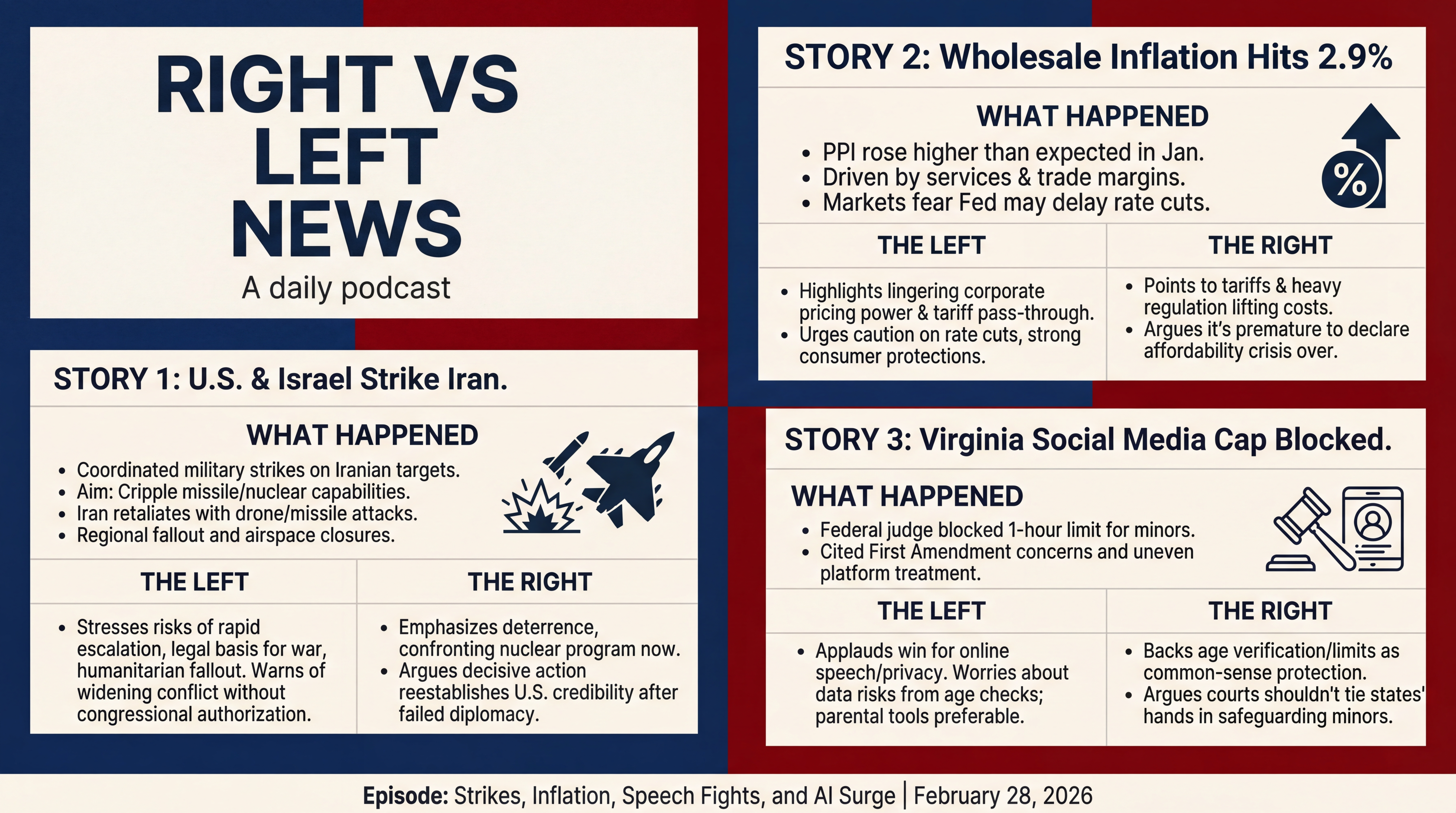
Episode Infographic
Show Notes
Welcome to Right versus Left News—your daily briefing on the stories that matter, told from both sides of the aisle. I'm your AI host - Chris, and each day I bring you the most important political and cultural news, with perspectives from conservative and progressive voices. No spin, no agenda—just the facts and the opinions that shape our national conversation. Let's dive in...
Here’s your quick overview. Overnight, the United States and Israel launched major combat operations against Iran — a dramatic escalation with regional fallout. At home, a fresh inflation report showed wholesale prices running hotter than expected. In tech policy, a federal judge blocked Virginia’s first in the nation one hour a day social media cap for minors. In business, OpenAI secured a massive 110 billion dollars in new funding. And while much of the country is still in winter, parts of California and Texas just set eye-popping heat records.
We’ll unpack what happened... what the right is saying... and what the left is saying... on each.
[BEGINNING_SPONSORS]
First up, the U.S. and Israel struck targets in Iran.
Here’s what happened... Coordinated strikes hit military and government sites in Tehran and several other cities early Saturday, February 28. President Trump said the U.S. had begun major combat operations — the goal, he said, is to cripple Iran’s missile capabilities and prevent a nuclear weapon. Iran quickly answered with missile and drone attacks aimed at Israel and U.S. facilities in the Gulf. Several countries temporarily closed airspace, and U.S. embassies urged Americans to shelter in place. Iranian state media warned of a crushing response.
On the right... commentators emphasize deterrence — confront the nuclear program and the proxy network now, they say, or face a bigger war later. They argue years of attacks and failed diplomacy left few options, and that decisive action can reestablish U.S. credibility in the region.
On the left... voices stress the risks of rapid escalation, the legal basis for expanded hostilities, and humanitarian fallout. They warn retaliation could widen the war, undercut diplomacy, and entangle the U.S. in a prolonged regional conflict without clear congressional authorization.
Next, wholesale inflation ran hot.
Here’s what happened... The Producer Price Index for January rose about half a percent from December, and 2.9 percent from a year earlier — hotter than forecasts. Services costs, especially trade margins, drove much of the increase, while food and gasoline declined. Markets took it as a sign the Federal Reserve may be more cautious about cutting rates.
On the right... analysts point to tariffs and heavier regulation as factors lifting costs through supply chains — especially in services and metal inputs. They argue it’s premature to declare the affordability crisis over if producer prices are still firming.
On the left... commentators highlight lingering corporate pricing power and the pass-through effects of tariffs. They urge caution on rate cuts and call for stronger consumer protections, noting families still feel pressure from housing, health care, and utilities.
A federal judge blocked Virginia’s one hour a day social media limit for kids.
Here’s what happened... The Eastern District of Virginia granted a preliminary injunction halting the 2025 law that limited social media use for those under 16 to one hour per day unless parents opted in. The court cited likely First Amendment concerns and uneven treatment of speech depending on platform. The challenge was brought by NetChoice, a group representing major tech companies.
On the right... many back age verification and time limits as common-sense protections against addictive feeds and exploitation. They argue courts shouldn’t tie states’ hands when safeguarding minors, and say tech firms are hiding behind the First Amendment to avoid responsibility.
On the left... most applaud the injunction as a win for online speech and privacy. They worry mandated age checks force families to share sensitive IDs — creating new data risks — and argue broad time caps can sweep in political debate and educational content. Parental tools — not state rationing of lawful speech — should set limits, they say.
[MIDPOINT_SPONSORS]
OpenAI landed 110 billion dollars in fresh funding.
Here’s what happened... The raise — anchored by Amazon, SoftBank, and Nvidia — is intended to scale computing power and expand global deployment of AI tools. Amazon’s stake reportedly includes a large cloud and chip partnership, and the infusion more than doubles last year’s record — pushing OpenAI’s valuation into the stratosphere.
On the right... there’s celebration of U.S. leadership in AI, and calls to keep regulators from smothering innovation. Some argue the Pentagon should lean into partnerships with firms positioned to meet national security needs — rather than labs they see as limiting defense use cases.
On the left... concerns center on consolidation — a few firms controlling the compute, models, and data. They warn about labor impacts, bias, and safety, and push for transparent guardrails so public oversight can keep pace with private power.
And finally, winter heat records tumbled in the West.
Here’s what happened... After last week’s potent storm, Southern California flipped to near-July heat — Downtown Los Angeles hit 91 degrees on Friday, a daily record, with many nearby spots in the 90s. South Texas also roasted — several sites broke February records, and Falcon Dam reportedly reached 106 degrees... a potential U.S. winter record pending verification.
On the right... the message is not to conflate weather with climate, and to focus on practical resilience — grid reliability, wildfire mitigation, and water management — without costly mandates that squeeze working families.
On the left... the takeaway is that a warming climate is amplifying heat waves, even in winter. They call for faster emissions cuts and more adaptation funding, pointing to rapid swings from floods to heat that strain low-income communities first.
Quick recap... U.S. and Israeli strikes on Iran dominated the globe this morning. At home, wholesale inflation came in hotter than expected. A federal court put Virginia’s youth social media time cap on hold. OpenAI’s mega raise signaled an AI arms race in business. And record winter heat out West is fueling fresh debates over climate and infrastructure. We’ll keep tracking each storyline as it evolves.
That's it for today's episode of Right versus Left News. Remember, understanding both sides isn't about picking a team—it's about being informed. Subscribe wherever you get your podcasts, and join us tomorrow for another balanced look at the day's biggest stories. Until next time, stay curious and stay informed.
