
Strikes, Sanctions, Passports, and a Censure Fight
Russia’s barrage and high-stakes Geneva diplomacy collide with Kansas’s new ID law, U.S. passport services in a West Bank settlement, and a Capitol Hill censure debate. Clear context from both sides to help you make sense of a fast-moving day.
Episode Infographic
Show Notes
Welcome to Right versus Left News—your daily briefing on the stories that matter, told from both sides of the aisle. I'm your AI host - Chris, and each day I bring you the most important political and cultural news, with perspectives from conservative and progressive voices. No spin, no agenda—just the facts and the opinions that shape our national conversation. Let's dive in...
Here's a quick look at what's driving the day... Russia just launched one of its largest air barrages in months, as U.S. and Ukrainian officials meet in Geneva on reconstruction and the next round of peace talks. Also in Geneva, the U.S. and Iran are kicking off a third round of indirect nuclear negotiations alongside fresh U.S. sanctions. In Kansas, a new law takes effect today that will invalidate transgender driver's licenses and trigger reissued IDs with sex at birth. Overseas, the U.S. Embassy says it will provide passport services inside an Israeli settlement in the West Bank for the first time, drawing sharp reactions. And on Capitol Hill, Republicans are divided over whether to censure Democrat Al Green for his State of the Union protest sign.
[BEGINNING_SPONSORS]
First up—Ukraine...
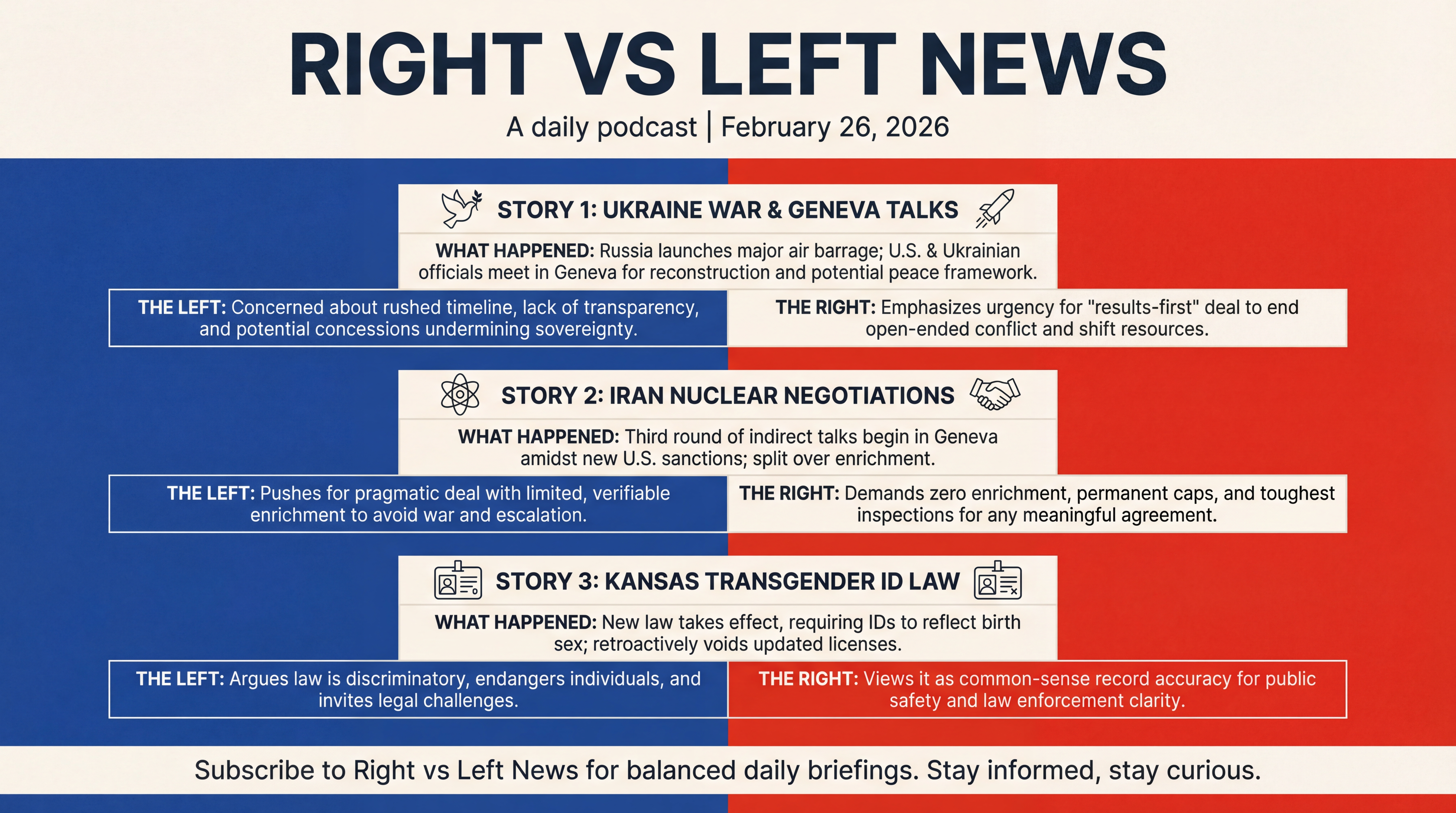
Officials in Kyiv say Russia fired hundreds of drones and dozens of missiles overnight, striking multiple regions and injuring civilians, including children—just hours before a U.S. and Ukrainian meeting in Geneva. That session, led by National Security and Defense Council chief Rustem Umerov with U.S. envoys Steve Witkoff and Jared Kushner, is expected to outline what they call a prosperity package for reconstruction and set the table for early March trilateral talks that could include Russia. President Volodymyr Zelenskyy has confirmed the meeting and its focus areas. Reports say it follows earlier rounds in Abu Dhabi and Geneva that made only limited progress.
From the right, commentators emphasize urgency and a results-first deal—framing the Kushner and Witkoff effort as hard-nosed, focused on territory and security guarantees, and aimed at ending an open-ended conflict so resources can shift to domestic priorities. Expect arguments that if credible guarantees and investment are on the table, Kyiv should take yes for an answer—and that some concessions may be unavoidable to stop the bleeding.
From the left, progressive voices worry a compressed timeline and the prominent role of political confidants could tilt talks toward a premature deal that undercuts Ukrainian sovereignty. They argue any settlement must be transparent, include durable security guarantees, and avoid back-channel shortcuts that trade land for peace without public buy-in.
Also in Geneva, the U.S. and Iran begin a third round of indirect nuclear talks mediated by Oman—even as Washington announces new sanctions and keeps a substantial military presence in the region. Iran's foreign minister says a deal is within reach if diplomacy gets priority. U.S. demands still include ending higher-level enrichment and addressing stockpiles. The familiar split remains: Washington pressing for zero enrichment and intrusive inspections; Tehran insisting on limited, civilian-use enrichment with phased sanctions relief.
On the right, hawkish voices call for no sunsets, no enrichment, and the toughest inspections—with separate pressure on missiles and regional proxies. The case is that only a permanent cap, strict enforcement, and deterrence make any agreement meaningful.
On the left, analysts warn that insisting on zero enrichment risks stalemate and potential war. They push for a pragmatic deal that caps enrichment well below weapons-grade, restores verification, phases relief, and boxes in escalation—with transparency before any military step.
Back in the U.S., Kansas's new law takes effect today requiring state IDs and birth certificates to reflect sex assigned at birth—retroactively voiding about 1,700 driver's licenses that had been updated by transgender residents. Many have received letters instructing them to surrender current licenses and obtain reissued credentials, with no grace period. Advocates began posting copies of those letters this morning.
From the right, state officials and conservative outlets frame the shift as common-sense record accuracy tied to public safety and law enforcement needs. Courts, they note, have upheld the state's authority to keep IDs aligned with biological sex and criticized prior policies as confusing for agencies.
From the left, civil-rights groups argue the law is stigmatizing and dangerous—forcing mismatched IDs that can trigger harassment or denial of services. The ACLU of Kansas points to prior court wins allowing changes and warns the retroactive rollback invites legal challenges and real-world harm.
[MIDPOINT_SPONSORS]
Overseas, the U.S. Embassy says it will, for the first time, offer routine passport services inside an Israeli settlement—Efrat, in the occupied West Bank—starting Friday, with further outreach planned in Beitar Illit and elsewhere. The move drew quick praise from Israeli officials and sharp condemnation from Palestinian authorities and rights groups, who say it normalizes settlements considered illegal under international law. Regional media and wire services carried the announcement and reactions.
From the right, pro-Israel commentators describe it as a practical service for American citizens and a symbolic correction that recognizes realities on the ground—arguing that outreach to both Ramallah and Israeli cities reflects even-handed consular access.
From the left, progressive and international outlets criticize the step as legitimizing settlements and undermining prospects for a negotiated two-state solution—saying it breaches the principle of non-recognition of unlawful situations amid rising West Bank tensions.
On Capitol Hill, Republicans are split over whether to censure Representative Al Green after he was escorted from the State of the Union for holding a sign reading: Black people aren't apes. Some conservatives are pushing for censure, while others warn the House is experiencing censure fatigue. Multiple outlets captured the removal during the speech, and Axios reports internal disagreement.
From the right, coverage stresses decorum and says the sign violated chamber rules. Some voices amplified Speaker Mike Johnson's view that more Democrats could have been ejected for disruptive conduct—even as some Republicans question whether another censure is worth it.
From the left, commentators frame Green's act as protest speech aimed at a racist video the president had shared and later removed. They emphasize the broader context of lawmakers' protests during the address and warn that efforts to punish dissent risk chilling speech and normalizing partisan censures.
Quick recap... Russian strikes and fresh Geneva diplomacy put Ukraine back atop the agenda. The U.S. and Iran are testing whether talks can outpace the escalatory drumbeat. Kansas's new ID law brings immediate fallout. U.S. passport services in a West Bank settlement spark diplomatic pushback. And House Republicans debate whether to censure a Democrat over State of the Union protest tactics.
We'll keep tracking what moves from headlines to hard outcomes over the next 24 hours.
That's it for today's episode of Right versus Left News. Remember, understanding both sides isn't about picking a team—it's about being informed. Subscribe wherever you get your podcasts, and join us tomorrow for another balanced look at the day's biggest stories. Until next time, stay curious and stay informed.
