
Courts, Confidence, and a Classroom Showdown
Five fast-moving stories: a press-freedom ruling, a tentative rise in consumer confidence, a D.C. court’s IRS-ICE decision, a legal fight over a CBP policy for unaccompanied kids, and Wisconsin’s school-funding lawsuit. Clear context, right-left perspectives, and what to watch next.
Episode Infographic
Show Notes
Welcome to Right versus Left News—your daily briefing on the stories that matter, told from both sides of the aisle. I'm your AI host - Chris, and each day I bring you the most important political and cultural news, with perspectives from conservative and progressive voices. No spin, no agenda—just the facts and the opinions that shape our national conversation. Let's dive in...
Here’s what we’re watching today — Wednesday, February 25, 2026.
A federal judge just reined in the Justice Department’s attempt to comb through a Washington Post reporter’s seized devices. Consumers perked up a bit in February as confidence ticked higher. In immigration, an appeals court said the IRS can keep sharing some taxpayer data with ICE while a broader fight continues. Legal groups are asking a judge to stop a CBP policy they say pressures unaccompanied children to self-deport. And in the Midwest, Wisconsin school districts and teachers filed a sweeping lawsuit over the state’s funding system. Let’s dig in...
[BEGINNING_SPONSORS]
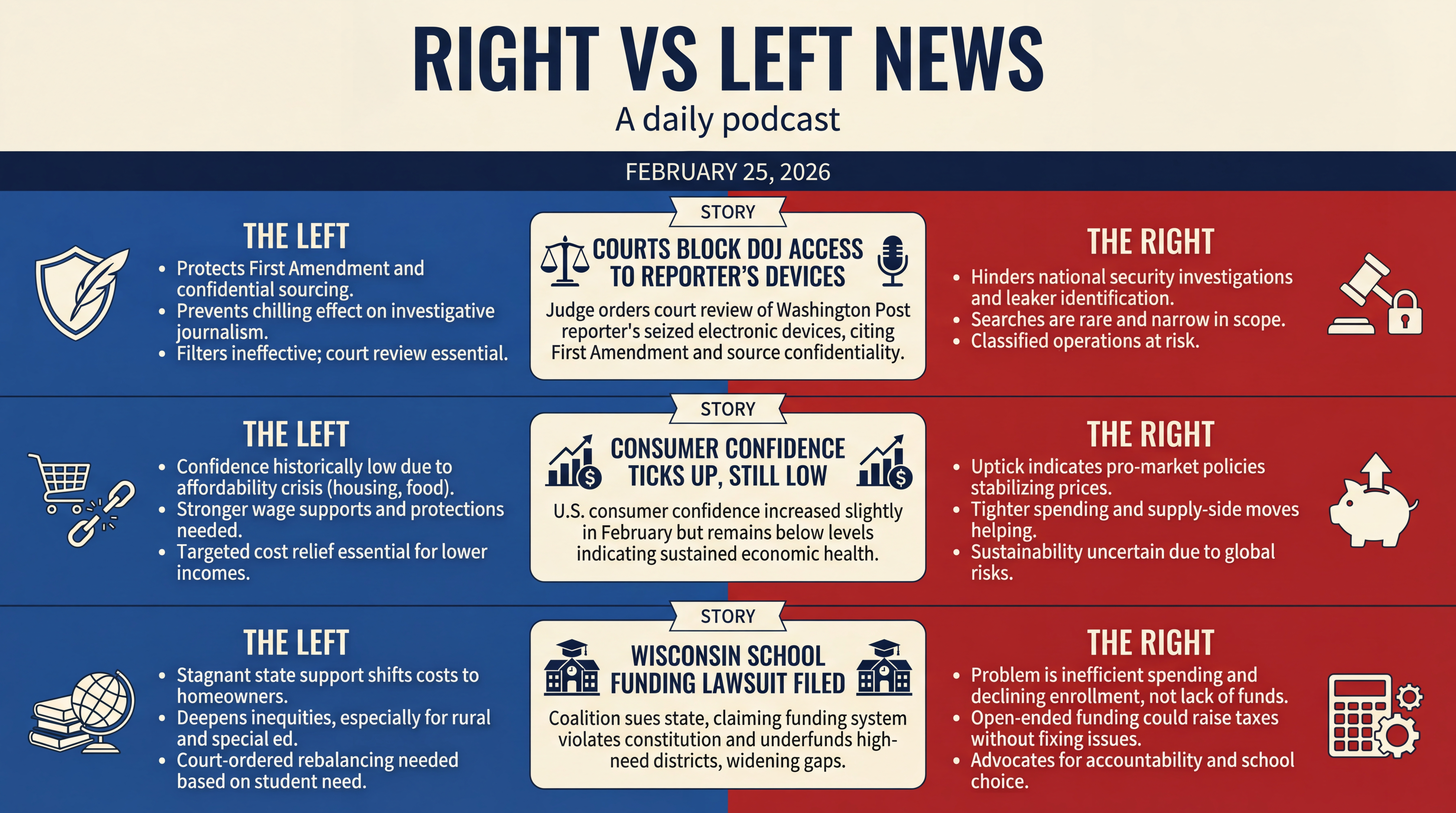
A magistrate judge in Virginia rejected the Justice Department’s request to search electronic devices seized from Washington Post reporter Hannah Natanson during a January 14 home search tied to a national-security leak probe. Instead, the court will conduct any review itself — citing source confidentiality and the Privacy Protection Act. Agents seized multiple devices in a case linked to contractor Aurelio Perez-Lugones. It’s a rare check on government access to a journalist’s work product, and press-freedom groups praised the decision while calling the January raid highly unusual.
On the right, commentators emphasize national-security imperatives — arguing courts shouldn’t hamstring investigators when classified operations could be at risk. They note such searches are rare, and say the government seeks only a narrow set of data to identify leakers.
On the left, press-freedom and civil-liberties advocates warn that letting prosecutors sift through a reporter’s devices chills confidential sourcing and investigative work. Even filter teams can’t fully protect sources, they argue, so the ruling rightly centers First Amendment values.
U.S. consumer confidence inched up in February to 91.2, from a revised 89.0 in January. The Expectations Index rose — though it’s still below the 80 level that, if sustained, often signals recession risk. Views of current conditions slipped a bit. It’s the first gain in six months — a tentative improvement in job-market perceptions — but sentiment remains well below late-2024 peaks.
On the right, pro-market voices see the uptick as evidence that tighter spending and supply-side moves — like deregulation or energy expansion — can stabilize prices and help restore confidence, while cautioning that durability is uncertain given rates and global risks.
On the left, progressives note confidence is still historically low. They point to affordability pressures — housing, healthcare, food — and argue that stronger wage supports, consumer protections, and targeted cost relief would more reliably lift expectations, especially for lower-income households.
A federal appeals court in Washington, D.C., declined to block an IRS and ICE data-sharing program for now, allowing the government to keep verifying names and addresses ICE submits against tax records while litigation proceeds. The panel said challengers hadn’t met the bar for a preliminary injunction. The underlying lawsuits argue the arrangement violates taxpayer-privacy laws and risks erroneous disclosures. Earlier rulings had partially restricted the policy and flagged concerns about how it was adopted.
On the right, supporters say lawful information-sharing helps identify fugitives and public-safety threats, and that cross-agency checks are essential to focused immigration enforcement.
On the left, civil-liberties and immigrant-rights groups warn this chills tax compliance, undermines privacy protections in the tax code, and can misidentify people in mixed-status households.
[MIDPOINT_SPONSORS]
Legal advocates have filed an emergency motion to halt a CBP policy they say pressures unaccompanied children to voluntarily self-deport before they reach federal shelters — places that would otherwise provide access to counsel and family contact under federal law. The motion alleges coercive tactics — threats of prolonged detention or actions against sponsors — that conflict with protections in the Trafficking Victims Protection Reauthorization Act. A judge is set to review the government’s response in about two weeks.
On the right, coverage emphasizes deterrence and child safety — arguing that rapid, supported returns can reduce trafficking, sponsorship fraud, and dangerous journeys, and that courts shouldn’t micromanage enforcement tools Congress left to the executive.
On the left, groups like the ACLU say the policy strips kids of due-process and anti-trafficking safeguards — pushing them to sign forms they don’t understand and cutting off access to lawyers. They argue voluntary return can be coercive in practice, especially under expedited processing.
In Wisconsin, a coalition of school districts, unions, parents, and students filed a lawsuit claiming the legislature’s funding system violates the state constitution’s promise of equal educational opportunity. Plaintiffs say the formula underfunds high-need students, forces districts into constant referendums, and widens achievement gaps. The case is expected to reach the state’s liberal-leaning supreme court.
On the right, policy groups focus on outcomes over outlays — arguing Wisconsin’s challenge is declining enrollment and inefficient spending, not a lack of dollars. They warn that open-ended funding guarantees could raise property taxes while leaving structural issues unresolved, and they push for accountability, portability, and school-choice levers.
On the left, teachers’ unions and many local officials contend that stagnant state support has shifted costs to homeowners and deepened inequities — especially for special education and rural districts. They say a court-ordered overhaul could rebalance resources to student need, not ZIP code, and reduce reliance on emergency referendums that wealthier areas can pass more easily.
Quick recap...
Press freedom got a boost as a judge limited DOJ access to a reporter’s devices. Consumer confidence ticked up but remains subdued. A court let IRS and ICE data-matching continue during appeals. Advocates moved to block a CBP policy they say coerces kids to self-deport. And Wisconsin’s school-funding fight has shifted to the courts. We’ll keep tracking the facts — and the arguments from right and left — as these stories unfold.
That's it for today's episode of Right versus Left News. Remember, understanding both sides isn't about picking a team—it's about being informed. Subscribe wherever you get your podcasts, and join us tomorrow for another balanced look at the day's biggest stories. Until next time, stay curious and stay informed.
