Governors Clash, Measles Surge, Economy Cools
A brisk, balanced look at the week: governors spar over affordability, measles cases climb, and fresh PMIs show a cooling-but-growing economy. We also break down a Connecticut bill on ICE near polling places and where Europe stands on new Russia sanctions and Ukraine diplomacy.
Episode Infographic
Show Notes
Welcome to Right versus Left News—your daily briefing on the stories that matter, told from both sides of the aisle. I'm your AI host - Chris, and each day I bring you the most important political and cultural news, with perspectives from conservative and progressive voices. No spin, no agenda—just the facts and the opinions that shape our national conversation. Let's dive in...
Here's a quick overview of what's moving today... First, the nation's governors wrapped a tense weekend in Washington — bipartisan talk on affordability gave way to a partisan split at the White House dinner. Second, the U.S. is closing in on 1,000 measles cases for the year, with some states declaring outbreaks. Third, fresh business surveys show the economy growing more slowly in February. Fourth, a new Connecticut bill would put buffer zones around polling places to keep ICE away. And fifth, in Europe, Ukraine diplomacy inches on while the EU debates another Russia sanctions package.
[BEGINNING_SPONSORS]
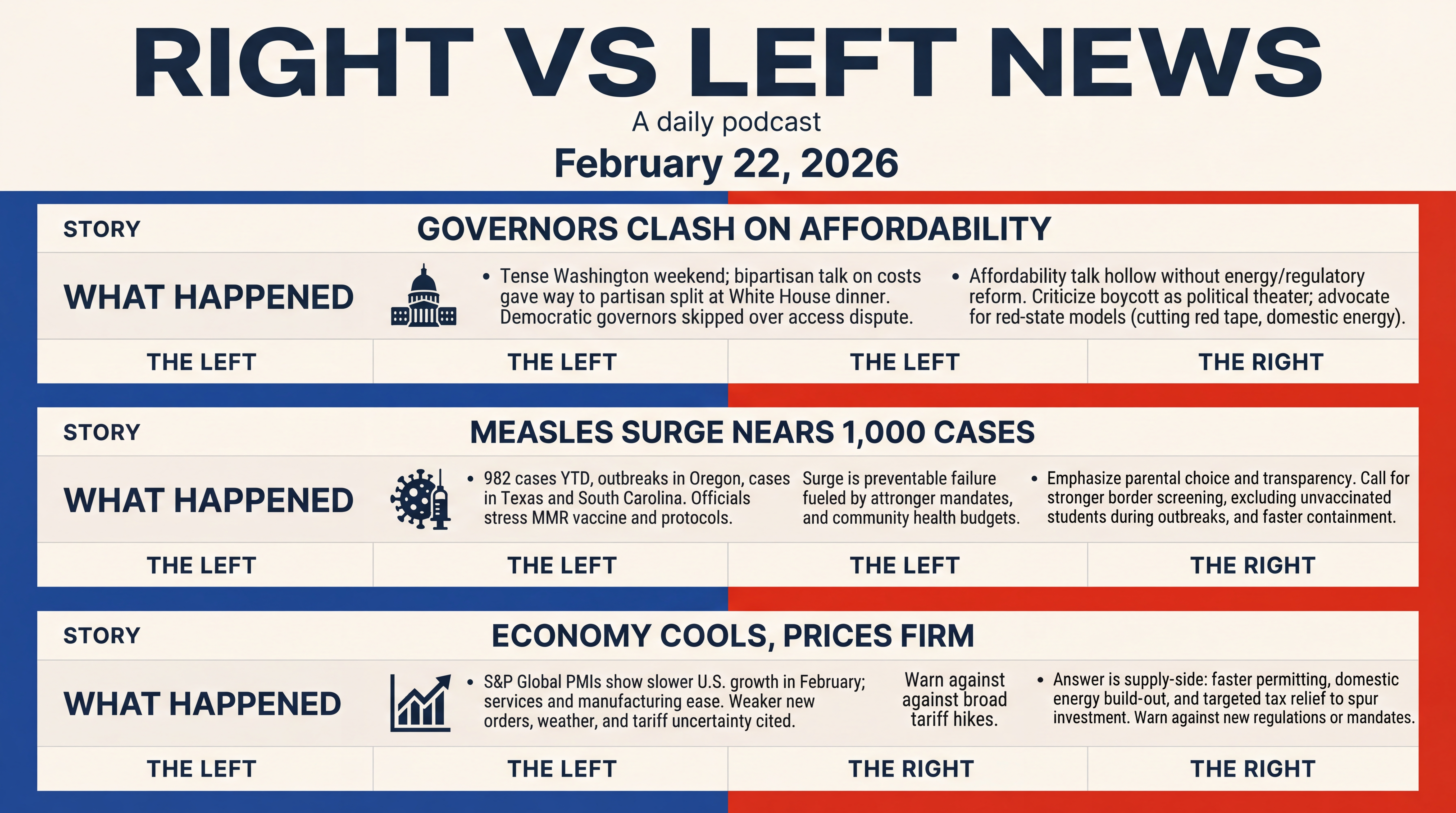
Let's start in Washington. The National Governors Association weekend zeroed in on pocketbook issues — affordability took center stage — while the traditional White House dinner turned into a flashpoint. Reports said a group of Democratic governors skipped the black-tie event after a dispute over meeting access... even as the broader sessions focused on costs, immigration, and civility on the trail. Both parties want to claim the affordability mantle heading into November — with governors spotlighting cost of living, but splitting over immigration and the balance between federal and state roles.
On the right, many conservatives call the boycott political theater and say affordability talk rings hollow without tackling energy, permitting, and regulatory costs. They point to red-state models — cutting red tape, expanding domestic energy, and resisting new mandates — over price controls or subsidies. Some also argue that an unstable border raises state social-service burdens that feed into higher costs.
On the left, progressives counter that Republicans dodge the real drivers of household strain — health care, housing, child care, and prescription prices — and that state actions like utility oversight, paid leave, and targeted tax relief matter more than culture-war fights. They add that federal immigration crackdowns have created new costs for schools, courts, and hospitals, undercutting GOP claims of fiscal prudence.
Moving to public health... The CDC reports 982 measles cases so far this year, with new outbreaks as of February 20. Local officials in Oregon formally declared an outbreak, and Texas outlets reported additional linked cases around San Antonio and the Hill Country. South Carolina has faced a large, months-long cluster. Reporters have tracked severe complications and school quarantines tied to under-vaccination, while officials continue to stress the MMR vaccine and post-exposure protocols.
On the right, conservative voices emphasize parental choice and transparency — but also stronger border screening, excluding unvaccinated students during outbreaks, and faster containment. You'll hear calls to prioritize clear risk communication over blanket mandates, and to scrutinize international travel rules and health safeguards in detention facilities.
On the left, progressives argue the surge is a preventable failure fueled by anti-vaccine misinformation and funding cuts. They push for higher vaccination rates through school requirements, stronger community health budgets, and coordinated responses — warning that piecemeal state approaches and political attacks on public-health institutions slow containment.
Shifting to the economy... The latest flash readings from S&P Global show the U.S. still expanding in February — but in a lower gear. Services activity slipped to a 10-month low, manufacturing cooled, and the composite PMI eased as firms cited weaker new orders, winter storm disruptions, and tariff uncertainty. Growth remains above the 50 line that marks expansion, yet the slowdown — alongside firmer input prices — complicates the outlook. It's an awkward mix of softer growth and renewed price pressure.
On the right, many conservatives say the answer is supply-side — faster permitting, a domestic energy build-out, and targeted tax relief to spur investment and productivity. They warn that new regulatory pushes or revived union mandates could squeeze margins and hiring.
On the left, progressives focus on worker pay and resilience. They want rate relief when inflation allows, tougher antitrust to keep prices honest, and public investment — especially in housing and grid upgrades — to ease chronic bottlenecks. They also caution that broad tariff hikes risk higher consumer prices and retaliation.
[MIDPOINT_SPONSORS]
In Connecticut, Democratic lawmakers proposed a bill to prohibit ICE operations within 250 feet of polling places, vote-counting sites, and election offices. Backers say the goal is to prevent intimidation and ensure access for immigrant communities; violations would be a state crime unless coordinated through courts and state officials. Republicans in Hartford argue it's a political distraction — and say there's no evidence of ICE disrupting elections in the state.
On the right, critics contend the plan ties law-enforcement hands for optics and that states shouldn't criminalize federal officers doing their jobs. They add that public confidence depends on enforcing existing election rules — ID, list maintenance, and observer access — rather than creating new buffer zones.
On the left, supporters say the bill mirrors long-standing limits on police near polling places and protects voters who might otherwise stay home. They argue that credible access fears — especially after calls to post immigration agents near voting sites — justify clear boundaries, along with more drop boxes and extended hours.
And in Europe, diplomacy over the Russia-Ukraine war inched forward without a breakthrough as EU states weigh another sanctions package. President Volodymyr Zelensky said opportunities to end the war with dignity still exist, while allies debate new air defenses and export controls. It's a slow-moving track — with tangible stakes for energy, trade, and U.S. policy heading into the State of the Union on February 24.
On the right, many conservatives insist Europe should shoulder more costs — ammunition, air defenses, reconstruction — while the U.S. focuses on deterrence and tight sanctions enforcement that doesn't punish American industry. They're skeptical of concessions on territory and argue that sustained pressure — not half-measures — will shape Moscow's calculus.
On the left, progressives back continued aid and sanctions but emphasize humanitarian relief, war-crime accountability, and guardrails to keep negotiations viable. They warn that escalating economic measures without a diplomatic off-ramp risks prolonged instability for European and U.S. consumers alike.
Quick recap... Governors sparred over affordability as a White House dinner turned partisan; measles cases neared 1,000 nationwide; PMIs pointed to a cooler — still growing — economy; Connecticut moved to keep ICE away from polling sites; and Europe weighed fresh Russia sanctions while Ukraine pressed for a just peace. We'll keep watching what changes before the State of the Union on Tuesday.
That's it for today's episode of Right versus Left News. Remember, understanding both sides isn't about picking a team—it's about being informed. Subscribe wherever you get your podcasts, and join us tomorrow for another balanced look at the day's biggest stories. Until next time, stay curious and stay informed.
