Court Curbs Tariffs, DOJ Clash, Coal Rollback
A Supreme Court ruling reins in emergency tariff powers just as the White House unveils a new ten percent levy. We also break down a DOJ-judiciary showdown in Virginia, a proposed asylum work-permit freeze, an EPA mercury rollback, and the fight over Capitol honors for Jesse Jackson.
Episode Infographic
Show Notes
Welcome to Right versus Left News—your daily briefing on the stories that matter, told from both sides of the aisle. I'm your AI host - Chris, and each day I bring you the most important political and cultural news, with perspectives from conservative and progressive voices. No spin, no agenda—just the facts and the opinions that shape our national conversation. Let's dive in...
Here’s what we’re tracking today—Saturday, February 21, 2026.
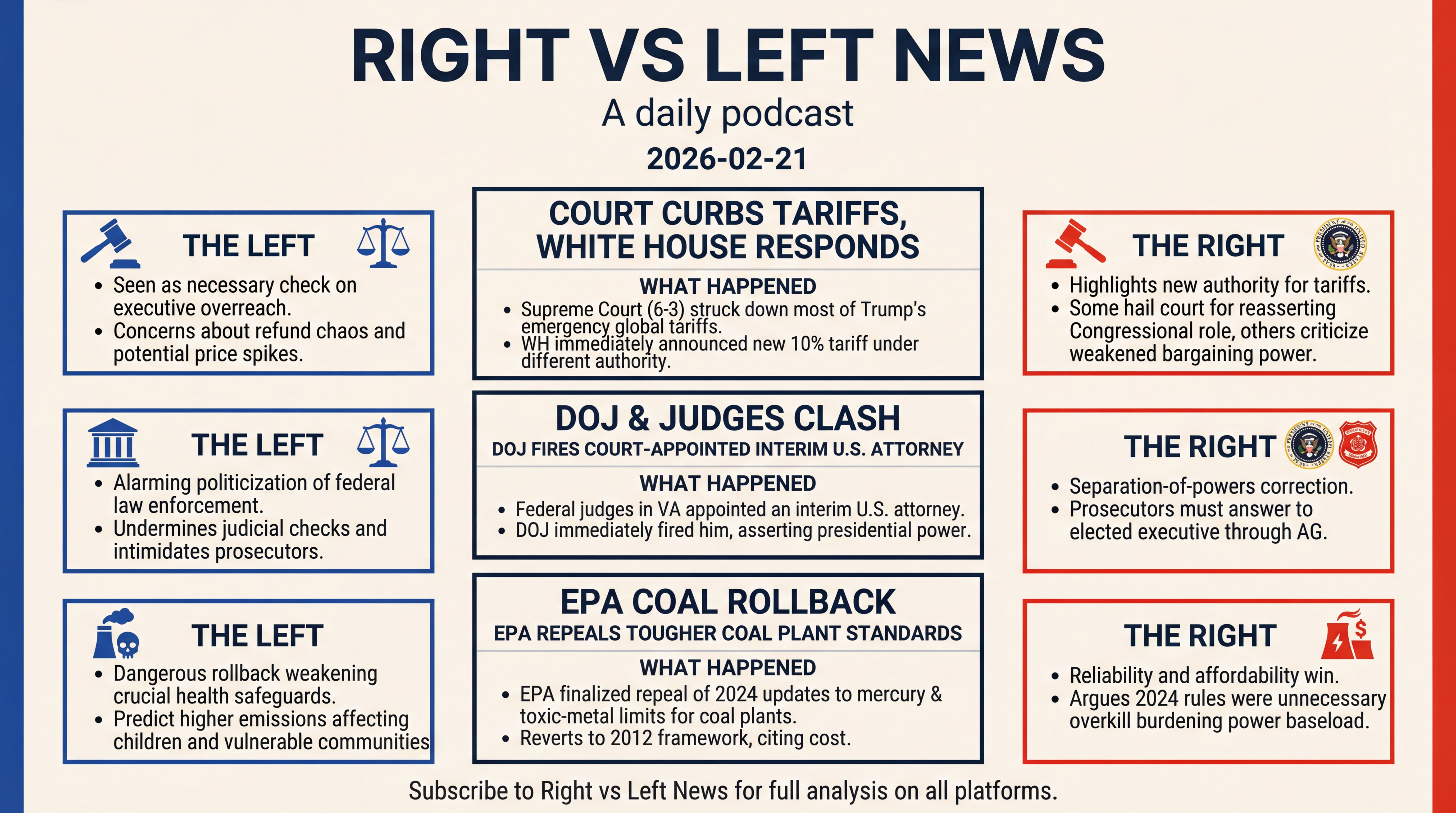
The Supreme Court, in a six-to-three decision yesterday, struck down most of President Trump’s emergency-based global tariffs. Minutes later, the White House said a new ten percent tariff is coming under different authority.
In Virginia, a dramatic tug-of-war: federal judges named an interim U.S. attorney—and the Justice Department immediately fired him. Homeland Security proposed rules that could freeze new work permits for asylum seekers for a very long time. The EPA scrapped tougher mercury and toxic-metal limits on coal plants set in 2024. And Speaker Mike Johnson denied a request for the late Reverend Jesse Jackson to lie in honor at the Capitol.
We’ll lay out what happened—and how the right and the left see it.
[BEGINNING_SPONSORS]
Let’s start with the Supreme Court and tariffs.
On Friday, the Court ruled—six to three—that President Trump overstepped by using the International Emergency Economic Powers Act to impose sweeping global tariffs. The decision could put roughly one hundred thirty-three billion dollars in collected duties in limbo—while lower courts sort out refunds.
Within hours, the president announced a new temporary ten percent global tariff, using Section 122 of the Trade Act of 1974. It’s set to take effect Tuesday, February 24, with carve-outs for some critical goods. Markets rose on the ruling, even as uncertainty lingered over how the new tariff will be implemented. Conservative outlets highlighted the president’s sharp criticism of the Court—and his vow to find alternate legal paths.
On the right, commentators point to separation of powers—but also to lawful alternatives. They emphasize that Section 122 gives the president short-term tariff tools, and some argue the ruling actually underscores authority for more "draconian" leverage—up to embargoes—while a ten percent global tariff can be quickly reimposed. Some Republicans hailed the Court for reasserting Congress’s role. Others said the justices weakened Trump’s bargaining power with China.
On the left, analysts frame the decision as a textbook check on executive overreach under the major-questions doctrine. They see potential consumer benefits if broad tariffs ebb—while also flagging confusion over refunds, and the risk of fresh price pressures if the new ten percent levy sticks. Data showing roughly one hundred thirty-three and a half billion dollars at stake amplifies concerns about chaotic implementation—and costs for import-reliant small businesses.
Now—the showdown over who picks top federal prosecutors.
In Alexandria, federal judges unanimously appointed longtime Virginia litigator James W. Hundley as interim U.S. attorney for the Eastern District of Virginia—then the Justice Department immediately fired him. A senior DOJ official said, in essence, judges in the Eastern District do not pick the U.S. attorney—the president does. This follows months of turmoil: a court earlier ruled a Trump-installed interim chief was improperly serving, and that appointee left last month. It’s the third time in recent weeks the department has ousted a court-appointed interim—arguing the power belongs to the executive until a Senate-confirmed nominee arrives.
On the right, conservatives call it a separation-of-powers correction. They cast the judges’ move as an overreach, stressing that interim prosecutorial leadership should answer to an elected president through the attorney general—and warning that judge-picked prosecutors blur accountability.
On the left, progressives see alarming politicization of federal law enforcement. They note the office handles national-security cases, point to prior findings that a Trump-aligned interim was improperly installed, and warn that rapid firings of court designees undermine judicial checks—and intimidate career prosecutors.
On immigration... DHS proposed a rule that would sharply restrict work permits for asylum seekers. Under the plan, USCIS would pause accepting new work-permit applications whenever average processing times for affirmative asylum exceed one hundred eighty days—right now, that could mean a very long pause. The proposal is set to publish Monday, February 23, and then move to a public-comment period. Internal estimates cited in news reports suggest that, under current backlogs, it could take anywhere from fourteen to one hundred seventy-three years to meet the time threshold. Faith-based groups warn the change would push people into the shadow economy.
On the right, supporters argue the work-permit pathway has become a magnet for dubious claims. They say non-citizens are not entitled to work while applications are pending—framing the rule as restoring integrity and reducing fraud so genuine refugees can be prioritized. Some add it protects low-wage American workers from wage suppression.
On the left, immigrant-rights and faith groups counter that work is essential for families while cases—often lasting years—move forward. They call the policy counterproductive and harmful to U.S.-citizen children in mixed-status families—and warn it risks swelling underground labor. Progressives also note that policy shifts since late 2025 already shortened authorizations and ended many automatic extensions—this would go much further.
[MIDPOINT_SPONSORS]
Energy and the environment...
The EPA finalized a repeal of the 2024 updates to the Mercury and Air Toxics Standards for coal- and oil-fired power plants—reverting to the older 2012 framework. The agency argues the 2024 add-ons were unnecessarily costly, and that sticking with existing standards will still protect health while saving an estimated six hundred seventy million dollars. Environmental groups and several news outlets say the rollback weakens mercury and toxic-metal limits and drops continuous emissions monitoring. Legal challenges are expected.
On the right, pro-energy conservatives and industry allies applaud the move as a reliability and affordability win. The agency says most plants already comply with the 2012 rule, so tougher 2024 add-ons were overkill that threatened baseload power—and that families and manufacturers will see cost relief.
On the left, environmental advocates call the rollback dangerous—predicting higher mercury, soot, and metal emissions that hit children and frontline communities hardest. They argue 2024’s tighter limits and continuous monitoring were modest, evidence-based safeguards—and that the administration is discarding them to prop up aging coal. Lawsuits are coming.
And finally—the Capitol honor for Reverend Jesse Jackson.
House Speaker Mike Johnson denied a request for the late civil-rights leader to lie in honor in the Capitol Rotunda. Civil-rights groups criticized the decision. Johnson’s office pointed to precedent—this ceremonial tribute is typically reserved for presidents, select officials, and, on rare occasions, private citizens like Rosa Parks and Reverend Billy Graham. There’s no formal law. Congress must agree to use the Rotunda, and exceptions have been rare. Jackson will lie in repose at Rainbow PUSH in Chicago on February 26 and 27, with additional services to follow.
On the right, commentators stress consistency and depoliticizing honors—pointing to historical lists that largely limit the ceremony to top officeholders, military heroes, or extraordinary one-offs. Some cite recent precedents like Medal of Honor recipient Ralph Puckett to argue the bar should remain high and bipartisan.
On the left, supporters say Jackson’s lifetime of civil-rights leadership, international hostage negotiations, and two groundbreaking presidential campaigns meet that bar—and that denying the honor sends the wrong message to Black Americans. Even political opponents have offered praise this week.
Quick recap... The Court clipped emergency tariff powers—and the White House pivoted to a new ten percent levy. DOJ and federal judges clashed over who picks top prosecutors. DHS proposed a dramatic curtailment of asylum work permits. EPA rolled back tougher coal-plant pollution rules. And Speaker Johnson said no to a Capitol lying-in-honor for Jesse Jackson.
We’ll keep tracking how each plays out—in courts, in Congress, and on your power bill... and your grocery receipt.
That's it for today's episode of Right versus Left News. Remember, understanding both sides isn't about picking a team—it's about being informed. Subscribe wherever you get your podcasts, and join us tomorrow for another balanced look at the day's biggest stories. Until next time, stay curious and stay informed.
