Banners, Airwaves, Aliens, and Deadlines Collide
A week of sharp turns: a DOJ banner stirs independence fears, the FCC probes equal time on The View, Trump vows UFO disclosures, Iran tensions rise, and Wisconsin moves to yearlong postpartum Medicaid. Clear context, both sides, and what to watch next.
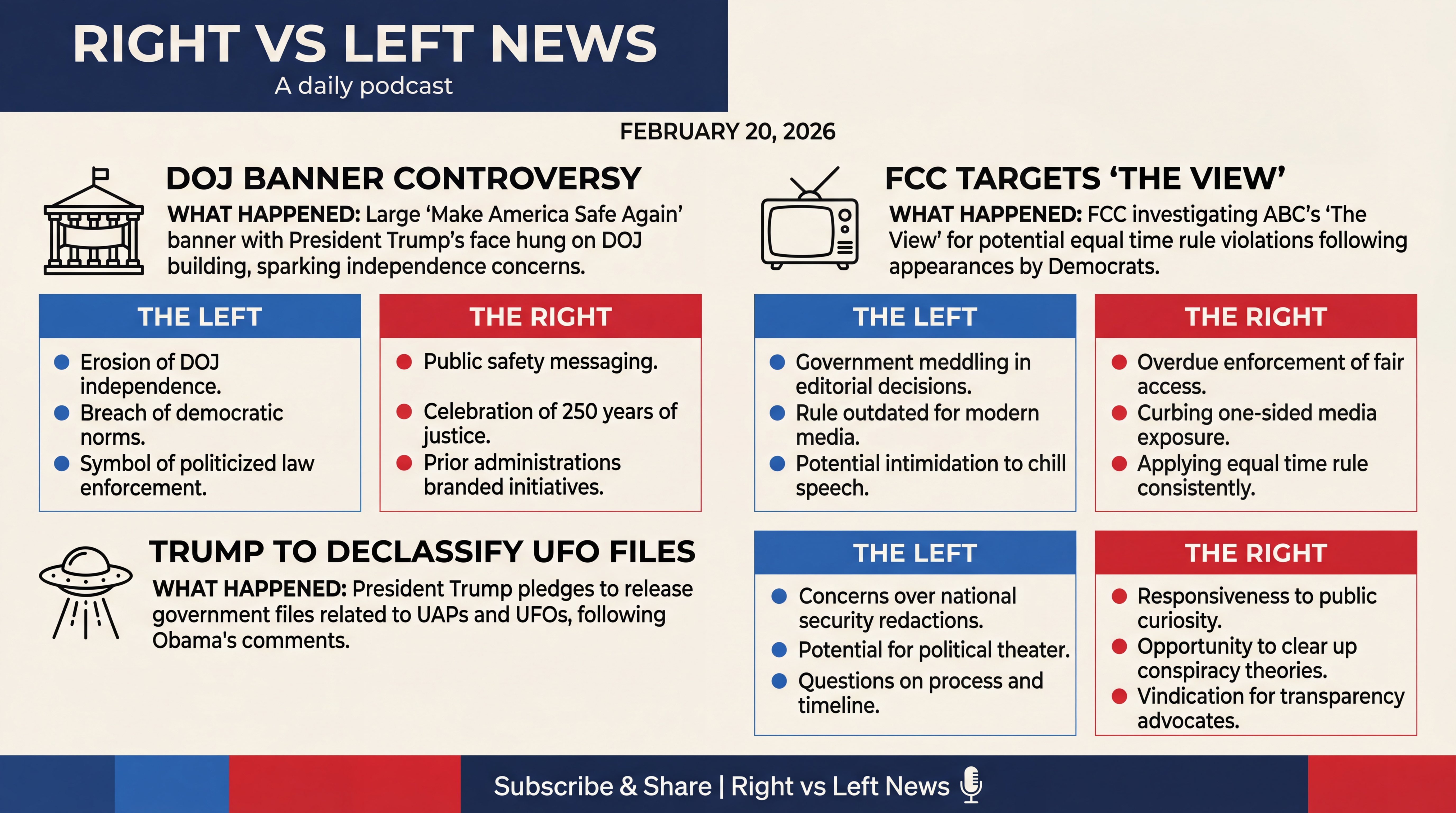
Episode Infographic
Show Notes
Welcome to Right versus Left News—your daily briefing on the stories that matter, told from both sides of the aisle. I'm your AI host - Chris, and each day I bring you the most important political and cultural news, with perspectives from conservative and progressive voices. No spin, no agenda—just the facts and the opinions that shape our national conversation. Let's dive in...
It’s Friday, February 20, 2026, and we’ve got a fast-moving lineup: a striking new banner at the Department of Justice sparks questions about independence... the FCC targets ABC’s The View under the equal time rule... President Trump says he’ll declassify UFO and alien-life files... the White House warns Iran as a second U.S. carrier steams toward the region... and Wisconsin advances postpartum Medicaid coverage to a full year. Let’s dive in.
[BEGINNING_SPONSORS]
Here’s what happened... On Thursday, February 19, a massive banner reading Make America Safe Again, with President Trump’s face, was hung on the facade of the Justice Department’s Robert F. Kennedy Building. According to the Associated Press and the Washington Post, the sign is part of a broader push by the administration to showcase crime-fighting priorities. Critics say it symbolizes erosion of the DOJ’s traditional independence from the White House. The department framed it as a 250th anniversary celebration of American justice. Photos and coverage spread widely across major outlets.
On the right... conservative outlets and commentators emphasize the message—public safety and border enforcement—and note similar banners at other agencies. Newsmax highlights the DOJ’s statement that it’s proud to celebrate 250 years while pushing to make America safe again, casting the display as public messaging rather than politicization. Supporters argue prior administrations branded initiatives too, and that critics are reading bad faith into a morale-boosting symbol.
On the left... the Washington Post and Financial Times describe the banner as a striking breach of norms that guard DOJ independence, while The Independent collected reactions likening the optics to personality-cult imagery. Progressives warn the symbolism tracks with pressure campaigns and targeted probes of perceived Trump adversaries—evidence, they argue, of politicized law enforcement.
Here’s what happened... The Federal Communications Commission confirmed this week it’s investigating ABC’s The View for potential violations of the equal time rule after appearances by Texas Democratic Senate contenders James Talarico and Jasmine Crockett. The Associated Press reports that FCC Chair Brendan Carr, a Trump appointee, said an enforcement action is underway, following January guidance that late-night and daytime shows must provide comparable access to candidates unless they qualify for the bona fide news exemption. CBS also pulled a Talarico interview from broadcast on The Late Show, later posting it online.
On the right... conservative media portray the probe as overdue enforcement to curb what they see as one-sided exposure for Democrats on network talk shows. They cite data from right-leaning watchdogs about guest imbalance and applaud the FCC for insisting the equal time statute be applied consistently.
On the left... CNN analysis calls the move more bark than bite—unlikely to produce serious penalties—and warns about government meddling in editorial decisions. The Wrap spotlighted The View’s Ana Navarro calling the rule outdated in a modern media ecosystem, and a Democratic FCC commissioner criticized the action as intimidation that could chill speech.
Here’s what happened... Late Thursday, February 19, President Trump said he’ll direct agencies to identify and release government files related to unidentified aerial phenomena—UAPs—along with UFOs and any records touching extraterrestrial life. The Washington Post notes the announcement followed his criticism of former President Obama’s recent speculative comments about aliens. Coverage across major outlets suggests the move could widen public access to decades of government material and revive congressional interest in transparency.
On the right... coverage highlights support from Republicans who’ve pressed for declassification—framing it as responsiveness to public curiosity and a chance to clear up conspiracy theories. Some say it could vindicate lawmakers who argue agencies were too secretive about military encounters.
On the left... the Washington Post underscores key questions—what exactly will be released, who decides redactions, and whether national security concerns will narrow disclosures—while The Guardian points to the political theater around alien talk and cautions against overinterpreting the pledge without a clear process or timeline.
[MIDPOINT_SPONSORS]
Here’s what happened... On Thursday, as indirect nuclear talks sputtered, President Trump warned that “bad things” could happen if Iran doesn’t agree to a deal within roughly 10 to 15 days—while a second U.S. aircraft carrier strike group nears the region. Reports also detail parallel Iranian drills with Russia and note repositioning of U.S. assets. Analysts say the buildup could signal leverage for talks... or preparation for strikes if diplomacy fails.
On the right... conservative voices emphasize deterrence and the value of military pressure—arguing that only credible force brings Tehran to the table. They say prior leniency invited escalation, and that a firm deadline can prevent endless negotiations.
On the left... critics warn that escalatory signals risk miscalculation, and some urge sustained diplomacy—arguing that a major conflict would roil energy markets and entangle allies. They question whether a public countdown helps talks... or boxes both sides in.
Here’s what happened... In Madison, the Wisconsin Assembly voted 95 to 1 on Thursday to extend postpartum Medicaid coverage from 60 days to a full 12 months—positioning the state to become the 49th with yearlong coverage once Governor Tony Evers signs it. The move followed years of gridlock and comes alongside a breast cancer screening bill. If it becomes law, Arkansas would be the lone holdout on yearlong postpartum coverage.
On the right... Wisconsin Republicans who backed the bill frame it as pro-family and pro-life—supporting maternal health after birth and reducing preventable complications—while some conservatives still worry about longer-term Medicaid cost growth. Public comments highlight bipartisan cooperation and the state’s budget surplus as cushions for near-term costs.
On the left... Democrats and progressive outlets call the vote a long-overdue win for maternal health and equity—citing research that extended coverage reduces mortality and improves continuity of care. They also point to years of delays, arguing politics—not policy—kept the change bottled up.
A controversial DOJ banner ignites a fight over optics and independence... the FCC’s probe of The View tests old rules in a new media world... Trump promises UFO file disclosures... Iran tensions rise as deadlines and carriers converge... and Wisconsin moves to a year of postpartum Medicaid. After a week like this... the weekend may be the only thing standing still.
That's it for today's episode of Right versus Left News. Remember, understanding both sides isn't about picking a team—it's about being informed. Subscribe wherever you get your podcasts, and join us tomorrow for another balanced look at the day's biggest stories. Until next time, stay curious and stay informed.
