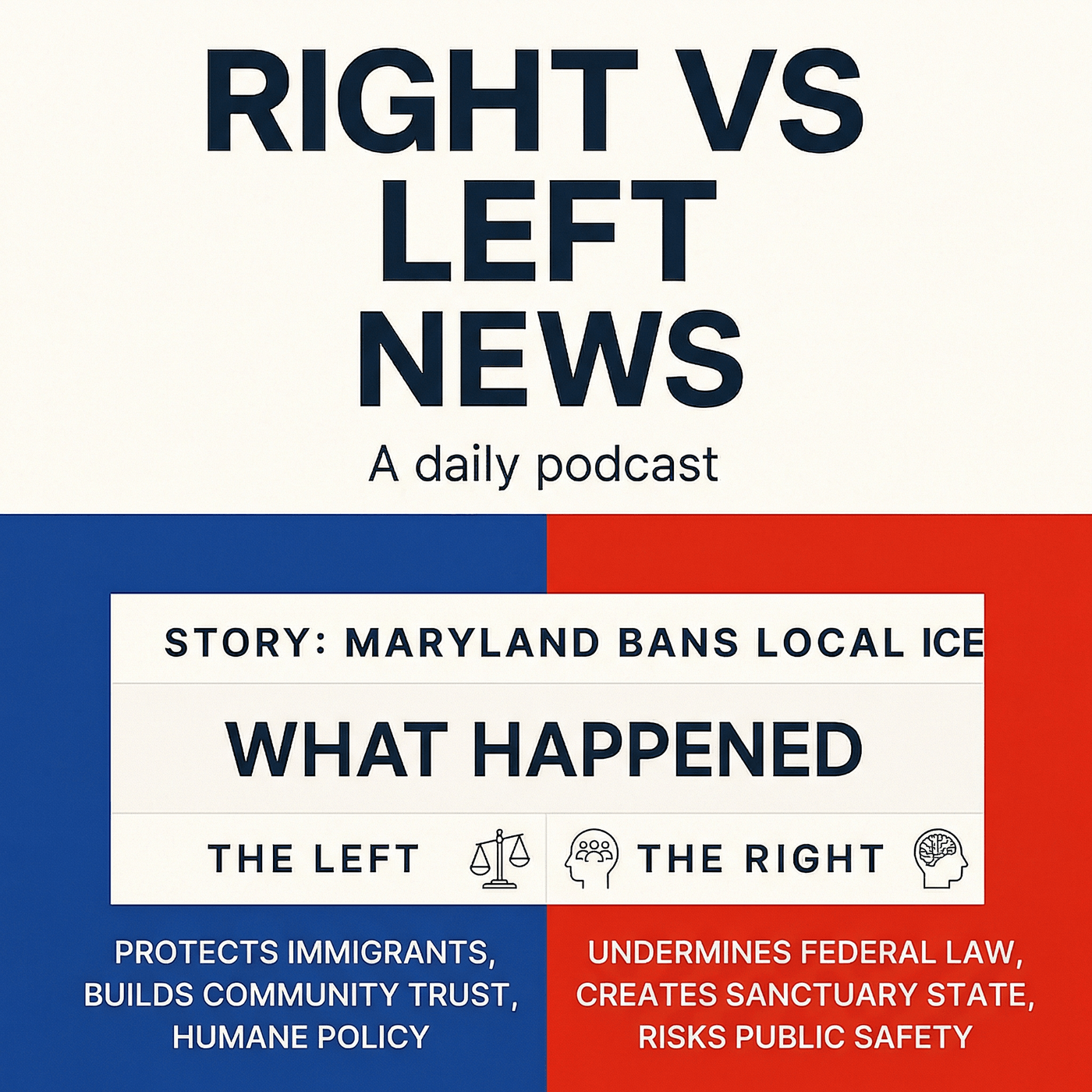
Maryland Ends ICE Ties, Brussels Bristles, Geneva Stalls
We unpack Maryland’s abrupt end to local ICE partnerships, a rare U.S.–Belgium diplomatic spat, a court order restoring slavery exhibits in Philadelphia, stalled Geneva talks on Ukraine, and the political fallout from the Potomac sewage spill. Hear what happened — and how the right and left are framing it.
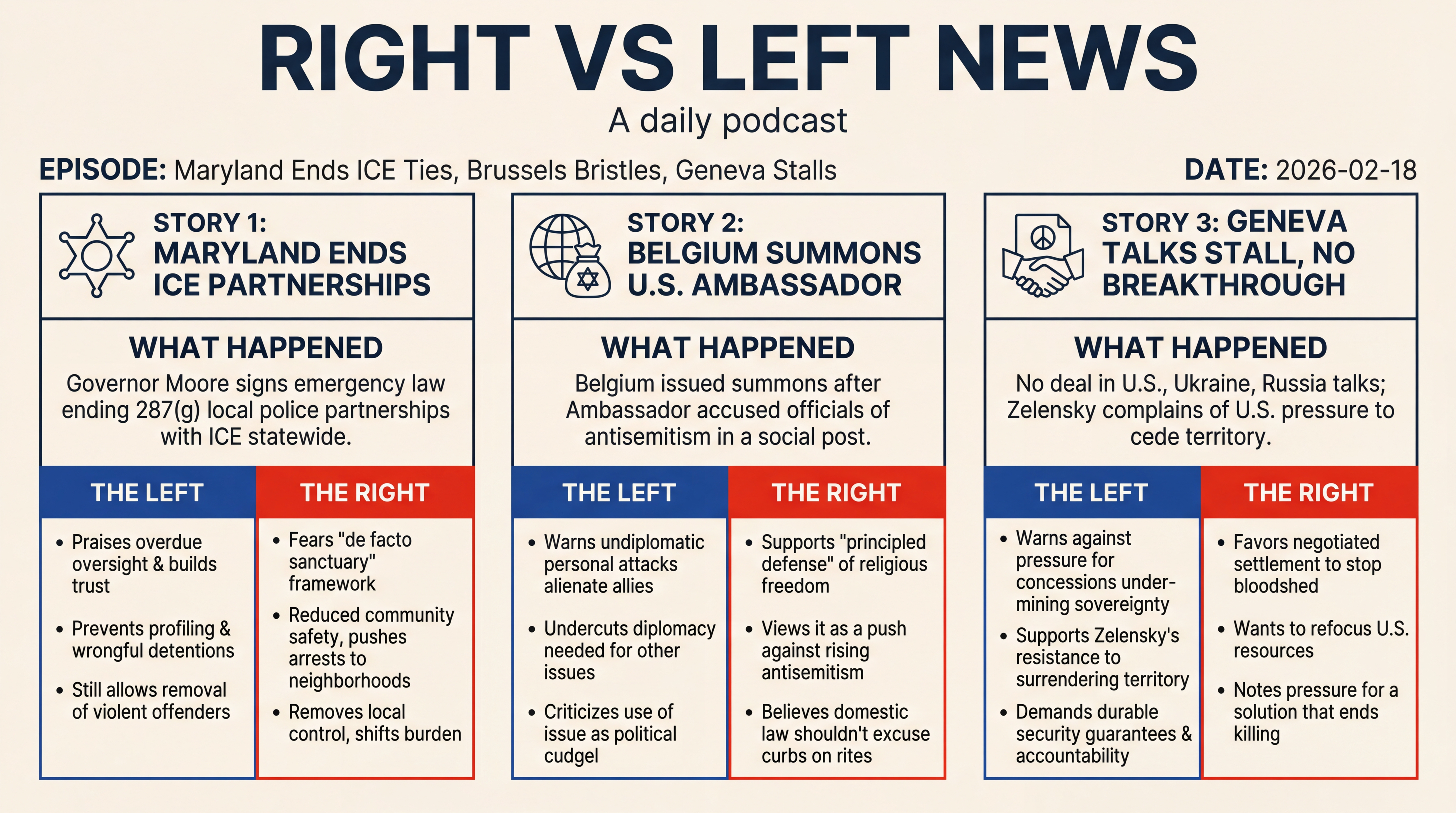
Episode Infographic
Show Notes
Welcome to Right versus Left News—your daily briefing on the stories that matter, told from both sides of the aisle. I'm your AI host - Chris, and each day I bring you the most important political and cultural news, with perspectives from conservative and progressive voices. No spin, no agenda—just the facts and the opinions that shape our national conversation. Let's dive in...
Here’s what we’re watching... Wednesday, February 18, 2026.
First, Maryland’s governor signed an emergency law ending local police partnerships with ICE statewide.
Second, Belgium summoned the U.S. ambassador after he accused officials of antisemitism in a social post — an unusual spat between close allies.
Third, a federal judge ordered the Park Service to restore an exhibit about slavery at a historic George Washington site in Philadelphia.
Fourth, day two of U.S., Ukraine, and Russia talks in Geneva brought no breakthrough, as President Zelensky complained of U.S. pressure.
And fifth, the massive sewage spill into the Potomac River is morphing into a political fight over infrastructure and federal help.
We’ll break down what happened — and how the right and left see it — right now.
[BEGINNING_SPONSORS]
Let’s start in Maryland.
On Tuesday, February 17, Governor Wes Moore signed an emergency bill ending all 287(g) agreements — the formal partnerships between local law enforcement and U.S. Immigration and Customs Enforcement. Nine sheriff’s offices have to cut ties immediately. Supporters say it protects community trust and reins in what Moore called unaccountable agents. Reporting also notes the law doesn’t stop jails from notifying ICE about inmate releases, and it comes as other blue states rethink cooperation with federal immigration enforcement.
What’s the right saying? Conservatives argue Maryland is adopting a de facto sanctuary framework that will make communities less safe. They point to DHS warnings that bans on cooperation push arrests into neighborhoods instead of jails — what some call playing Russian roulette with public safety. Some sheriffs say the change strips local control and shifts the burden onto federal agents.
And the left? Progressives call it overdue oversight of an agency they say expanded too far, too fast — meant to prevent profiling and wrongful detentions. Civil rights groups pushed for the ban after high-profile deportation mistakes. Supporters add the state can still help remove violent offenders — just without deputizing local officers into federal roles.
Now to Belgium.
Belgium summoned the U.S. ambassador, Bill White, after he accused Belgian officials of antisemitism tied to an investigation into unlicensed ritual circumcisions by three mohels. Brussels reminded him about noninterference and separation of powers. White said he was defending religious freedom and didn’t see a need to apologize. It’s an unusual dust-up between close allies — and part of broader strains in transatlantic relations.
On the right, commentators back the ambassador’s hard line, framing it as a principled defense of Jewish religious practice and a push against rising antisemitism in Europe. They note his view that citing domestic law shouldn’t excuse curbs on religious rites.
On the left, critics warn that personal broadsides from political appointees can undercut diplomacy and alienate partners the U.S. needs on Ukraine and tech regulation. Belgian officials say the case is about medical licensing, not faith — and argue accusations of antisemitism shouldn’t be wielded as political cudgels.
To Philadelphia.
On Presidents’ Day, a federal judge ordered the National Park Service to restore 34 panels about slavery at the President’s House site — rejecting the administration’s effort, under an executive order targeting divisive narratives, to remove them. The judge compared the move to Orwell’s 1984 and said the public is entitled to an honest account of history, including the enslavement within Washington’s household.
What’s the right saying? Supporters of the administration cite its Restoring Truth and Sanity to American History directive, which aims to purge federal displays of what it calls ideological distortion and present a more uplifting view of American heritage — arguing elected leaders have authority over federal exhibits.
And the left? Liberals hail the ruling as a check on political interference in public history. They argue removing slavery narratives sanitizes the past and violates agreements with local partners. The court emphasized that the exhibits are a memorial to enslaved people whose stories shouldn’t shift with political winds.
[MIDPOINT_SPONSORS]
To Geneva now.
Day two of U.S., Ukraine, and Russia talks continued with U.S. envoys facilitating working groups after earlier sessions in Abu Dhabi. Officials describe meaningful progress, but there’s no concrete deal. Ukraine’s defense chief said the focus is on mechanisms while the fighting grinds on. President Zelensky told reporters the U.S. is pressing Kyiv too hard — rejecting any plan that would cede additional Donbas territory not already occupied by Russia.
On the right, you’ll hear arguments that pushing for a negotiated settlement — however imperfect — could stop the bloodshed and refocus U.S. resources. Officials highlight Secretary Rubio’s message that President Trump wants a solution that ends the killing, while Europeans remain skeptical of earlier drafts but open to revisions.
On the left, progressives warn against pressuring Ukraine into concessions that undermine sovereignty and set a dangerous precedent. They echo Zelensky’s resistance to surrendering more of Donbas and push for any deal to include durable security guarantees and accountability for Russian aggression.
Finally, the Potomac River.
The sewage spill — more than 200 million gallons after a January pipeline collapse — continues to spark concern and finger-pointing. Crews have built a major bypass, and full repairs will take months. Officials say drinking water remains safe because the main intake is upstream, but health risks like elevated E. coli levels are being monitored. The White House says FEMA will play a key role. The president blasted regional leaders, while local officials say they’ve been working nonstop and will seek federal help with costs.
On the right, critics argue the crisis exposes blue-state mismanagement of aging infrastructure and a culture of no accountability. They want transparency on testing errors and cleanup timelines — and they praise swift federal coordination.
On the left, the focus is on long-term infrastructure investment and environmental safeguards. Advocates point out that climate-intensified weather and decades-old pipes make failures more likely — and they warn against politicizing emergency response while agencies work around the clock.
A quick recap.
Maryland’s ICE partnership ban escalates blue-state pushback on federal immigration enforcement. Belgium’s summons shows how online rhetoric can spill into real-world friction. A judge in Philadelphia said the government can’t erase hard history. Geneva talks continue without a deal as both pressure and skepticism rise. And the Potomac spill is now as political as it is environmental.
We’ll keep watching as the facts — and the debate — evolve.
That's it for today's episode of Right versus Left News. Remember, understanding both sides isn't about picking a team—it's about being informed. Subscribe wherever you get your podcasts, and join us tomorrow for another balanced look at the day's biggest stories. Until next time, stay curious and stay informed.
