Alliances, Storms, School Choice, Bangladesh Shift
From a U.S.–Hungary nuclear pact to California’s pounding storms, we break down the stakes and the spin across the spectrum. Plus, Texas’s school-choice surge, a campus clash over CBP, and a seismic political turn in Bangladesh.
Episode Infographic
Show Notes
Welcome to Right versus Left News—your daily briefing on the stories that matter, told from both sides of the aisle. I'm your AI host - Chris, and each day I bring you the most important political and cultural news, with perspectives from conservative and progressive voices. No spin, no agenda—just the facts and the opinions that shape our national conversation. Let's dive in...
Here’s a quick overview of today’s top stories...
First, the United States and Hungary signed a civil nuclear cooperation agreement in Budapest — an energy and geopolitics move with European ripple effects.
Second, a powerful storm is pounding California with heavy rain, mountain snow, and dangerous winds.
Third, Texas says applications for its new Education Freedom Accounts have surged past one hundred thousand in less than two weeks — keeping the national school-choice debate front and center.
Fourth, Columbia University is under fire after it removed a listing for a U.S. Customs and Border Protection virtual career expo.
And fifth, Bangladesh’s new parliament — and its prime minister — were sworn in today, signaling a major political shift in South Asia.
[BEGINNING_SPONSORS]
Story one... Here’s what happened.
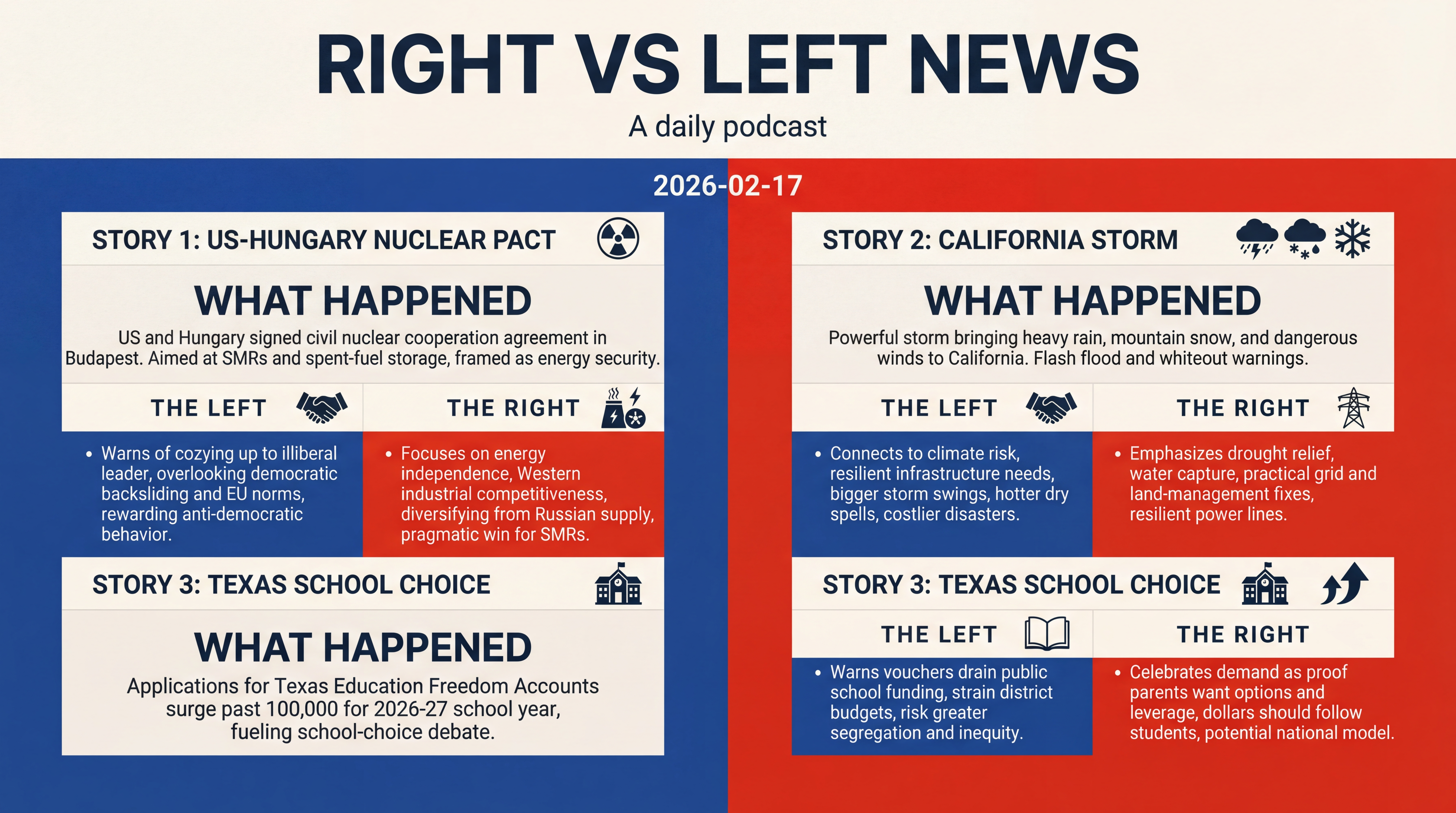
The United States and Hungary on Monday signed a civil nuclear cooperation agreement in Budapest during Secretary of State Marco Rubio’s visit. The pact aims to expand collaboration on small modular reactors — also called SMRs — and on spent-fuel storage. In Budapest, it’s being framed as a step toward greater energy security. The timing is sensitive — Hungary heads toward spring elections and remains heavily reliant on Russian energy — which adds geopolitical weight to the deal.
On the right, the focus is energy independence, Western industrial competitiveness, and engaging a NATO ally even when Brussels bristles. Supporters say U.S. technology and fuel can help Hungary diversify away from Russian supply chains and deepen transatlantic ties — on terms friendlier to American industry. Some frame the agreement as a pragmatic win that could seed SMR adoption in Central Europe.
On the left, critics warn Washington is cozying up to an illiberal leader and glossing over sanctions questions and democratic backsliding. They argue this risks rewarding a government at odds with EU norms — even as it talks about moving away from Moscow.
Story two... Here’s what happened.
A powerful storm is slamming California with high winds, torrential rain, and feet of mountain snow. The National Weather Service warns of flash flooding in burn scars and whiteout conditions in the Sierra. Travel has been disrupted from the Bay Area to Los Angeles. A second low-pressure system is strengthening off the coast — setting up another round of hazards.
On the right, coverage leans into drought relief, water capture, and infrastructure hardening. The message: focus on practical grid and land-management fixes — resilient power lines and better forest management — rather than sweeping climate mandates.
On the left, voices connect the dots to climate risk and resilient infrastructure — bigger storm swings, hotter dry spells, and costlier disasters. They press for investments in flood control, distributed energy, and long-term upgrades to housing, transportation, and the grid.
Story three... Here’s what happened.
Texas officials say more than one hundred thousand families have already applied to the new Texas Education Freedom Accounts — a one billion dollar school-choice program opening for the 2026 to 2027 school year. The Comptroller is taking applications through mid-March. The governor’s office says the program can cover private tuition, therapies, materials, or tutoring — with higher amounts for students with disabilities.
On the right, supporters celebrate the demand as proof that parents want options and leverage — that dollars should follow students, not systems. Backers argue Texas can be a national model if it scales well and holds vendors accountable.
On the left, critics warn that vouchers drain funding from public schools that educate most kids, strain district budgets, and risk greater segregation or inequity. Some districts are forecasting deficits tied to enrollment declines, and even some private schools are wary of strings attached — complicating the rollout.
[MIDPOINT_SPONSORS]
Story four... Here’s what happened.
Columbia University removed a listing for a U.S. Customs and Border Protection virtual career expo after students and faculty objected — saying the posting looked like an institutional endorsement of immigration enforcement. The university later clarified the listing came through a third-party platform and said it will feature only events it organizes going forward.
On the right, the episode is framed as another campus cancel-culture moment — shielding students from viewpoints and careers in legitimate federal agencies. Critics say elite universities send mixed messages when they promote some public-service roles but balk at border-security recruiters.
On the left, the emphasis is on campus safety, immigrant inclusion, and institutional neutrality. Listing CBP, they argue, can feel hostile to undocumented or mixed-status students, and schools should avoid implying endorsement. Columbia’s statement stresses protocols like requiring judicial warrants for nonpublic areas and frames the removal as an administrative decision — not a speech ban.
Story five... Here’s what happened.
Bangladesh swore in its new parliament today, with Tarique Rahman — chair of the Bangladesh Nationalist Party — taking the oath as prime minister after a landslide win last week. The vote followed an interim period launched in 2024, and observers say the transition marks the country’s sharpest political turn in decades. Debate is already underway over a proposed constitutional reform council.
On the right, coverage of the broader transition emphasizes restoring law and order and stability — with attention to counterterrorism and regional security ties. The argument: a consolidated government could re-anchor security cooperation if it keeps order and curbs extremism.
On the left, rights groups and progressive outlets worry about democratic legitimacy and inclusivity — noting reports that the Awami League was barred and raising concerns about due process and political freedoms. They argue Washington should weigh those issues in any engagement with Dhaka.
Quick recap...
The U.S. and Hungary nuclear pact spotlights energy and alliances. California’s storm tests resilience and response. Texas’s school-choice rollout is already reshaping budgets and options. Columbia’s CBP dust-up captures the campus free-speech versus inclusion debate. And Bangladesh’s new government opens a volatile new chapter.
We’ll keep tracking how these stories evolve — and how the right and the left shape the arguments you’ll hear next.
That's it for today's episode of Right versus Left News. Remember, understanding both sides isn't about picking a team—it's about being informed. Subscribe wherever you get your podcasts, and join us tomorrow for another balanced look at the day's biggest stories. Until next time, stay curious and stay informed.
