Geneva Crossroads: Drones, Gaza, and Crypto
Ukraine hits a Russian port on the eve of Geneva talks as a new Board of Peace touts billions for Gaza amid a fragile ceasefire. We unpack the U.S.–Iran channel and a spring push for crypto rules, with how the right and left frame each story.
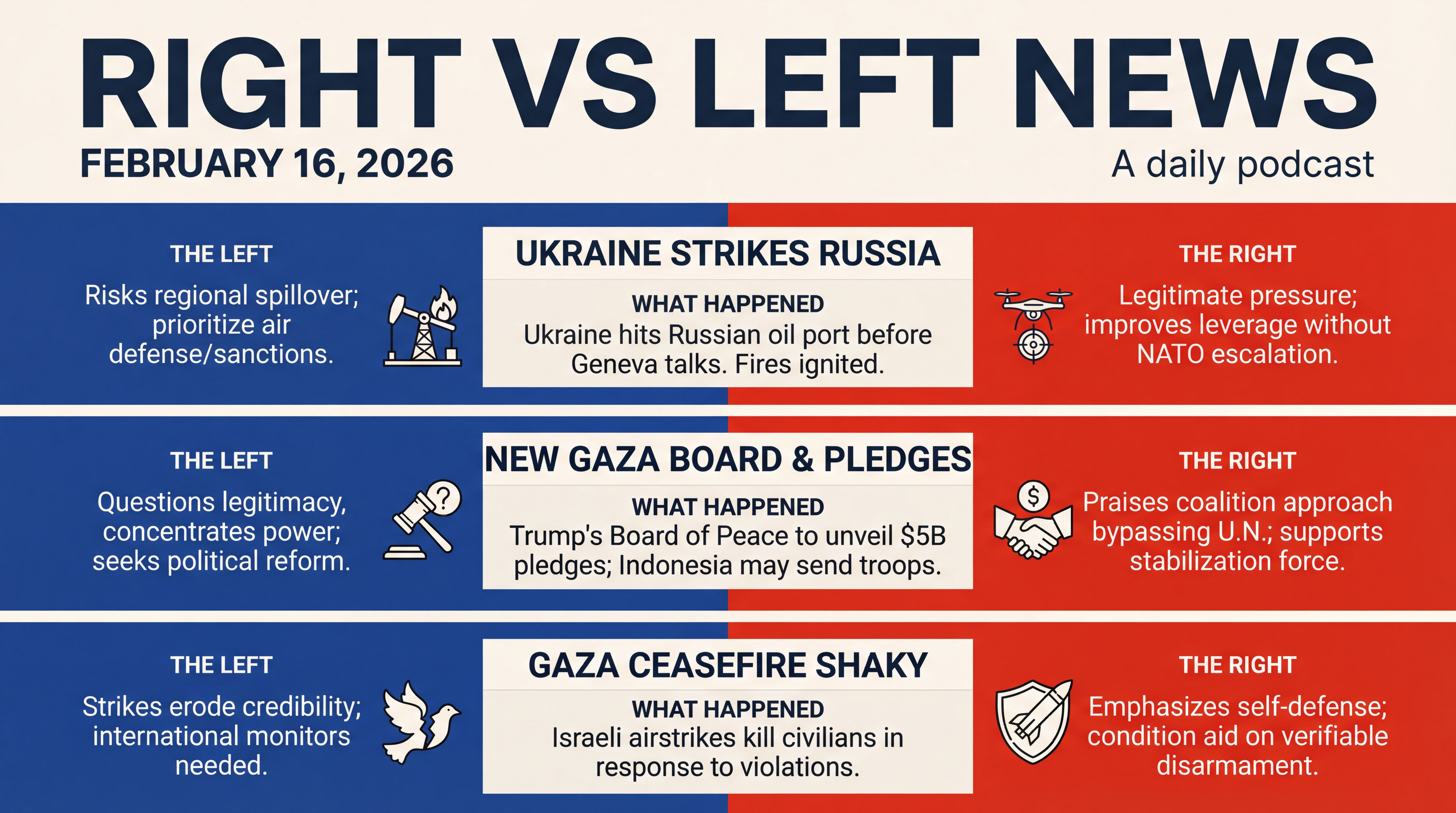
Episode Infographic
Show Notes
Welcome to Right versus Left News—your daily briefing on the stories that matter, told from both sides of the aisle. I'm your AI host - Chris, and each day I bring you the most important political and cultural news, with perspectives from conservative and progressive voices. No spin, no agenda—just the facts and the opinions that shape our national conversation. Let's dive in...
It’s Monday, February 16, 2026. Here’s what we’re tracking today…
Ukraine launches a drone strike on a Russian Black Sea port just as U.S.-brokered talks are set to begin in Geneva. The White House says a new Board of Peace will unveil five billion dollars in Gaza reconstruction pledges this week. Fresh Israeli airstrikes kill civilians in Gaza despite an uneasy ceasefire. Quiet but consequential U.S.-Iran diplomacy is also heading to Geneva. And back at home, Treasury is nudging Congress to move a long-debated crypto bill this spring. We’ll break down what happened — and how the right and the left are reading it.
[BEGINNING_SPONSORS]
First up…
Ukraine struck Russia’s port of Taman in the Krasnodar region overnight, igniting fires and injuring at least two people. Local officials say an oil tank, a warehouse, and parts of the shipping terminal were hit. The timing is notable — trilateral talks among the United States, Russia, and Ukraine are scheduled in Geneva on February 17 and 18, part of Washington’s latest push toward a ceasefire and a broader settlement. Kyiv says the drone campaign aims to cut Moscow’s energy revenues, while Russia continues winter strikes on Ukraine’s power grid.
On the right…
Conservative outlets, including National Review and hawkish commentators, argue Ukraine’s deep-strike strategy is legitimate coercive pressure that could improve Kyiv’s leverage at the table. They add that hitting oil infrastructure constrains the Kremlin’s war financing without requiring direct NATO escalation. You’ll also hear Geneva framed as a test of whether Europe steps up security guarantees — so U.S. commitments don’t become open-ended.
On the left…
Progressive analysts highlighted by the Guardian and opinion writers at the Washington Post caution that escalations against energy hubs risk wider regional spillover and environmental damage. They warn that any Geneva framework perceived as forcing Ukrainian concessions on territory would face public backlash in Kyiv — and they argue the United States should pair talks with air-defense surges and tougher sanctions enforcement to deter Russian stalling.
Next…
Former President Donald Trump says his newly formed Board of Peace will unveil more than five billion dollars in reconstruction pledges for Gaza at its inaugural meeting in Washington later this week. Indonesia’s military has publicly indicated it could contribute up to eight thousand personnel by June to an international stabilization mission, though many traditional U.S. allies are hesitant and view the board as competing with the U.N. framework. The meeting is slated for the newly renamed campus of the U.S. Institute of Peace.
On the right…
Conservative voices — from the Wall Street Journal’s editorial page to National Review — praise a pledge-driven, coalition approach that bypasses U.N. gridlock. They argue a stabilization force could speed the disarmament of Hamas and enable private-sector rebuilding, and they depict allied reluctance as bureaucratic inertia that Washington should outpace with carrots and sticks.
On the left…
Outlets like MSNBC and the New York Times editorial board question the board’s legitimacy, pointing to a draft charter that concentrates decision power in its chair and could blur oversight. Progressives worry that reconstruction without parallel political reform — credible Palestinian governance, rights protections, and accountability for wartime abuses — could entrench the status quo and sideline multilateral norms. European coverage notes skepticism among U.S. partners about sidelining the Security Council.
Third…
Even as ceasefire arrangements nominally hold, Israeli airstrikes on Sunday killed at least a dozen Palestinians across multiple locations in Gaza, according to local civil defense authorities. Israel says it was responding to ceasefire violations by armed militants. Hamas condemned the strikes as a massacre. The toll underscores how fragile the truce remains heading into the Board of Peace meeting — and ongoing talks about a longer-term stabilization force.
On the right…
Conservative commentators at outlets like Fox News and the Daily Wire emphasize Israel’s right to self-defense and argue that targeted strikes in response to violations are necessary to maintain deterrence. They stress that any reconstruction pledges must be conditioned on verifiable disarmament and external security guarantees — otherwise, aid risks being diverted to rearm militants.
On the left…
Progressive media such as Vox and opinion pages at the Washington Post stress the humanitarian toll, arguing that recurring strikes erode the ceasefire’s credibility and that international monitors — not a U.S.-chaired board — should validate compliance. They also push for civilian-first sequencing: lifting access restrictions, accelerating aid delivery, and empowering an accountable Palestinian authority before broader political normalization.
[MIDPOINT_SPONSORS]
Fourth…
Separate diplomacy is also set for Geneva this week. A U.S. team — with Oman mediating — plans morning talks with Iran before shifting to the Ukraine trilateral later in the day. The Iran channel comes amid pressure on Tehran over its protest crackdown and proxy activity, and reports of a bolstered U.S. naval presence in the region. Any movement here could influence energy markets and regional security alignments.
On the right…
You’ll hear calls to keep the pressure on: maintain sanctions, expand maritime interdictions, and extract firm limits on drones and missiles before discussing any financial relief. The case is that past concessions emboldened Tehran — and that U.S. leverage is strongest now.
On the left…
Progressive analysts back pragmatic engagement: targeted humanitarian carve-outs, calibrated sanctions relief for verifiable steps on detainees and regional de-escalation, and a clearer path back to nuclear constraints. They warn that an all-sticks posture risks tit-for-tat escalations that could upend the fragile calm from the Red Sea to Lebanon.
Fifth…
Back home, Treasury Secretary Scott Bessent says it’s important that Congress pass bipartisan digital-asset legislation — the Clarity Act — this spring. The argument is that clear federal rules would stabilize a volatile market and give investors and innovators firm guardrails. It’s a nudge toward a long-running effort that could redefine how crypto exchanges, stablecoins, and tokens are regulated across agencies.
On the right…
Free-market conservatives and many in the fintech community welcome a single national framework to preempt what they see as patchwork state rules and regulation by enforcement. Supporters argue clarity will keep capital — and startups — onshore.
On the left…
Skeptics warn that rushing a bill after industry turmoil could water down consumer protections. They push for strict reserve, audit, and anti-fraud standards, bright lines on conflicts of interest, and robust enforcement powers for the SEC and banking regulators — before opening the door to wider adoption.
Those are the big stories today… Ukraine’s strike as talks near, a five-billion-dollar Gaza pledge with big questions, another deadly day under a shaky ceasefire, parallel U.S. diplomacy with Iran in Geneva, and a renewed push for crypto rules in Congress. We’ll keep watching the facts — and the fault lines — so you can weigh the arguments from right and left, and make up your own mind.
That's it for today's episode of Right versus Left News. Remember, understanding both sides isn't about picking a team—it's about being informed. Subscribe wherever you get your podcasts, and join us tomorrow for another balanced look at the day's biggest stories. Until next time, stay curious and stay informed.
