
Rubio’s Munich Pitch, Harvard Fight, Iran Rallies, SEC Reset
A fast, focused briefing on Rubio’s outreach to Europe, the DOJ’s lawsuit against Harvard over admissions data, global rallies by Iran’s diaspora amid regime change talk, the SEC’s fraud-first pivot, and an Olympic free speech clash. Clear context, sharp contrasts, and what to watch next.
Episode Infographic
Show Notes
Welcome to Right versus Left News—your daily briefing on the stories that matter, told from both sides of the aisle. I'm your AI host - Chris, and each day I bring you the most important political and cultural news, with perspectives from conservative and progressive voices. No spin, no agenda—just the facts and the opinions that shape our national conversation. Let's dive in...
Here’s a quick look at what’s driving the day.
America’s top diplomat tries to calm Europe at Munich while keeping Trump-era priorities front and center... The Justice Department sues Harvard over admissions data after the end of affirmative action... Iranians and their allies rally worldwide as Washington talks openly about regime change... Wall Street watches the SEC’s new enforcement boss sketch out a back to basics game plan... and an Olympic court backs a ban on a Ukrainian athlete’s tribute helmet, stoking a free speech fight. Let’s dive in.
[BEGINNING_SPONSORS]
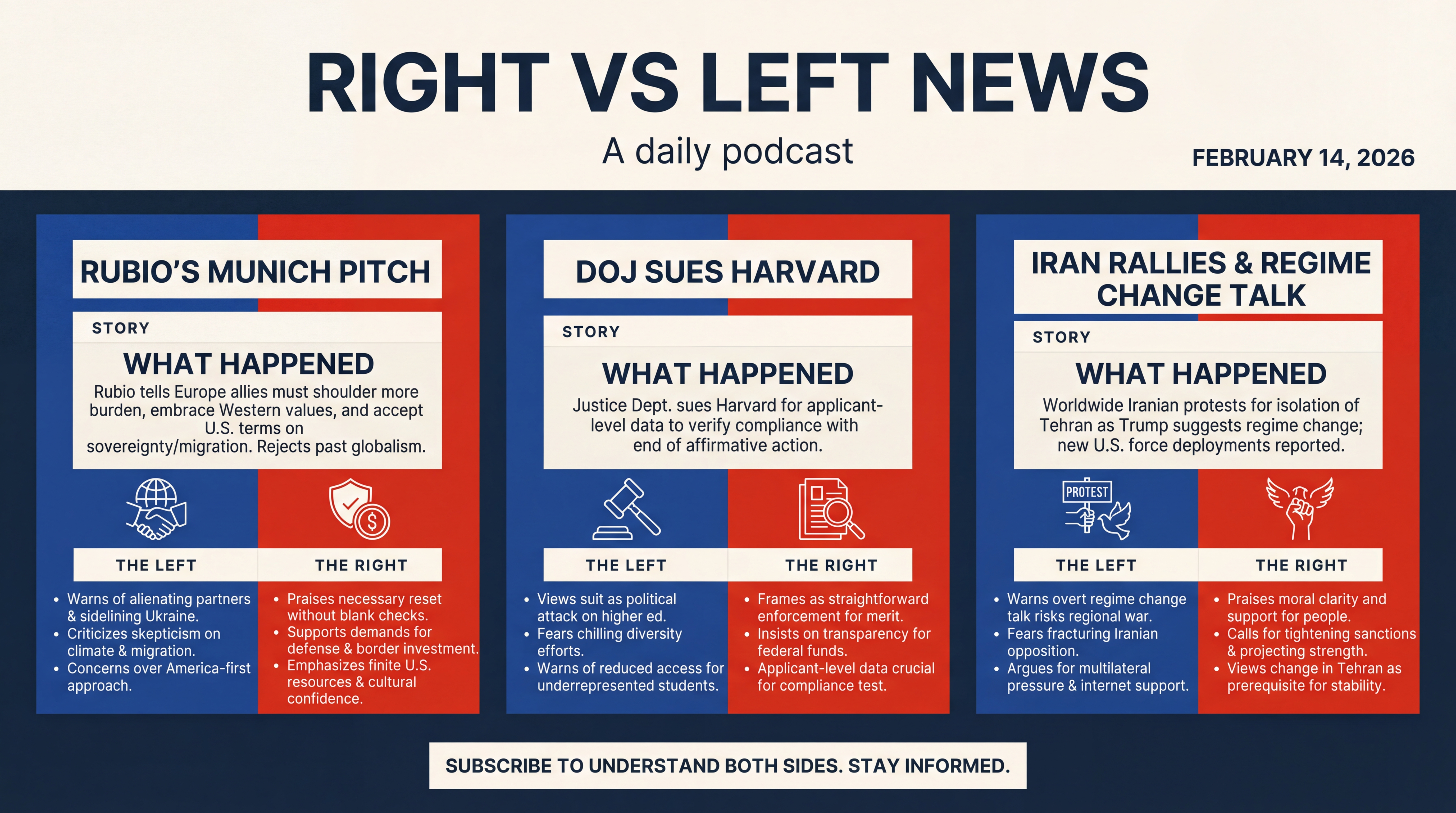
At the Munich Security Conference today, Secretary of State Marco Rubio told European leaders the U.S. and Europe belong together — calling America a child of Europe. He also criticized past globalism and border policies he says weakened the West.
His tone was warmer than that of some prior Trump officials... yet he made clear Washington expects allies to shoulder more — and to accept U.S. terms on sovereignty and migration. European responses were mixed: some relief at the outreach, some worry about an unequal partnership.
From the right, commentators call it a necessary reset — support for NATO without blank checks, a push to reform aging institutions, and a demand that Europe invest more in defense and border control. They argue U.S. resources are finite, and that cultural confidence matters as much as hardware.
From the left, progressives point to Rubio’s embrace of Western civilizational language and his skepticism about climate policy and migration. They warn it could alienate partners and sideline Ukraine — cooperation, they say, is being offered on America’s terms, while multilateralism and human rights take a back seat.
The Justice Department sued Harvard on Friday, saying the university withheld applicant-level admissions data needed to verify compliance with the Supreme Court’s 2023 ruling that ended race-based affirmative action. Officials say Harvard produced summaries, not the raw files required to test whether race still factors into decisions. Harvard says it is in compliance and calls the suit overreach.
On the right, the case is framed as straightforward enforcement — a push for merit over DEI and a reminder that transparency is nonnegotiable when federal funds are involved. Applicant-level data, they argue, is the only way to test compliance.
On the left, progressives call the suit political — another broadside against higher education that could chill diversity efforts and academic independence. They warn it may reduce access for underrepresented students.
Iranians in cities worldwide rallied for a global day of action organized by exiled crown prince Reza Pahlavi, urging governments to isolate Tehran after a deadly crackdown and an internet blackout inside the country. The protests landed alongside new remarks from President Trump, who said regime change in Iran would be the best outcome, as reports point to additional U.S. force deployments in the region.
On the right, there’s praise for moral clarity — support the Iranian people, tighten sanctions, and, if necessary, project strength to deter the regime. Many argue change in Tehran is a prerequisite for lasting regional stability.
On the left, progressives back human rights demands but warn that overt talk of regime change — especially with military signaling — risks regional war and could fracture the Iranian opposition. They argue for multilateral pressure, United Nations mechanisms, and robust support for internet access... not escalation.
[MIDPOINT_SPONSORS]
The SEC’s new enforcement director, Judge Margaret Ryan, delivered her first major remarks this week and, in a follow-up today, defended a fraud-first approach — focusing on investor harm, insider trading, accounting fraud, and market manipulation — while stepping back from ultra-punitive penalties for technical compliance lapses. She also promised a more transparent Wells process as the agency shifts under Chair Paul Atkins.
On the right, pro-market voices see a welcome end to regulation by enforcement. Clearer rules, due process in Wells meetings, and prioritizing real fraud, they say, will bolster capital formation — especially for crypto and smaller issuers long whipsawed by shifting signals.
On the left, progressives worry a softer stance could embolden bad actors and politicize policing — particularly after several high-profile stumbles in crypto. Fewer cases, they argue, do not necessarily mean safer markets, and vigilance is needed so retail investors are not left exposed.
The Court of Arbitration for Sport rejected the appeal of Ukrainian skeleton racer Vladyslav Heraskevych after he was disqualified from the Milan Cortina Olympics for planning to wear a helmet of remembrance honoring Ukrainians killed in the war. The IOC said it violated athlete expression rules on the field of play, and CAS found those limits reasonable and proportionate.
On the right, many praise the athlete’s courage and fault the IOC for an inconsistent neutrality standard — strict with Ukraine’s memorials, lenient elsewhere. Critics say bureaucracy is being privileged over moral clarity in the face of Russian aggression.
On the left, views are split. Some support the tribute as protected expression, while others argue that uniform rules must apply to all political symbols to keep competition fair. Many note that athletes can speak off the field... just not during play — a line that continues to fuel debate about values, visibility, and venue.
Quick recap... Rubio reassures Europe — with caveats; DOJ forces a transparency fight with Harvard; Iran’s diaspora floods the streets as Washington talks regime change; the SEC promises fraud-first enforcement; and CAS upholds an Olympic speech limit that will not end the argument. We’ll watch the negotiations, court dockets, and markets — and bring you the latest tomorrow.
That's it for today's episode of Right versus Left News. Remember, understanding both sides isn't about picking a team—it's about being informed. Subscribe wherever you get your podcasts, and join us tomorrow for another balanced look at the day's biggest stories. Until next time, stay curious and stay informed.
