
Funding Standoff, Court Reversal, and Winter War
A DHS funding clash hits the brink as a judge orders returns for deported Venezuelans, DOJ antitrust shakes up, states pause health grant cuts, and Ukraine strikes deep while enduring blackouts. Balanced perspectives and clear context from today’s top reporting.
Episode Infographic
Show Notes
Welcome to Right versus Left News—your daily briefing on the stories that matter, told from both sides of the aisle. I'm your AI host - Chris, and each day I bring you the most important political and cultural news, with perspectives from conservative and progressive voices. No spin, no agenda—just the facts and the opinions that shape our national conversation. Let's dive in...
Here’s the quick rundown for Friday, February 13, 2026.
Congress is at an impasse, with Senate Democrats blocking a Department of Homeland Security funding bill on the very day the money runs out. A federal judge in Washington ordered the government to let certain Venezuelan migrants return for hearings after rapid deportations last year. At Justice, the head of the Antitrust Division abruptly resigned amid internal clashes over merger policy. Blue-state attorneys general scored a temporary win against federal cuts to public health and HIV prevention grants. And overseas, Ukraine launched one of its deepest drone strikes into Russia while enduring severe blackouts from winter bombardment.
Today’s sources include the Wall Street Journal, the Washington Post, the Associated Press, Axios, the Guardian, and Business Insider.
[BEGINNING_SPONSORS]
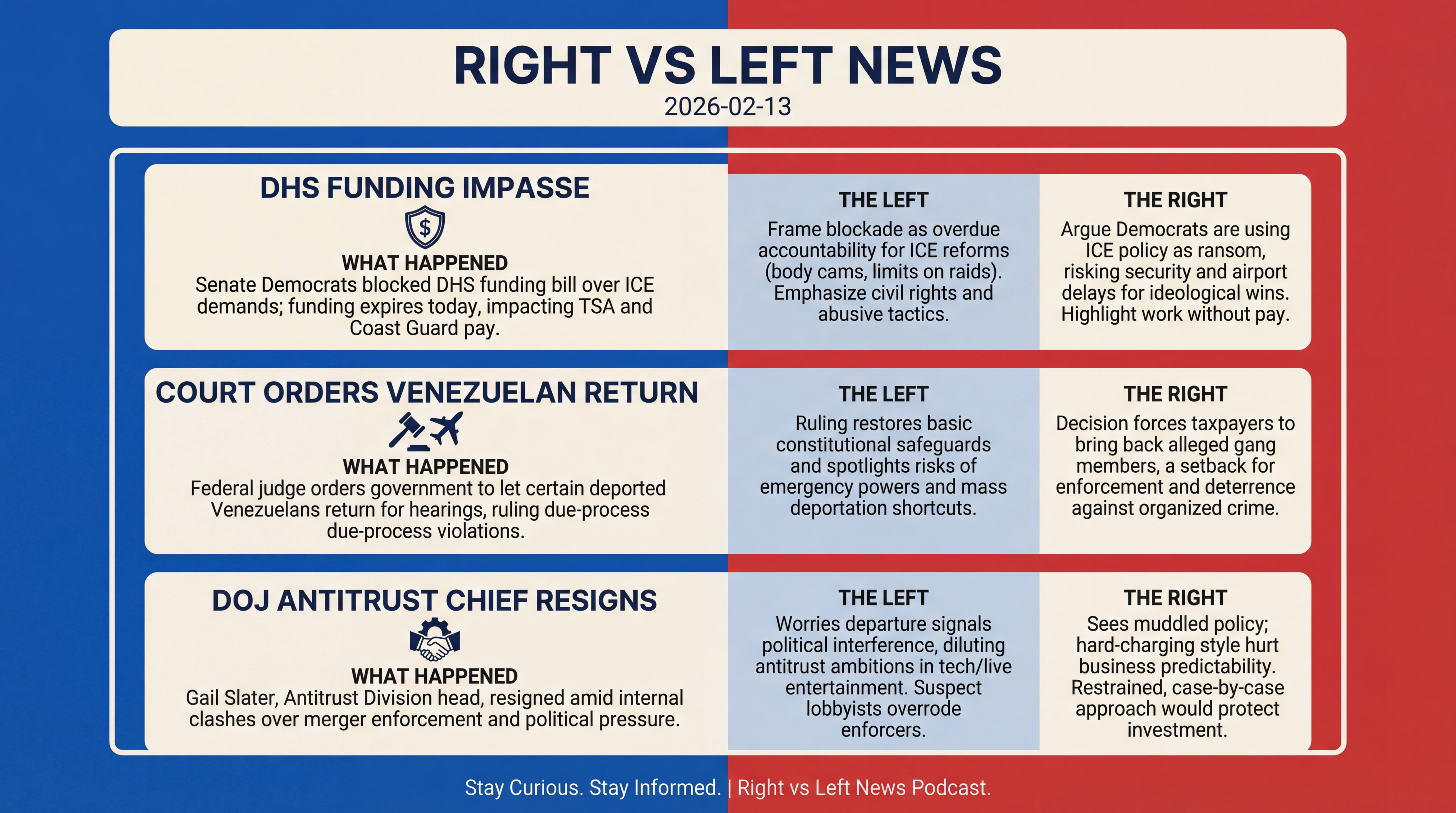
The Senate failed to advance a full-year DHS funding bill. The vote was 52 to 47 — short of the 60 needed to overcome a filibuster. Democrats are pushing for stricter limits on ICE — Immigration and Customs Enforcement — after controversial enforcement actions, while Republicans want to lock in funding through September. With DHS money expiring today, agencies like TSA and the Coast Guard face pay interruptions, though core border and security functions continue. Republican leaders say they could call senators back to Washington if a deal emerges.
On the right, conservatives argue Democrats are using ICE policy demands as ransom — risking airport delays and undercutting homeland security to score ideological wins. Some highlight the DHS secretary’s warning that a lapse forces critical staff to work without pay, and accuse Democrats of brushing off an offer to negotiate reforms.
On the left, progressive voices frame the blockade as overdue accountability for ICE — calling for body cameras, visible IDs, and limits on raids near schools and hospitals after fatal incidents in Minnesota. Center-left outlets emphasize civil-rights concerns and argue that reining in abusive tactics is a prerequisite to passing DHS funds.
In the courts, Chief U.S. District Judge James E. Boasberg ruled that the government must allow certain Venezuelans deported in 2025 to return for court hearings. He said their due-process rights were violated when they were removed under an emergency law without a meaningful chance to contest gang designations. The order applies to those no longer in Venezuela and directs the government to cover travel for eligible returnees. The Washington Post reports the Justice Department will appeal.
On the right, some coverage frames the decision as forcing taxpayers to bring back alleged gang members — a setback for tougher enforcement — citing officials who say expedited removals targeted criminals tied to Tren de Aragua. Commentators warn the ruling could hamper efforts to deter organized-crime networks.
On the left, liberal-leaning outlets argue the ruling restores basic constitutional safeguards, noting the judge’s criticism that people were deported before they could file habeas petitions. Civil-rights advocates say the case spotlights the risks of governing immigration through emergency powers and mass-deportation shortcuts.
At the Justice Department, Gail Slater — the Antitrust Division chief — resigned after roughly a year on the job. Multiple outlets report her exit followed internal clashes over merger enforcement and high-profile cases, just weeks before a scheduled Live Nation trial. Deputies have recently departed as tensions mounted over settlements and perceived political pressure on big deals.
On the right, center-right commentary sees a muddled policy line — split between populist trust-busting and deal-friendly instincts. Some conservatives suggest Slater’s hard-charging style hurt predictability for businesses, and that a more restrained, case-by-case approach would protect investment. Markets even showed a bit of optimism for Live Nation after her exit.
On the left, progressives worry her departure signals political interference diluting antitrust ambitions, particularly in tech and live entertainment. Critics argue lobbyists and senior officials overrode career enforcers — and some want Congress to probe whether politics skewed merger decisions.
[MIDPOINT_SPONSORS]
Four states — California, Illinois, Minnesota, and Colorado — won a 14-day restraining order pausing federal cuts to about 600 million dollars in public health and HIV prevention grants. An Illinois federal judge found the states would face irreparable harm while courts review claims that the administration’s rescissions were unlawful and retaliatory. The Associated Press and Axios detail the programs at risk as the legal challenge moves forward.
On the right, conservatives argue judges are micromanaging executive-branch priorities and insulating health-equity grantmaking from scrutiny. Some editorial voices say courts are forcing agencies to keep funding ideologically driven projects — while others note the need for clearer, more consistent standards.
On the left, public-health groups and progressive outlets call the pause essential to protect HIV prevention, outbreak response, and services for vulnerable communities — arguing sudden pullbacks undermine long-term care and could cost lives. State officials say the cuts were politically motivated and contrary to congressional intent.
Overseas, Ukraine carried out one of its deepest drone strikes into Russia — hitting an oil facility in the Komi Republic nearly 1,100 miles from Ukraine — even as Russian attacks continue to cripple Ukraine’s power infrastructure amid subzero temperatures. A Ukrainian security source described the strike’s aims, while Kyiv residents face rolling blackouts and bitter cold as energy sites are hit.
On the right, coverage emphasizes hard-power realities: targeting refineries strains Russia’s war machine and deters aggression. Commentators call for robust air defenses and tougher pressure on Moscow to end attacks on civilians and infrastructure.
On the left, center-left voices stress the humanitarian toll and urge sustained aid focused on energy resilience — transformers, air defense, and grid repairs — alongside diplomacy. Europe has pledged additional air-defense support even as talks sputter.
Big themes today... a DHS funding standoff with real security stakes. A court-ordered reset on due process for deported Venezuelans. Turbulence inside DOJ antitrust. States putting a pause on public-health grant cuts. And a grinding winter battlefield in Ukraine — where long-range drones and blackouts define the fight.
That's it for today's episode of Right versus Left News. Remember, understanding both sides isn't about picking a team—it's about being informed. Subscribe wherever you get your podcasts, and join us tomorrow for another balanced look at the day's biggest stories. Until next time, stay curious and stay informed.
