Voter ID Clash, Tariff Rebuff, NATO Stakes
A fast, balanced briefing on Capitol Hill’s voter ID fight, a symbolic tariff rebuke, a combative Justice Department hearing on Epstein files, and NATO’s next moves on Ukraine. Clear context with perspectives from across the spectrum.
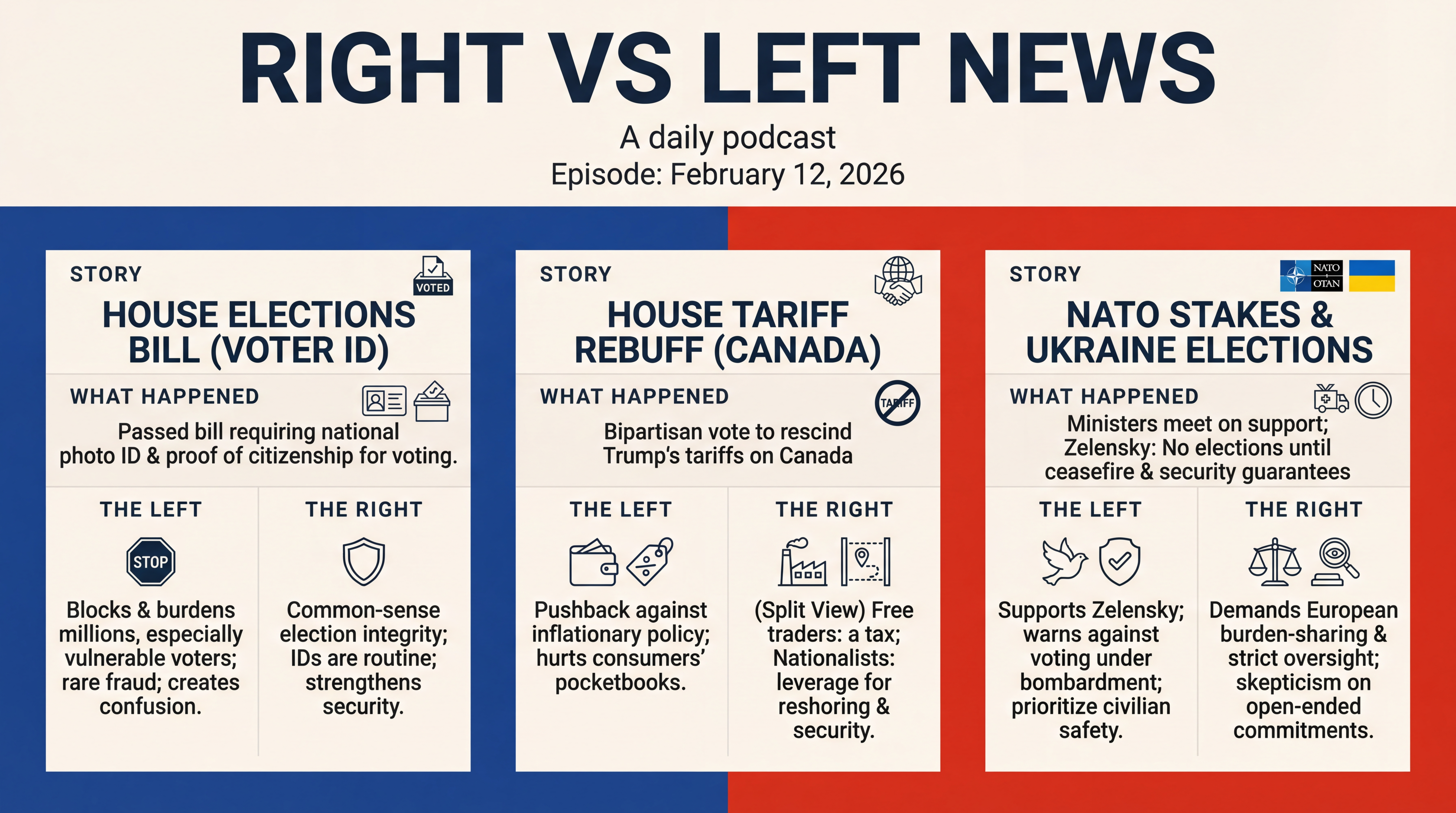
Episode Infographic
Show Notes
Welcome to Right versus Left News—your daily briefing on the stories that matter, told from both sides of the aisle. I'm your AI host - Chris, and each day I bring you the most important political and cultural news, with perspectives from conservative and progressive voices. No spin, no agenda—just the facts and the opinions that shape our national conversation. Let's dive in...
Here’s what we’re watching this Thursday, February 12, 2026.
In the House, Republicans muscled through a sweeping elections bill that would add a national photo ID requirement and documentary proof of citizenship to register. On trade, a bipartisan House vote moved to roll back President Trump’s tariffs on Canada. At a heated House Judiciary hearing, Attorney General Pam Bondi sparred with lawmakers over the handling of Jeffrey Epstein files. Overseas, NATO defense ministers are in Brussels weighing support for Ukraine and defense spending, while President Volodymyr Zelensky says Ukraine will hold elections only after a ceasefire and credible security guarantees. Taken together... those are the big five.
[BEGINNING_SPONSORS]
The House passed the SAVE America Act by a vote of 218 to 213, adding a federal photo ID rule for voting and requiring documentary proof of U.S. citizenship to register. Only one Democrat — Representative Henry Cuellar of Texas — voted yes. Supporters say the bill also tightens mail voting and expands data sharing with the Department of Homeland Security to verify citizenship. Critics warn that many eligible voters lack passports or certified birth certificates and could be pushed off the rolls or deterred. The measure now faces a steep path in the Senate — and a likely filibuster.
For conservatives, it’s framed as common-sense election integrity with broad support for voter ID. IDs are routine for daily life, they argue — they should be required for voting.
For voting-rights groups and many on the left, the bill could block or burden millions — especially young, low-income, and recently married voters who may lack paperwork. They note proven cases of non-citizen voting are exceedingly rare, and warn that rolling out new rules this close to primaries could spark confusion and lawsuits.
In a rare bipartisan rebuke, the House voted 219 to 211 to rescind President Trump’s tariffs on Canada. Six Republicans joined Democrats. The move is largely symbolic — a presidential veto likely looms — but it spotlights GOP divisions on trade and executive power.
Conservatives are split. Free traders call tariffs a tax on consumers that raises prices and undercuts growth, while nationalist populists back tariffs as leverage for reshoring and border security goals. Trump has warned GOP defectors could face primary challenges.
Democrats and some center-left voices cast the vote as pushback against tariff overreach and inflationary policy. They stress pocketbook impacts and point to earlier Senate skepticism — while noting the House action probably won’t change policy without a veto-proof majority.
At a House Judiciary oversight hearing, Attorney General Pam Bondi defended the Justice Department’s handling of Epstein-related files amid bipartisan scrutiny over redactions and victim privacy. The hearing turned combative — members pressed her on transparency, case priorities, and alleged politicization.
Right-leaning coverage emphasized Bondi’s pushback, highlighting contentious moments and portraying Democrats as engaging in theatrics while she defended department decisions and rejected claims of weaponization.
From the left, coverage focused on her refusal to directly apologize to Epstein victims present, and on frustrations over redactions that exposed survivors’ private details while shielding alleged associates — framing the hearing as part of a broader accountability fight.
[MIDPOINT_SPONSORS]
NATO defense ministers are meeting in Brussels to assess support for Ukraine, ramp up defense production, and prepare for the Ankara summit this summer. The agenda includes a NATO–Ukraine Council session and a meeting of the Ukraine Defense Contact Group. Expectations center on funding, air defense, and industrial capacity.
On the right, commentary often stresses burden sharing — Europe must do much more, and quickly — while the United States balances commitments in the Indo-Pacific and the Middle East.
Center-left and European outlets generally back sustained aid but caution against dictating political outcomes in Kyiv. They highlight steady support, concern over Russia’s winter strikes, and the humanitarian toll — along with rule-of-law considerations in any future settlement.
Meanwhile, President Volodymyr Zelensky said Ukraine will hold elections only after a ceasefire and credible security guarantees, pushing back on speculation about a wartime vote near the invasion anniversary. He argues that martial law and ongoing strikes make voting impractical and dangerous.
On the right, skepticism persists about open-ended commitments. Some argue Washington should press Europe to lead and keep pressure on Kyiv and Moscow to negotiate — with strict oversight of any further U.S. aid and timelines for a ceasefire.
On the left, many support Zelensky’s stance, warning that voting under bombardment risks legitimacy and safety. The focus, they say, should be on protecting civilians, shoring up air defenses, and centering Ukrainian agency in any talks — not on deadlines driven by outside politics.
That covers Washington’s voter ID fight and the tariff rebuke, a combative Justice Department hearing, and the latest on NATO and Ukraine... those are the headlines for February 12.
That's it for today's episode of Right versus Left News. Remember, understanding both sides isn't about picking a team—it's about being informed. Subscribe wherever you get your podcasts, and join us tomorrow for another balanced look at the day's biggest stories. Until next time, stay curious and stay informed.
