
Rollbacks, Ground Stops, Warsh Watch, and Ballroom Battles
We break down the EPA's bid to undo the endangerment finding, the surprise El Paso airspace shutdown, and Trump's pick of Kevin Warsh to lead the Fed — plus Europe's conditions for Ukraine and the White House ballroom fight. Clear views from the right and left, and what to watch next.
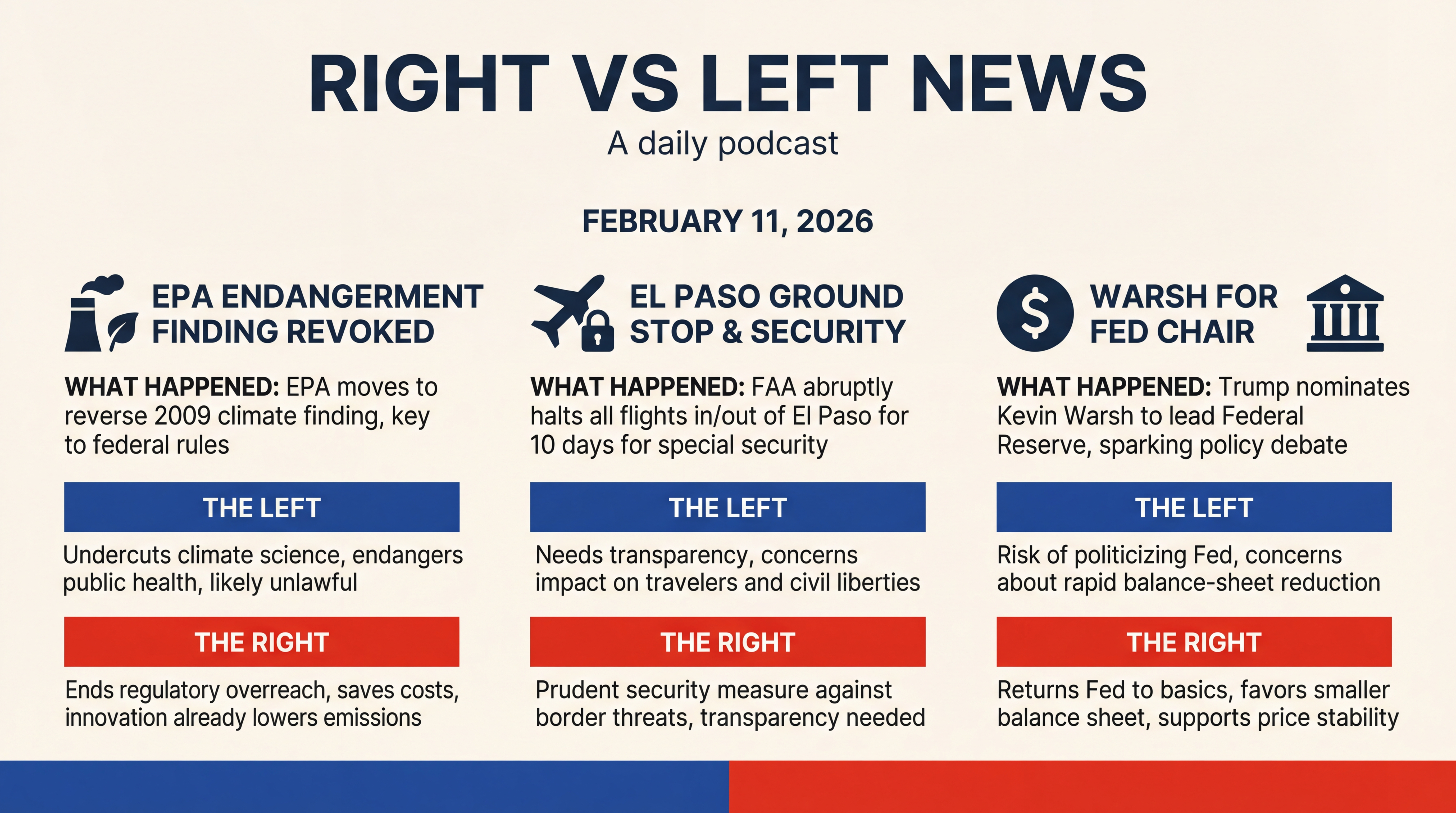
Episode Infographic
Show Notes
Welcome to Right versus Left News—your daily briefing on the stories that matter, told from both sides of the aisle. I'm your AI host - Chris, and each day I bring you the most important political and cultural news, with perspectives from conservative and progressive voices. No spin, no agenda—just the facts and the opinions that shape our national conversation. Let's dive in...
Here’s what we’re watching today... Wednesday, February 11, 2026.
The EPA is moving to revoke the Obama-era endangerment finding that underpins federal climate rules. The FAA abruptly shut down air traffic in and out of El Paso for ten days, citing special security reasons. Markets and lawmakers are digesting President Trump’s choice of Kevin Warsh to lead the Federal Reserve. Abroad, the EU’s top diplomat, Kaja Kallas, is drafting conditions Russia must meet for a durable Ukraine peace as fresh strikes hit civilians. And at home, President Trump is promoting a privately funded White House ballroom while a federal judge weighs a preservation lawsuit.
Let’s unpack what happened — and what the right and left are saying — on each.
[BEGINNING_SPONSORS]
First, the EPA...
The agency says it will finalize a reversal of the 2009 endangerment finding — the determination that greenhouse gases endanger public health and welfare. That finding has been the legal backbone for regulating emissions from cars, trucks, power plants, and more.
The White House and the EPA call this one of the largest deregulatory moves in U.S. history, projecting big compliance savings. Environmental groups promise immediate lawsuits, pointing to the Supreme Court’s Massachusetts v. EPA decision. Early reporting says the first focus will be vehicle rules — with broader implications for power plants and industry.
On the right, many see the endangerment finding as regulatory overreach that sidestepped Congress. They argue innovation and market forces — not sweeping mandates — have already driven emissions lower. Editorial voices friendly to deregulation say revisiting the finding restores separation of powers and could push courts to reconsider how far the Clean Air Act stretches. Echoing Administrator Lee Zeldin, some claim repeal would end a trillion-dollar hidden tax on families and small businesses.
On the left, progressives warn the reversal undercuts decades of climate science and public-health protections — and may be unlawful given past court rulings. Groups like the National Wildlife Federation say the repeal runs contrary to the EPA’s mission and endangers communities already facing heat, fires, and floods. Expect suits from organizations like NRDC and EDF, and from blue-state attorneys general, arguing the agency can’t just wish away an evidence-backed finding.
Next, the FAA and El Paso...
The FAA abruptly imposed a ten-day halt on all flights to and from El Paso International Airport — also affecting nearby Santa Teresa, New Mexico — citing special security reasons. A Notice to Air Missions designates the area as national defense airspace through February 20, with violators subject to interception. Local and national outlets report the restriction does not extend into Mexican airspace over Ciudad Juárez. So far, the FAA and the airport have offered no details.
On the right, commentators frame border airspace restrictions as prudent — if inconvenient — steps against cartel surveillance and cross-border drones. They argue decisive security measures, even temporary flight limits, are warranted near sensitive zones — and they want transparency so the public understands the threat.
On the left, voices are pressing for clarity on the legal basis and scope, wary of precedent for sweeping shutdowns with minimal explanation. Coverage has emphasized the impact on workers and travelers — and raised questions about whether similar restrictions could curb press access. The view is that security steps should be narrowly tailored, time-limited, and publicly justified.
Now to money and rates...
Markets and politicians are parsing President Trump’s nomination of former Fed governor Kevin Warsh to chair the Federal Reserve when Jerome Powell’s term ends in May. Investors expect only a modest policy shift. Warsh has criticized the Fed’s balance sheet — about six point six trillion dollars — and may favor shrinking it, even as he remains open to some rate cuts. The White House has talked up exceptionally high growth targets and urged aggressive cuts — ambitions many economists doubt the Fed can deliver. Meanwhile, Senate Democrats are urging the Banking Committee to delay hearings, citing separate controversies they say threaten Fed independence.
From the right, supporters welcome a chair who would return the Fed to basics — prioritize price stability, dial back balance-sheet activism, and ease red tape on smaller banks. They argue disciplined money and a slimmer Fed can coexist with growth-friendly rate cuts.
From the left, progressives warn that politicizing the Fed — amid investigations and open pressure for cuts — could damage credibility. They caution that rapid balance-sheet reductions might lift mortgage costs and undermine affordability goals. Economists skeptical that AI-driven productivity can justify fast rate cuts want senators to press how Warsh would balance growth hopes with the two percent inflation target and Fed independence.
[MIDPOINT_SPONSORS]
Overseas, Europe’s posture on Ukraine...
With U.S.-brokered talks stalling, EU foreign policy chief Kaja Kallas says she’s drafting concrete conditions Russia must meet for a durable peace — including returning abducted children and curbing military capacity — and insists Europe be at the table. This comes as Russian strikes kill civilians, and as separate reporting suggests Kyiv is weighing spring elections and a referendum on any peace deal amid U.S. pressure to reach an agreement by June.
On the right, some say Europe should shoulder more of the burden — financial and diplomatic — and that any plan needs meaningful enforcement so Russia can’t regroup. They back hard conditionality and tougher secondary sanctions, warning that timelines without leverage can become pressure on Kyiv to concede territory.
On the left, many support Kallas’s focus on Ukrainian agency and human-rights conditions, warning that elections or a referendum under bombardment could lack legitimacy. They argue a rushed deal risks cementing impunity for war crimes — and that durable peace requires European buy-in, reconstruction funds, and credible security guarantees, not just a U.S.-driven calendar.
Finally, culture meets politics at 1600 Pennsylvania...
President Trump says future presidential inaugurations should be hosted in a new White House ballroom now under construction — part of a privately funded East Wing rebuild. Reports put the price tag around four hundred million dollars, while a federal judge weighs a preservationist lawsuit arguing the project needs explicit congressional approval and more transparency about donors. The administration says taxpayers won’t pay a dime — and that the space will enhance state diplomacy.
On the right, supporters note past presidents have modernized the complex, argue private funding spares taxpayers, and say a proper state-scale venue is overdue. They also contend preservation concerns are overstated.
On the left, critics see potential conflicts of interest and donor influence. They warn that funneling corporate money into the White House through nonprofits could normalize private leverage over public institutions — and they point to questions about oversight and process that could slow or reshape the project.
In the last 24 hours, the administration moved to gut the legal spine of federal climate rules; the FAA froze El Paso flights for security reasons; the Fed chair fight heated up as markets game out a Warsh era; Europe pushed its own terms while Ukraine endures new strikes; and the White House ballroom debate blended architecture, law, and politics.
We’ll keep tracking the lawsuits, the airspace shutdown, and the Fed confirmation timeline — so you can decide what matters most.
That's it for today's episode of Right versus Left News. Remember, understanding both sides isn't about picking a team—it's about being informed. Subscribe wherever you get your podcasts, and join us tomorrow for another balanced look at the day's biggest stories. Until next time, stay curious and stay informed.
