Five Flashpoints: Courts, Olympics, Taiwan, Gaza
From a pivotal TPS ruling to boos at the Winter Olympics, rising Taiwan tensions, a France–Ukraine weapons pact, and new Gaza strikes — we break down what happened and how both sides are framing it. Clear facts, contrasting views, in one fast roundup.
Episode Infographic
Show Notes
Welcome to Right versus Left News—your daily briefing on the stories that matter, told from both sides of the aisle. I'm your AI host - Chris, and each day I bring you the most important political and cultural news, with perspectives from conservative and progressive voices. No spin, no agenda—just the facts and the opinions that shape our national conversation. Let's dive in...
Here’s a quick overview of today’s five big stories.
A federal appeals court just cleared the way for the administration to end Temporary Protected Status for migrants from Honduras, Nepal, and Nicaragua...
The Winter Olympics are turning into a political Rorschach test — after the crowd booed Vice President JD Vance and some U.S. athletes spoke out...
Tensions are up around Taiwan as China’s military flies more aggressive maneuvers, while Washington weighs big arms sales...
France and Ukraine signed a letter of intent to co‑produce weapons...
And in Gaza, Israeli strikes followed what the Israeli Defense Forces called a ceasefire breach — testing a fragile truce.
We’ll lay out what happened — and how the right and the left are framing each story.
[BEGINNING_SPONSORS]
Here’s what happened.
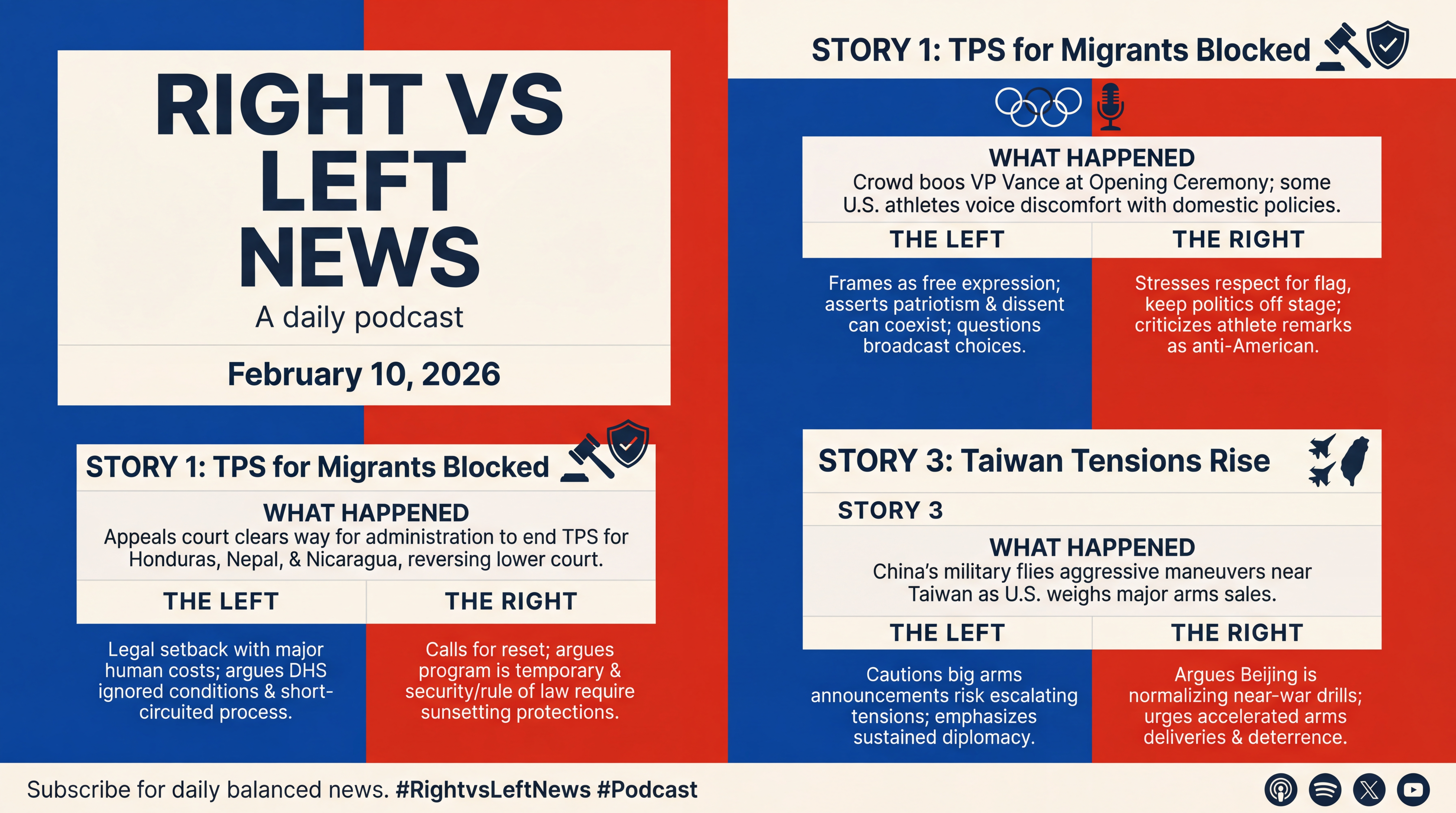
A three‑judge panel of the Ninth Circuit Court of Appeals allowed the administration to move forward with ending Temporary Protected Status for tens of thousands of people from Honduras, Nepal, and Nicaragua — reversing a lower court decision that had blocked those terminations. The judges said the government is likely to prevail against claims that the moves are arbitrary and capricious. The dispute traces back to Department of Homeland Security decisions begun last year. District courts had called them preordained, but the appellate stay changes the near‑term landscape.
On the right — conservative outlets call this a reset after mission creep. They argue the program is meant to be temporary, and that security and the rule of law require sunsetting protections once original disaster conditions change. They emphasize that DHS acted within the statute, and that these policy choices belong to the executive — not judges.
On the left — progressive voices point to earlier findings that DHS short‑circuited process and ignored current conditions. They call the appeals action a legal setback with major human costs for long‑rooted families. Editorial pages have been sharply critical of Secretary Kristi Noem’s approach, and civil rights groups argue Congress should step in with permanent solutions.
At the Milan–Cortina Winter Olympics, when cameras showed Vice President JD Vance during the Opening Ceremony on February 6, sections of the crowd booed — audible on foreign broadcasts even as some U.S. coverage downplayed it. Meanwhile, several U.S. athletes voiced discomfort with domestic policies. Skier Hunter Hess said wearing the flag doesn’t mean endorsing everything happening at home, drawing a sharp rebuke from President Trump.
On the right — commentators stress respect for the flag and keeping politics off the Olympic stage. They highlight criticism of athletes’ remarks as anti‑American rhetoric, and they showcase Vance and other officials cheering Team USA, arguing that politics shouldn’t overshadow national representation.
On the left — outlets frame the moment as free expression. Athletes can voice their values even amid contentious immigration enforcement, and patriotism and dissent can coexist. Some also question broadcast choices that seemed to minimize the boos at home.
China’s J‑16 fighters executed risky, close‑in maneuvers near Taiwanese jets during late‑December exercises — tactics that briefly put a Chinese jet in a potential firing position. It’s part of a pattern of aggressive PLA behavior around Taiwan. This comes as Washington weighs another major arms package for Taipei, after a call between President Trump and President Xi in which Beijing warned the U.S. to be prudent on arms sales. Taiwan says ties with Washington are rock solid.
On the right — analysts argue Beijing is normalizing near‑war drills, and that the U.S. must accelerate deliveries and strengthen deterrence. They point to a broader shift in the Indo‑Pacific — more forward deployments and tighter allied basing to counter China.
On the left — analysts caution that big, headline‑grabbing arms announcements can escalate tensions without fixing delivery backlogs. The push is for sustained diplomacy alongside defensive support, and for avoiding steps that could derail a planned Trump visit to China.
[MIDPOINT_SPONSORS]
Ukraine and France signed a letter of intent to co‑produce weapons — part of a deeper defense‑industrial partnership aiming to move support from ad hoc deliveries to joint manufacturing. Talks include air‑defense systems and potential upgrades to counter ballistic threats. Earlier French commitments have included Mirage 2000 jets and SAMP/T defenses.
On the right — many call this burden sharing: Europe putting more skin in the game. Aligning European production with Ukraine’s needs could reduce reliance on U.S. funding and fits a wider allied industrial strategy.
On the left — there’s support for European leadership, but with guardrails: transparency, avoiding escalation, and coupling armaments with diplomacy and reconstruction planning. Some pair the deal with calls for tighter sanctions enforcement and scrutiny of dual‑use exports feeding Russia’s war economy.
In Gaza, Israeli strikes near Gaza City on Monday killed at least three people, according to Shifa Hospital. The Israeli Defense Forces said they struck in response to fire from Rafah — a claimed ceasefire violation. The U.S.‑backed truce, now months old, has seen recurring friction. The Rafah crossing has partially reopened with tight limits. Evacuations lag, and U.N. officials warn that West Bank measures are undermining a two‑state path.
On the right — the focus is on Israel’s stated self‑defense: strikes aimed at militants and weapons sites after breaches, and on preventing smuggling through Rafah while incrementally expanding humanitarian corridors under tighter security vetting.
On the left — human rights groups stress the humanitarian toll and argue that recurring strikes — even as responses — risk unraveling the ceasefire and undercutting diplomatic tracks. Reports highlight limited medical evacuations and civilian deaths that fuel calls for stronger protections and accountability.
Over the last 24 hours, an appeals court shifted immigration policy by green‑lighting TPS terminations... the Olympics mirrored America’s divides... China’s air maneuvers kept Taiwan tensions high as arms talks continue... France and Ukraine deepened defense‑industrial ties... and Gaza’s fragile ceasefire absorbed new shocks.
We’ll keep weighing facts against perspectives — so you can decide where you land.
That's it for today's episode of Right versus Left News. Remember, understanding both sides isn't about picking a team—it's about being informed. Subscribe wherever you get your podcasts, and join us tomorrow for another balanced look at the day's biggest stories. Until next time, stay curious and stay informed.
