
Maxwell Deposition, Measles Surge, Congress in Motion
Ghislaine Maxwell’s House deposition, a fast-rising measles outbreak, and two security-focused bills on undersea cables and less-lethal policing — plus Iran’s internal crackdown amid quiet U.S.-Iran contacts. A concise, balanced look at what to watch over the next 24 hours.
Episode Infographic
Show Notes
Welcome to Right versus Left News—your daily briefing on the stories that matter, told from both sides of the aisle. I'm your AI host - Chris, and each day I bring you the most important political and cultural news, with perspectives from conservative and progressive voices. No spin, no agenda—just the facts and the opinions that shape our national conversation. Let's dive in...
It’s Monday, February 9, 2026, and here’s what we’re watching over the next 24 hours.
Congress is moving on two security-tinged bills — protecting undersea internet cables and redefining how police use less-lethal tools. Health officials are sounding the alarm as measles cases climb across multiple states. On Capitol Hill, a high-profile deposition: Ghislaine Maxwell appears before the House Oversight Committee in its Epstein probe. Overseas, Iran’s security services have detained several prominent reformists even as U.S.-Iran contacts continue… setting the week’s political tone.
[BEGINNING_SPONSORS]
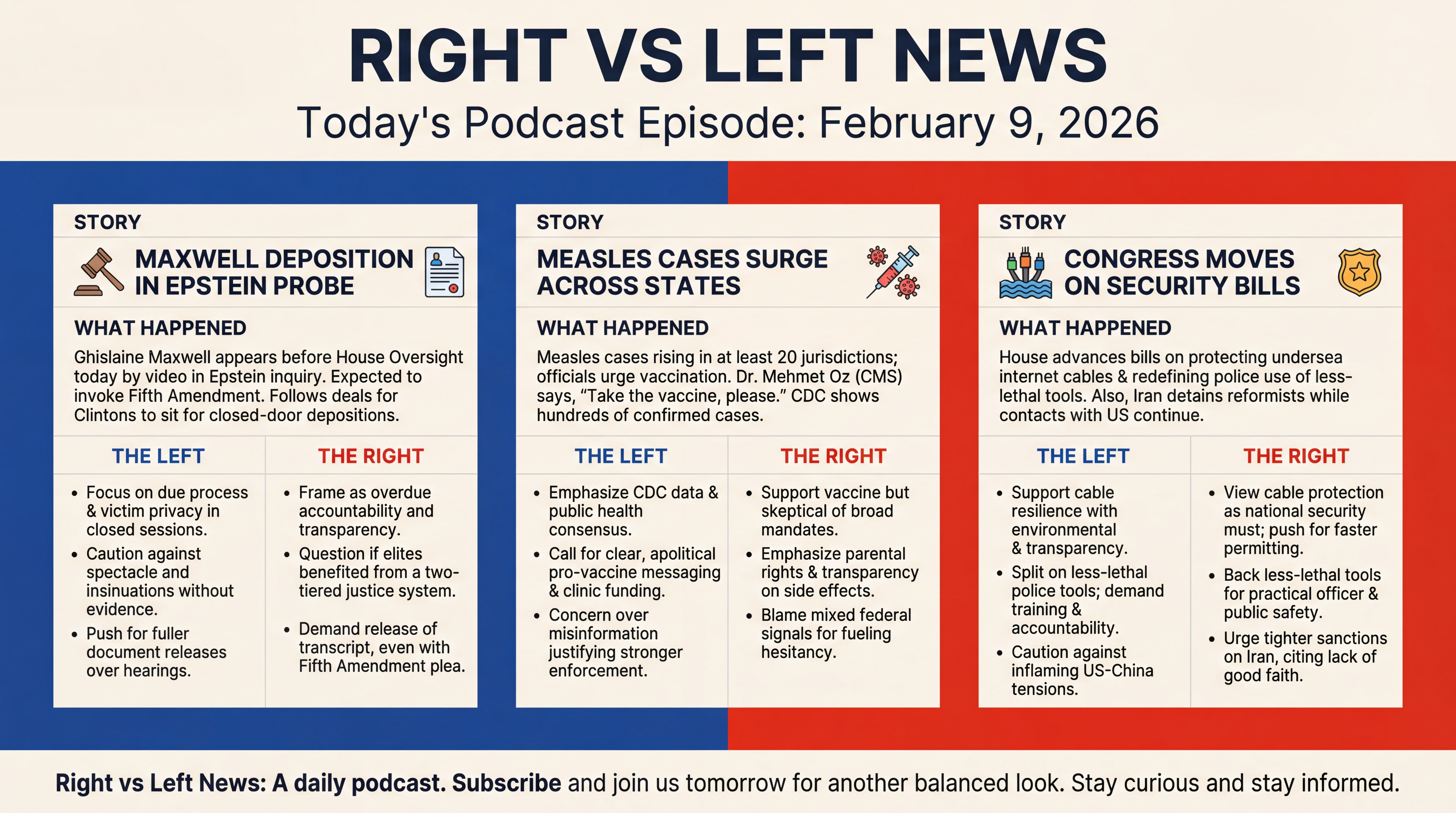
House Oversight Chair James Comer says the committee is deposing Ghislaine Maxwell today by video as part of Congress’s broader Epstein inquiry. Maxwell’s attorneys have signaled she’ll invoke the Fifth Amendment, and members in both parties expect limited answers. The session follows recent deals for Bill and Hillary Clinton to sit for closed-door depositions later this month. Fox News and Axios first reported today’s plan, and The Washington Post reported the Clintons’ agreement.
On the right, conservative outlets frame this as overdue accountability — arguing the public deserves transparency on how Epstein operated and whether elites benefited from a two-tiered justice system. Some also say Comer shouldn’t grant immunity and should release as much of the transcript as possible, even if Maxwell pleads the Fifth.
On the left, progressives highlight due process concerns and warn against spectacle. Democrats point to negotiated, closed-door sessions as a way to protect victims’ privacy while preserving the probe’s integrity. Left-leaning commentators caution against insinuations absent new evidence and press the Justice Department for fuller document releases rather than personality-driven hearings.
With measles cases rising across at least 20 jurisdictions, federal officials and medical voices urged vaccination over the weekend. Dr. Mehmet Oz — now head of the Centers for Medicare and Medicaid Services — said, 'Take the vaccine, please,' as state health departments report clusters in places like South Carolina and Utah. The CDC’s latest update shows hundreds of confirmed U.S. cases so far this year, and the Pan American Health Organization has warned the Americas risk losing elimination status without urgent action.
On the right, you’ll hear support for the measles vaccine itself paired with skepticism of broad mandates — emphasizing parental rights, transparency about side effects, and concern that politicized messaging undermines trust built by local doctors. Some conservatives also fault mixed signals from federal leaders for fueling hesitancy.
On the left, voices point to CDC data and public health consensus — arguing leaders must deliver a clear, apolitical pro-vaccine message and quickly resource community clinics. They stress that falling kindergarten MMR coverage and online misinformation, left unchecked, could justify stronger school immunization enforcement.
The House Rules Committee meets this afternoon to set floor debate on House Bill 261, the Undersea Cable Protection Act. The bill would tighten permitting and resilience measures for telecom cables that carry the vast majority of global data. Lawmakers cite suspected sabotage and gray-zone activity near Taiwan and in the Baltic, as well as U.S. warnings about Chinese-linked repair fleets.
On the right, conservatives and security hawks call this a national security must — pushing for faster permitting, more domestic repair capacity, and penalties for foreign interference.
On the left, progressive analysts generally support resilience but want strong environmental safeguards around marine sanctuaries, transparency on private-sector cost sharing, and guardrails against over-classification that could stifle oversight. They also caution against inflaming U.S.-China tensions without allied coordination.
[MIDPOINT_SPONSORS]
Also on the House Rules docket: House Bill 2189, the Law-Enforcement Innovate to De-Escalate Act. The measure would update federal firearms definitions to exempt specified less-lethal projectile devices and set up a Justice Department pathway to review those tools — part of a broader push to reduce fatal encounters while modernizing statutes written for older technologies. The Judiciary Committee reported the bill late last month.
On the right, many conservatives back expanding access to less-lethal options and clarifying federal law so departments aren’t deterred by legal ambiguity. They argue officers need practical tools that protect the public and police alike — and that reducing lethal force doesn’t require new federal mandates on local policing.
On the left, progressives are split. Some civil-rights advocates support clearer standards if paired with training, data reporting, and strict accountability for misuse; others worry 'less-lethal' labels can mask serious injuries without addressing root causes like biased stops. Expect pushes for reporting requirements, independent review of deployments, and community oversight to accompany any expansion.
Iran’s Revolutionary Guards detained several prominent reformist figures tied to President Masoud Pezeshkian, even as Tehran signals it will keep talking with Washington. The arrests — amid an ongoing internet crackdown and a recent U.N. human-rights rebuke — underscore tensions inside Iran’s power structure during tentative diplomatic contacts.
On the right, commentators argue the arrests show Tehran isn’t negotiating in good faith — urging tighter sanctions enforcement, targeting the shadow fleet moving Iranian oil, and avoiding concessions until verifiable behavior changes occur.
On the left, voices caution that repression inside Iran is real — but say U.S. diplomacy can still reduce nuclear and regional risks if paired with human-rights pressure and multilateral coordination. They favor safeguarding protesters, expanding internet access tools, and sequencing any sanctions relief to concrete steps… verifiable curbs on enrichment and de-escalation by all sides.
Quick recap: today’s spotlight is split between Congress and crises — a high-profile Maxwell deposition; urgent measles warnings and vaccine messaging; House action on undersea cable and less-lethal policing bills; and Iran’s internal crackdown shadowing delicate talks. We’ll keep tracking votes at the House Rules Committee this afternoon, and any readouts from the Oversight deposition… stay tuned.
That's it for today's episode of Right versus Left News. Remember, understanding both sides isn't about picking a team—it's about being informed. Subscribe wherever you get your podcasts, and join us tomorrow for another balanced look at the day's biggest stories. Until next time, stay curious and stay informed.
