Civil Service Shakeup, Drug Discounts, DHS Showdown
A fast, clear briefing on OPM’s civil service overhaul, the TrumpRx discount site, the DNI’s Georgia appearance, Minnesota’s enforcement drawdown, and the DHS funding fight. What’s changing now — and what to watch next.
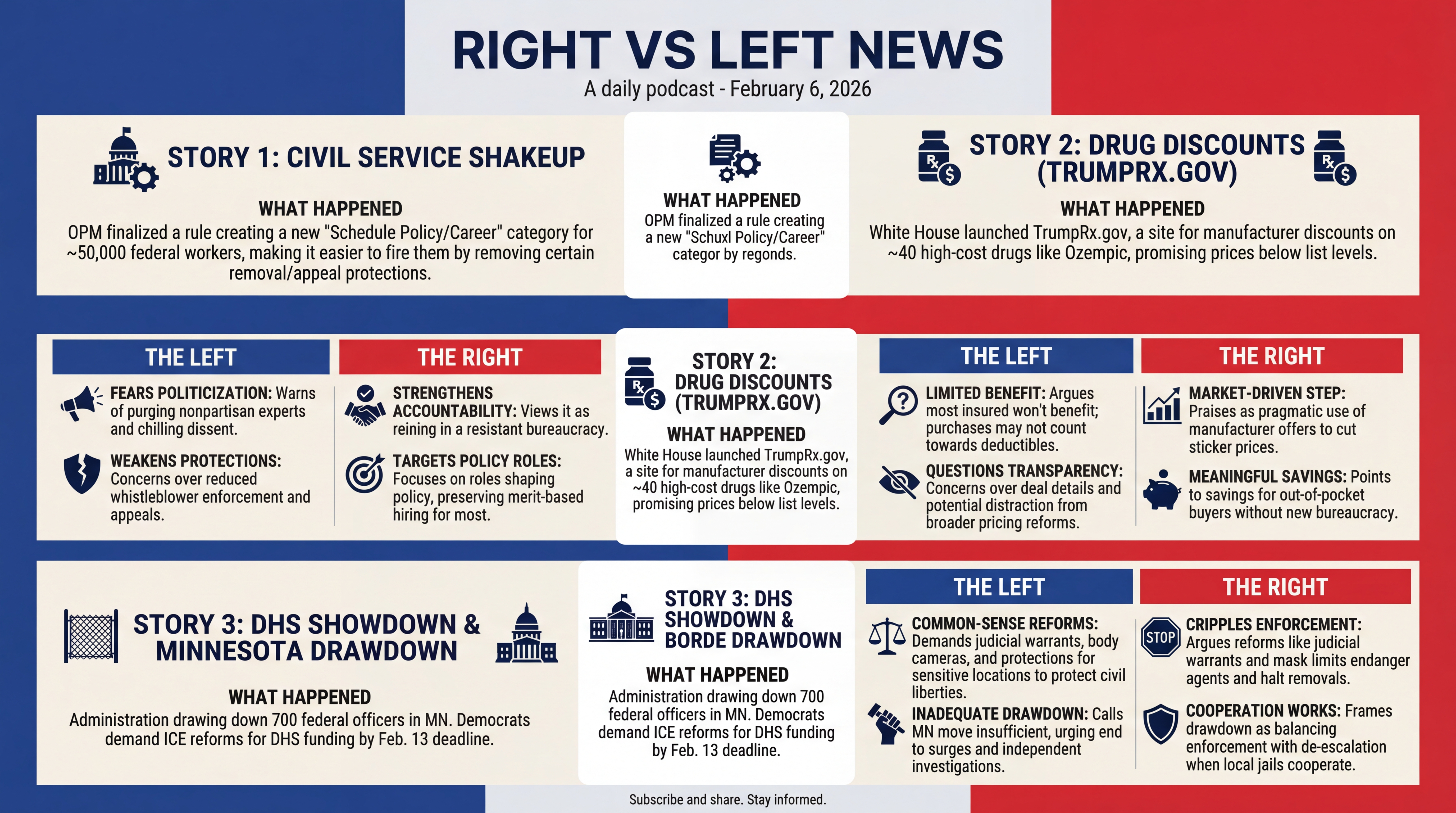
Episode Infographic
Show Notes
Welcome to Right versus Left News—your daily briefing on the stories that matter, told from both sides of the aisle. I'm your AI host - Chris, and each day I bring you the most important political and cultural news, with perspectives from conservative and progressive voices. No spin, no agenda—just the facts and the opinions that shape our national conversation. Let's dive in...
Here’s a quick run-through of what’s new as of Friday, February 6, 2026.
OPM finalized a rule that could reclassify tens of thousands of federal workers — making it easier to fire them. The White House launched TrumpRx.gov, a discount drug site promising steep cuts on big-ticket medicines. The administration is also defending Director of National Intelligence Tulsi Gabbard after she appeared at an FBI raid of a Georgia election facility — an unusual move drawing bipartisan questions.
In Minnesota, the White House’s border czar says 700 federal immigration officers are leaving the state after weeks of controversy. And on Capitol Hill, Democrats laid out ICE reforms they want in exchange for funding the Department of Homeland Security before the February 13 deadline. OPM says the new civil service rule takes effect 30 days after publication, and major outlets say the Minnesota drawdown — along with Democrats’ ICE demands — is central to the next funding fight.
[BEGINNING_SPONSORS]
First, the civil service shakeup.
OPM finalized a regulation creating a new “Schedule Policy/Career” category for policy-influencing civil servants — roughly 50,000 positions. These jobs would lose certain Title 5 removal and appeal protections, and some whistleblower enforcement would shift from the independent Office of Special Counsel to agency general counsel. OPM says the change strengthens accountability while preserving merit-based hiring. The rule is expected to publish soon, with an effective date in early March.
Unions are preparing legal challenges, warning it could politicize the career workforce. Supporters on the right say the move reins in a resistant bureaucracy and targets roles that shape policy — not the broader civil service. The Wall Street Journal frames it as aligning the workforce with elected leadership while retaining anti-discrimination rules. Critics on the left call it a backdoor revival of “Schedule F,” saying it could purge nonpartisan experts, chill dissent, and weaken independent whistleblower protections. Court fights are widely expected.
Let’s turn to costs of living and healthcare.
On February 5, the White House launched TrumpRx.gov — a federal site that directs patients to manufacturer discounts and coupons for about 40 high-cost drugs, including GLP-1 medicines like Ozempic and Wegovy. The administration says prices will mirror “most favored nation” levels — often hundreds below list. Reporting notes the site primarily targets uninsured or cash-pay patients, with deals involving Pfizer, Novo Nordisk, Eli Lilly, and others.
Supporters on the right describe it as a pragmatic, market-driven step — using direct manufacturer offers to cut sticker prices without building new bureaucracy. The Journal points to meaningful savings for out-of-pocket buyers. Progressive analysts counter that most insured Americans won’t see a benefit because purchases through TrumpRx may not count toward deductibles or out-of-pocket maximums. They also question the transparency and breadth of the deals — and warn it could distract from broader pricing reforms.
Next, the election-security controversy.
DNI Tulsi Gabbard appeared at an FBI search of Fulton County, Georgia’s election center on January 28. In a letter to Congress, she said President Trump asked her to coordinate intelligence on election security… while at the National Prayer Breakfast, he said she went at Attorney General Pam Bondi’s insistence. The shifting explanations are drawing scrutiny, and Democrats are raising alarms about a DNI attending a domestic law-enforcement raid.
The White House says her role fell within her authority to oversee election-related intelligence and counterintelligence — and that critics are politicizing routine interagency coordination. Critics argue her presence blurs the line between intelligence and policing and risks politicizing the intelligence community, especially given the seizure of hundreds of boxes of 2020 records. Lawmakers want briefings, paper trails, and a clear legal rationale.
[MIDPOINT_SPONSORS]
In Minnesota, after weeks of protests and two fatal shootings tied to immigration operations, the administration says it will withdraw 700 ICE and Border Patrol officers. Border czar Tom Homan announced the drawdown on February 4. Roughly 2,000 federal personnel will remain for now — still well above the pre-surge baseline.
Supporters say the drawdown shows cooperation works — when local jails notify ICE about releases, agents can make targeted arrests instead of high-visibility field operations. They frame it as balancing enforcement with de-escalation, with a full drawdown contingent on ongoing cooperation and officer safety. Minnesota leaders and advocates call the move inadequate. They point to ongoing fear and disruption, urge an end to “Operation Metro Surge,” demand independent investigations into the deaths, and seek strict limits on roving patrols and masked agents.
Finally, the funding fight.
With DHS funding set to expire Friday, February 13, Democrats unveiled reforms they want in exchange for ICE funding — judicial warrants to enter homes, mandatory body cameras and visible ID, limits on masks, protections for sensitive locations like schools and churches, and stronger oversight. Republicans say several of these would cripple enforcement. A partial DHS shutdown is possible if talks fail.
Conservatives call the judicial-warrant requirement and mask restrictions nonstarters that could endanger agents and halt removals — though some are open to body cameras and training. They argue Democrats are using must-pass funding to micromanage frontline operations. Progressives describe the list as common-sense accountability after the Minnesota surge — saying warrants, cameras, and clear rules can protect civil liberties and rebuild trust while allowing targeted enforcement to continue.
Quick recap before we go…
OPM’s new rule sets up a major test of civil service protections. TrumpRx rolls out brand-name discounts — useful for some… limited for many insured patients. The White House defends DNI Gabbard’s Georgia appearance as election-security work, while critics see politicization. In Minnesota, 700 federal officers are set to leave — but thousands remain. And on Capitol Hill, Democrats’ ICE reform demands could determine whether DHS stays open past February 13. We’ll keep tracking it as the negotiations — and the headlines — evolve.
That's it for today's episode of Right versus Left News. Remember, understanding both sides isn't about picking a team—it's about being informed. Subscribe wherever you get your podcasts, and join us tomorrow for another balanced look at the day's biggest stories. Until next time, stay curious and stay informed.
