Treaties Lapse, Talks Reset, Tariffs Loom
From the end of New START to renewed U.S.-Iran talks and Europe’s pushback on Greenland-linked tariff threats, we break down the day’s biggest moves. Plus, Senate confirmations and NBC’s sports mega month where ads, politics, and spectacle collide.
Episode Infographic
Show Notes
Welcome to Right versus Left News—your daily briefing on the stories that matter, told from both sides of the aisle. I'm your AI host - Chris, and each day I bring you the most important political and cultural news, with perspectives from conservative and progressive voices. No spin, no agenda—just the facts and the opinions that shape our national conversation. Let's dive in...
Here’s your quick rundown for Thursday, February 5, 2026.
The last U.S.-Russia nuclear arms treaty expires today, raising fears of a new arms race.
U.S.-Iran nuclear talks are back on for Friday after venue drama, and oil prices popped on the uncertainty.
The Senate is poised to confirm two district judges.
Europe is sharpening its response to tariff threats tied to Greenland.
And NBC says a Legendary February is here — Olympics, Super Bowl, NBA All-Star — an ad and influence bonanza with political overtones.
Let’s get into it…
[BEGINNING_SPONSORS]
First up, the New START Treaty — the last limit on U.S. and Russian deployed strategic nuclear warheads — expires today.
Moscow says it will keep observing the treaty’s numbers for one more year if Washington does the same… and the Kremlin reiterated this week that the offer still stands. Arms-control groups warn the expiration is a serious inflection point, especially with verification largely suspended since 2020. Analysts at the Center for Strategic and International Studies flag the risks of a post New START world, and the Arms Control Association is urging both sides to freeze forces while negotiating a successor. Russian state media says the offer remains open, and U.S. officials haven’t announced a formal reply.
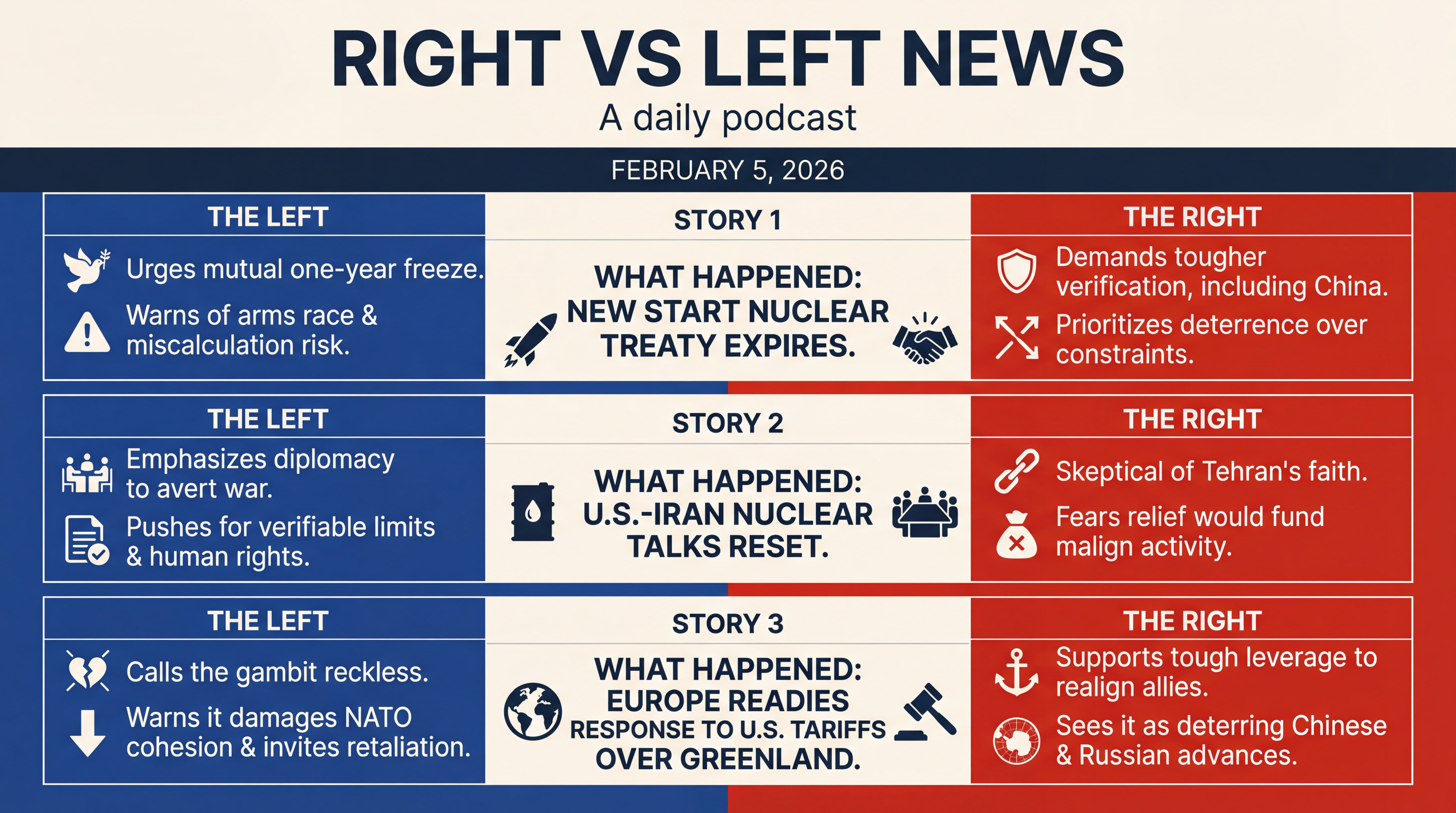
On the right, national-security hawks argue the U.S. shouldn’t lock itself into constraints while Russia — and China — build up. Expect a focus on deterrence and leverage. They point to Russia’s suspension of inspections since 2023 and say any new deal needs tougher verification — ideally including China’s arsenal — and a harder line on NATO burden-sharing.
On the left, arms-control voices warn that letting New START lapse raises the risk of miscalculation, accelerates a costly arms race, and erodes transparency. They’re urging a mutual one-year pledge to keep the limits, restore data exchanges, and launch talks on a successor that also covers new tech and non-strategic weapons.
Meanwhile, U.S.-Iran nuclear talks are slated for Friday, reportedly in Muscat, Oman, after a day of wrangling over the venue and format. Conflicting signals — Istanbul or a bilateral in Oman — spooked energy markets; crude jumped roughly three to four percent on Wednesday before settling. The reset comes amid Iran’s protests and crackdowns, U.S. carrier deployments, and a delicate back-channel push to de-escalate.
On the right, skepticism runs high that Tehran negotiates in good faith, with warnings that sanctions relief — explicit or de facto — would bankroll malign activity. They argue the pressure campaign is working, and that keeping Iran at the table without up-front concessions is the right stance.
On the left, progressives emphasize diplomacy to avert war, pushing for verifiable limits on enrichment and human-rights benchmarks. They also caution that messaging whiplash — threats one day, talks the next — adds volatility that hits consumers at the pump and complicates allied coordination.
Back at home, the Senate plans votes today to confirm Brian Charles Lea to the U.S. District Court in West Tennessee and Justin R. Olson to the Southern District of Indiana. The first vote is around 11:30 a.m. Eastern, with a second expected mid-afternoon. It’s part of a steady cadence of lower-court confirmations in a polarized era when courts arbitrate big policy fights.
On the right, conservatives frame the confirmations as a counterbalance to progressive legal activism — prioritizing textualist judges and a faster Senate process after years of procedural holdups. They argue that lifetime appointees who hew closely to statute and the Constitution help stabilize governance.
On the left, progressives warn that rushed confirmations can entrench ideological hardliners for decades, elevating the judiciary’s role in issues — from immigration to labor and voting rights — that Congress hasn’t resolved. They call for more vetting and balance, noting how confirmation warfare has consumed Senate bandwidth.
[MIDPOINT_SPONSORS]
Overseas, Europe is bristling at President Trump’s tariff threats against eight NATO allies unless Denmark agrees to a U.S. purchase of Greenland. European Union diplomats have weighed potential retaliation tools — including the anti-coercion instrument — while urging de-escalation ahead of a February 6 decision point. Allies are condemning what they call blackmail and warning of a downward spiral for transatlantic unity. London has also signaled opposition to a trade war among friends.
On the right, supporters say tough leverage — tariffs, defense burden-sharing, and resource access — can realign allies to U.S. priorities in the Arctic and deter Chinese and Russian advances. They point to past EU trade spats that ended in deals once Europe recognized U.S. resolve.
On the left, progressives call the Greenland gambit reckless — damaging NATO cohesion, inviting EU retaliation that could hit U.S. consumers, and undermining climate and security cooperation. They argue that diplomatic investment — not tariff brinkmanship — is the way to build Arctic security.
Finally, NBCUniversal is touting a Legendary February — with the Winter Olympics opening Friday, the Super Bowl on Sunday, and the NBA All-Star Game next week — seventeen days of wall-to-wall spectacle. Ad inventory is largely sold out across TV and Peacock, with brands buying cross-event packages for reach. It’s a real-time test of how sports, streaming, and politics intersect — think campaign-year image ads, issue advocacy, and corporate messaging reaching tens of millions.
On the right, some applaud NBC’s market flex and the shift to live sports — content that’s resilient to cord-cutting. Others will watch for perceived ideological slants in coverage or advertising during culturally charged moments.
On the left, progressives see both opportunity and risk — broad platforms for pro-democracy and voting-rights messages, but also concern about media consolidation and paywalls that limit access to civic information. Expect calls for responsible ad standards during high-audience events.
Quick recap… New START expires today with calls for a one-year mutual freeze. U.S.-Iran talks get a Friday reset as oil wobbles. The Senate advances two trial-court judges. Europe readies responses to U.S. tariff threats over Greenland. And NBC’s mega month shows how sports, business, and politics collide.
We’ll keep tracking the outcomes — and the spin from both right and left — tomorrow.
That's it for today's episode of Right versus Left News. Remember, understanding both sides isn't about picking a team—it's about being informed. Subscribe wherever you get your podcasts, and join us tomorrow for another balanced look at the day's biggest stories. Until next time, stay curious and stay informed.
