
Courts, Cameras, Congress — and the Super Bowl
Courts hit pause on Haitian TPS, DHS orders body cams in Minneapolis, and Congress battles over sports policy and a balanced-budget push — all as the Super Bowl turns political. Here’s what happened and what to watch next.
Episode Infographic
Show Notes
Welcome to Right versus Left News—your daily briefing on the stories that matter, told from both sides of the aisle. I'm your AI host - Chris, and each day I bring you the most important political and cultural news, with perspectives from conservative and progressive voices. No spin, no agenda—just the facts and the opinions that shape our national conversation. Let's dive in...
It’s Tuesday, February 3, 2026, and here’s what we’re watching over the last 24 hours.
A federal judge blocks the administration’s plan to end deportation protections for Haitians.
Homeland Security orders body‑worn cameras for federal officers in Minneapolis after two high‑profile civilian deaths.
The House Judiciary Committee takes up a bill on transgender participation in amateur and Olympic sports — alongside a push for a balanced‑budget amendment.
And the Super Bowl becomes a flashpoint over immigration and culture — with petitions, protests, and a halftime show fight.
Let’s dive in.
[BEGINNING_SPONSORS]
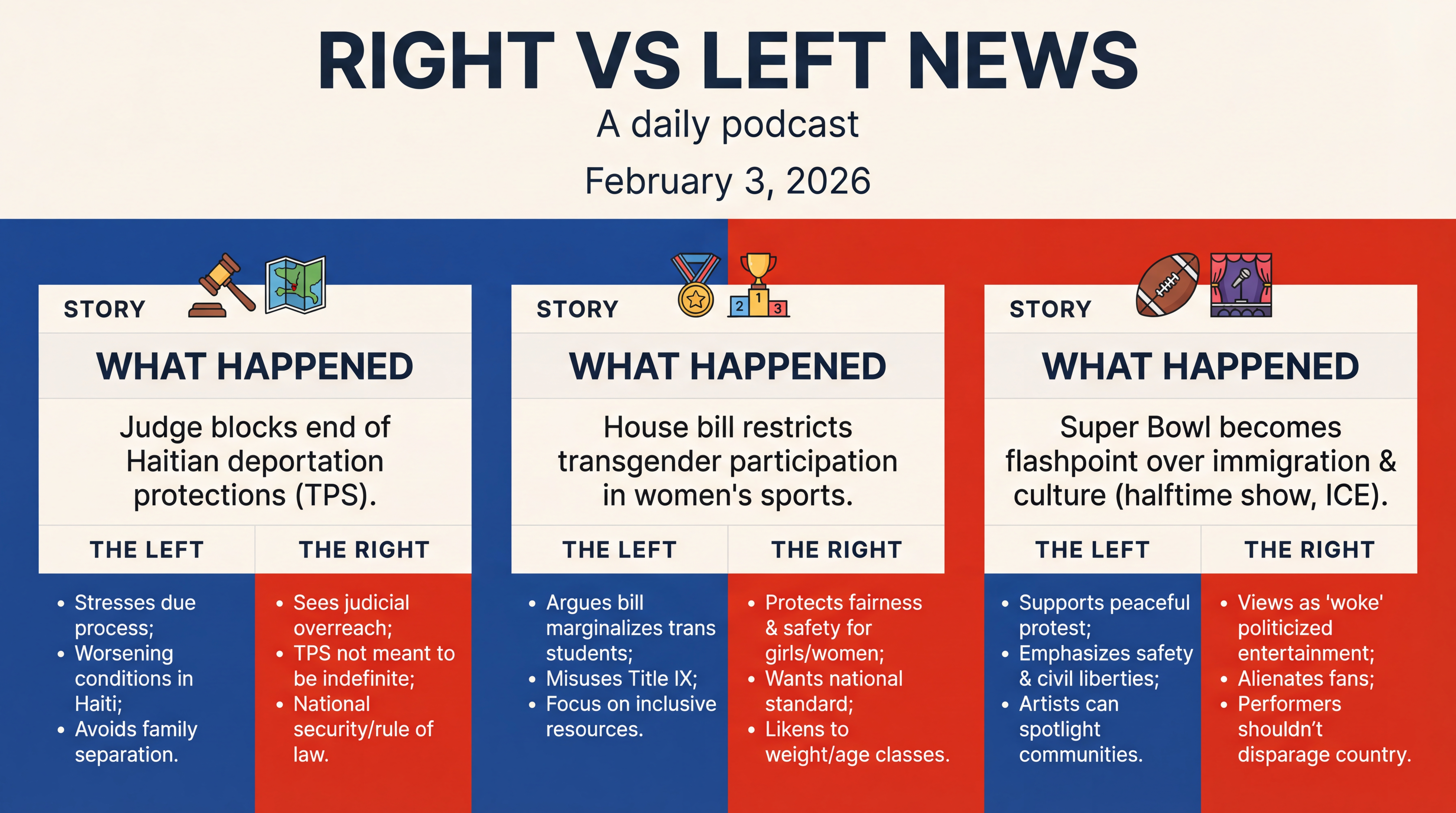
Here’s what happened... A federal judge in Washington, D.C. — Judge Ana C. Reyes — temporarily halted the administration’s move to end Temporary Protected Status for roughly 350,000 Haitians. She said the challengers are likely to prevail, and pointed to rhetoric from DHS Secretary Kristi Noem as possible evidence of bias.
The ruling, issued late February 2, pauses the rollback and lets TPS holders keep living and working in the United States while appeals play out.
On the right, many see judicial overreach that ties the executive’s hands on immigration. They argue TPS was never meant to be indefinite — and that national security and the rule of law justify ending it. Expect renewed emphasis on Congress — not judges — deciding long‑term status.
On the left, advocates stress due process and worsening conditions in Haiti. They say the court correctly checked an arbitrary policy that risked family separation and economic disruption — and they’re calling for a legislative path to convert long‑standing TPS into more durable status, rather than mass removals.
Here’s what happened... Homeland Security Secretary Kristi Noem ordered body‑worn cameras for every DHS officer operating in Minneapolis — ICE included — after two high‑profile civilian deaths. The policy takes effect immediately in the city and could expand nationally if funding is approved. The move comes amid protests, a civil‑rights probe, and debate over whether cameras should already have been standard.
On the right, many conservatives back body cams as protection for both officers and the public — evidence that can clear good officers and deter false narratives. Some see Minneapolis as a test bed before a broader rollout, and argue Democrats should help fund cameras in DHS appropriations rather than, in their view, politicizing enforcement. The Senate has included camera funding that’s now pending House action.
On the left, progressives see body cams as necessary but not sufficient. They want stronger rules on activation, public release, and discipline when footage contradicts official accounts — plus independent oversight and clear timelines for releasing video.
Here’s what happened... The House Judiciary Committee is marking up H.R. 1028 — the Protection of Women in Olympic and Amateur Sports Act. It would restrict transgender women’s participation in women’s categories in amateur and Olympic‑path sports. The markup coincides with related executive‑branch activity — including recent Education Department findings — and comes days before the Winter Olympics open. The hearing is scheduled for 10 a.m. Eastern, in Room 2141 of the Rayburn Building.
On the right, supporters say the bill protects fairness and safety for girls and women — likening sex‑based categories to weight classes or age divisions. They want a clear national standard rather than a patchwork of policies, and they highlight coaches and athletes who say they lost opportunities under current rules.
On the left, civil‑rights groups argue the bill marginalizes trans students and misuses Title IX. They note sports bodies already set sport‑specific criteria and say Congress should invest in resources and participation for all girls — including trans youth — instead of passing blanket bans.
[MIDPOINT_SPONSORS]
Here’s what happened... Also on today’s agenda, House Republicans are pushing a constitutional amendment requiring a balanced federal budget. H.J. Res. 139 is slated for Judiciary markup alongside the sports bill. The text would tie spending to recent average receipts, with supermajority carve‑outs for war or emergencies. Supporters say Washington needs a fiscal rule; skeptics warn it would force pro‑cyclical cuts during recessions.
On the right, fiscal hawks call it overdue discipline to curb debt and interest costs. They argue constitutional rules prevent politicians from kicking the can — and note that polls show broad support in principle.
On the left, budget analysts warn a balanced‑budget mandate would deepen downturns, tie Congress’s hands during crises, and risk undercutting guarantees unless supermajorities act. They favor targeted reforms — closing loopholes and pursuing long‑term tax and entitlement changes — over a rigid constitutional cap.
Here’s what happened... With Super Bowl LX this Sunday at Levi’s Stadium, politics are in the huddle. Petitions and rallies are pressuring the NFL over a possible ICE presence, and a halftime show headlined by Bad Bunny is already a proxy fight over immigration and culture. Conservative politicians have labeled it a “woke” halftime, and former President Trump says he’ll skip the game. Some on the right are elevating an alternative show backed by conservative groups.
On the right, the argument is that the NFL and its halftime choices are out of touch — politicized entertainment that alienates fans — and that the league should avoid performers who, in their view, disparage America or law enforcement.
On the left, supporters of the petition say peaceful protest is quintessentially American. They emphasize safety and civil liberties, note that ICE says it doesn’t conduct enforcement at big events, and argue artists can spotlight immigrant communities on a national stage.
Quick recap... In the past day, a judge paused the termination of Haitian TPS; DHS put body cams on Minneapolis‑based federal officers; the House weighed in on transgender participation in amateur and Olympic sports; Republicans advanced a balanced‑budget amendment; and the Super Bowl turned into a debate about ICE, culture, and who the game represents.
We’ll keep tracking votes, appeals, and any last‑minute shifts before kickoff.
That's it for today's episode of Right versus Left News. Remember, understanding both sides isn't about picking a team—it's about being informed. Subscribe wherever you get your podcasts, and join us tomorrow for another balanced look at the day's biggest stories. Until next time, stay curious and stay informed.
