
Kennedy Pause, Epstein Files, Texas Shockwave
We break down the Kennedy Center’s planned two-year pause, DOJ’s Epstein files review and the redaction backlash, a surprise Texas state Senate flip, the Southeast bomb cyclone and grid emergency, and a judge-ordered release from ICE detention. Hear what happened — and how the right and the left are interpreting it.
Episode Infographic
Show Notes
Welcome to Right versus Left News—your daily briefing on the stories that matter, told from both sides of the aisle. I'm your AI host - Chris, and each day I bring you the most important political and cultural news, with perspectives from conservative and progressive voices. No spin, no agenda—just the facts and the opinions that shape our national conversation. Let's dive in...
Here’s what we’re watching on Monday, February 2, 2026...
President Trump says the Kennedy Center will shut down entertainment operations for roughly two years starting July 4, 2026.
The Justice Department says its review of the Jeffrey Epstein files is over — even as reporting shows some victims’ names slipped through redactions.
Democrats notch a surprise flip of a Texas state Senate seat that Trump carried by double digits.
A bomb cyclone slams the Southeast, and the Energy Department activates emergency grid powers.
And a federal judge orders a five-year-old and his father freed from ICE custody.
We’ll lay out what happened... then what the right and the left are saying.
[BEGINNING_SPONSORS]
First up, the Kennedy Center closure.
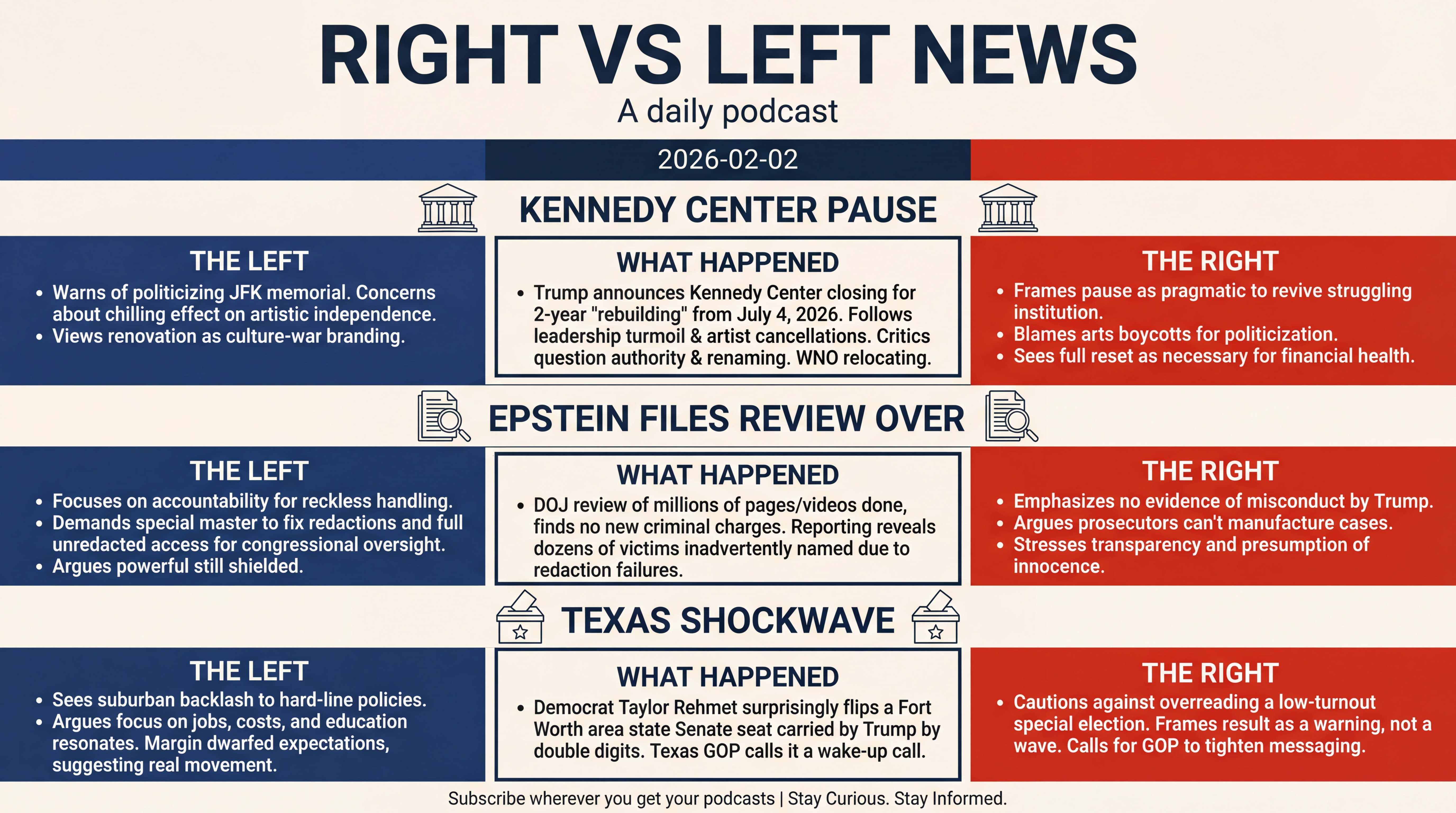
Here’s what happened... President Trump announced that Washington’s Kennedy Center will pause entertainment operations for about two years starting July 4, 2026, for renovations — calling it a “complete rebuilding,” pending board approval. The announcement follows months of artist cancellations and leadership turmoil after Trump allies took charge. The Washington National Opera is already relocating some productions. Reporting says the move reverses earlier assurances that the venue would stay open during upgrades. Critics — including members of the Kennedy family and some lawmakers — are questioning any renaming and whether Congress needs to sign off.
On the right, the pause is framed as pragmatic — get the work done quickly, avoid half measures, and revive a struggling institution. Commentators say arts boycotts politicized the venue, and that a full reset — new programming, new branding, and repairs — could restore financial health and make the Center more welcoming to broader audiences.
On the left, there are warnings about politicizing a memorial to JFK, questions about the legal authority to rename it, and concerns about a chilling effect on artistic independence. They note that artists pulled out because of the new direction — and argue the renovation is as much culture-war branding as bricks and mortar.
Next, the Epstein files.
Here’s what happened... Deputy Attorney General Todd Blanche says the DOJ’s review is essentially finished. The latest trove — millions of pages and thousands of videos and images — doesn’t support new criminal charges, according to the department. At the same time, the Wall Street Journal reports that at least dozens of survivors were inadvertently named in the release, despite pledges to protect identities — fueling outrage from attorneys and lawmakers. Other outlets emphasize the scale of the release and DOJ’s bottom line, while the Journal focuses on the redaction failures.
On the right, officials and commentators stress there’s no evidence of criminal or inappropriate conduct by President Trump in Epstein’s communications. They argue prosecutors can’t manufacture cases to satisfy public anger. The emphasis is on transparency, the presumption of innocence, and moving on unless credible new evidence emerges.
On the left, the focus is accountability. Advocates call the handling reckless, want a special master to fix redactions, and press for full, unredacted access for congressional oversight — arguing the powerful are still shielded while victims are exposed.
In Texas — a shocker.
Here’s what happened... Democrat Taylor Rehmet flipped a Fort Worth area state Senate district that Trump carried by 17 points in 2024, winning the January 31 runoff by roughly 14 points. It’s part of a string of Democratic over-performances in special elections, and Texas GOP leaders are calling it a wake-up call.
On the right, conservatives caution against overreading a low-turnout special election — pointing to unique local dynamics and the likelihood Republicans try to reclaim the seat in November. The result is framed as a warning, not a wave — a prompt for the GOP to tighten messaging on cost of living, crime, and schools.
On the left, progressives say the result shows suburban backlash to hard-line policies — including immigration raids and culture-war fights — and that Democrats’ bread-and-butter focus on jobs, costs, and public education is resonating in red-leaning areas. The margin dwarfed expectations, suggesting real movement among swing voters.
[MIDPOINT_SPONSORS]
The storm and the grid.
Here’s what happened... A powerful bomb cyclone brought historic snow to the Carolinas and deep-freeze conditions across the Southeast, with Florida setting rare February cold records. There were widespread travel disruptions, multi-state power outages, and public safety emergencies. In response, the Department of Energy extended emergency orders under Section 202(c) to keep PJM and Duke systems stable — even allowing generators and some backup units to run past normal permit limits during the peak.
On the right, the refrain is grid reliability: prioritize winterization, dispatchable power, and permitting reform so utilities can harden systems and build new generation — nuclear, gas, and hydro — without years of delay. The emergency orders are cited as proof that, when push comes to shove, reliability trumps red tape.
On the left, outlets point to climate change intensifying extremes — Arctic outbreaks mingling with coastal storm tracks — and call for resilience investments alongside clean-energy build-out: bury lines where feasible, weatherize homes, and accelerate grid modernization with renewables and storage. They also push for stronger safety nets during outages.
Finally, a detention case that gripped the country.
Here’s what happened... A federal judge ordered the release of five-year-old Liam Conejo Ramos and his father from ICE detention in Dilley, Texas. Over the weekend, they were escorted back to Minnesota. The case drew national attention after a photo of Liam in a bunny hat and Spider-Man backpack went viral. Reporting describes the judge’s unusually sharp criticism of the government’s actions, while DHS disputes claims that the child was used as bait.
On the right, voices emphasize the rule of law — arguing that if parole lapsed or claims are unproven, ICE has a duty to enforce the statutes, and that individual hard cases shouldn’t dictate national policy. Court-ordered releases, they say, should be paired with timely adjudication and deterrence to prevent future surges.
On the left, advocates call this emblematic of overreach — arguing child detention is traumatic and unnecessary, that asylum-seekers with pending claims should be in community-based alternatives, and that Congress should curb tactics seen during recent raids.
Quick recap...
The Kennedy Center faces a politically charged two-year pause. DOJ says the Epstein review is done, but redaction errors sparked backlash. Democrats score a Texas upset. A bomb cyclone tests grid resilience and prompts federal emergency orders. And a judge frees a five-year-old and his dad from ICE detention. Two lenses — right and left — with very different takeaways.
That's it for today's episode of Right versus Left News. Remember, understanding both sides isn't about picking a team—it's about being informed. Subscribe wherever you get your podcasts, and join us tomorrow for another balanced look at the day's biggest stories. Until next time, stay curious and stay informed.
