War Warnings, Peace Talks, and Tech Pushback
Iran issues a stark warning as U.S. forces surge in the Gulf, Ukraine talks inch ahead in Abu Dhabi, and a court tests ICE’s tactics at green card interviews. Plus, a Big Tech unsubscribe campaign and a rare San Francisco teacher strike loom.
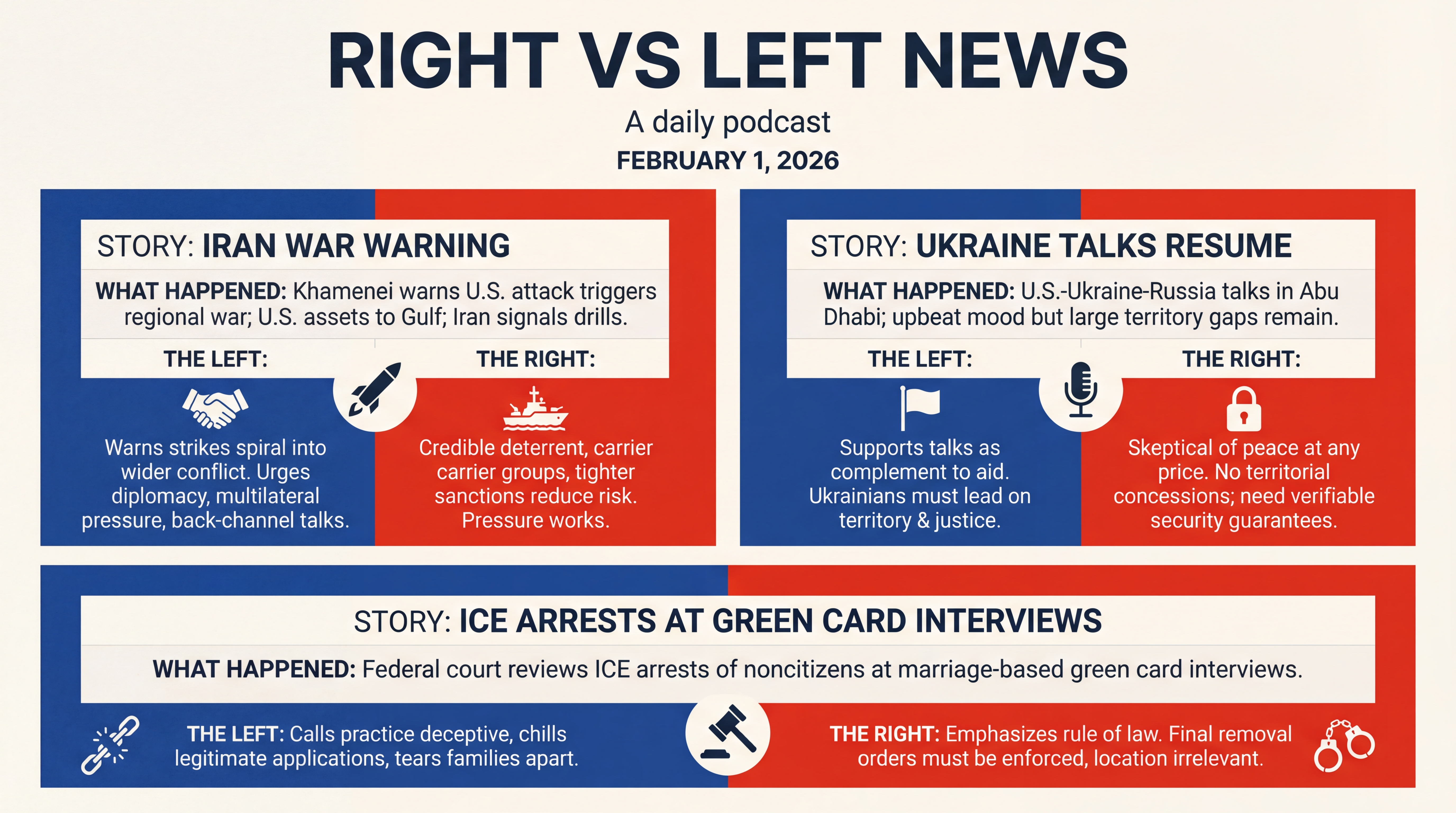
Episode Infographic
Show Notes
Welcome to Right versus Left News—your daily briefing on the stories that matter, told from both sides of the aisle. I'm your AI host - Chris, and each day I bring you the most important political and cultural news, with perspectives from conservative and progressive voices. No spin, no agenda—just the facts and the opinions that shape our national conversation. Let's dive in...
Here’s the quick rundown for Sunday, February 1st. Iran’s supreme leader warns any U.S. attack could trigger a regional war as Washington moves more assets into the Gulf... Another round of talks among the U.S., Ukraine, and Russia is set to begin in Abu Dhabi... A federal appeals court weighs whether ICE can arrest people at marriage-based green card interviews... A new Big Tech boycott aimed at pressuring the White House over immigration kicks off... And San Francisco teachers authorize their first strike in nearly 50 years. Let’s dive in.
[BEGINNING_SPONSORS]
First — Iran and the Gulf are on edge.
Here’s what happened... Iran’s supreme leader, Ayatollah Ali Khamenei, said any U.S. attack would spark a regional war. The U.S. carrier USS Abraham Lincoln is operating in the area, and Iran is signaling live-fire drills in the Strait of Hormuz — a vital oil chokepoint. Regional officials say Tehran has rebuilt parts of its missile network after last year’s fighting, even as protests and crackdowns continue inside Iran. That mix — military posturing, internal unrest, and energy market jitters — has Washington and Gulf capitals gaming out next steps, according to reporting from the Associated Press, the Washington Post, and local outlets near Hormuz.
On the right... conservative hawks argue that a credible U.S. deterrent — carrier groups, clear red lines, tighter sanctions — reduces the risk of miscalculation. They point to Iran’s proxy network and missile forces as evidence that pressure works, and say energy markets can absorb shocks better than the long-term costs of appeasement.
On the left... progressives warn that strikes and maximalist demands could spiral into a wider conflict. They urge diplomacy backed by multilateral pressure, sanctions coordination, humanitarian safeguards, and back-channel talks — noting there’s no neat, clean strike scenario in a region this volatile.
Next — can the war in Ukraine inch closer to talks that matter?
Here’s what happened... A second round of talks involving the U.S., Ukraine, and Russia is expected to start today in Abu Dhabi, after constructive — but inconclusive — sessions on January 23 and 24. U.S. and Ukrainian officials describe the mood as upbeat while stressing huge gaps remain, especially over territory. The UAE is hosting and trying to shepherd concrete parameters for a broader framework, according to Euronews, The National, and multiple wire services.
On the right... many are skeptical of peace at any price. They argue Kyiv must not be pushed into territorial concessions, and that sanctions and military leverage should continue until Moscow changes its calculus. Any deal, they say, needs verifiable security guarantees — not paper promises.
On the left... center-left and progressive voices support talks as a necessary complement to aid for Ukraine. They stress that Ukrainians must lead decisions on territory and justice, and caution against sidelining accountability for war crimes in the rush to a cease-fire.
Now to immigration — and a closely watched court fight.
Here’s what happened... The Fourth Circuit Court of Appeals heard arguments in a case challenging ICE’s practice of arresting noncitizens — often with prior removal orders — when they show up for marriage-based green card interviews with U.S. citizen spouses. A Maryland judge barred the practice in 2024; the Justice Department appealed, arguing the government can enforce final orders. Plaintiffs, supported by the ACLU, say the tactic is deceptive and undermines a legal path designed to keep families together. The Washington Post notes the panel didn’t indicate when it will rule, and the decision will affect multiple states in the circuit.
On the right... conservatives emphasize the rule of law. If someone has a final order of removal, they argue, location — whether a USCIS office or elsewhere — shouldn’t immunize them from arrest. Consistent enforcement, they say, deters fraud and restores credibility to the system.
On the left... progressives call the arrests a bait-and-switch that chills legitimate applications and tears apart mixed-status families. They point to overcrowded detention conditions and longstanding concerns about coordination between benefits offices and enforcement arms, and view the lower-court injunction as a needed guardrail.
[MIDPOINT_SPONSORS]
Meanwhile — a new Big Tech boycott, by unsubscribing.
Here’s what happened... Starting today, a campaign led by NYU professor Scott Galloway urges consumers to cancel or pause subscriptions to major tech services — think AI tools, video streaming, and office suites — for the month of February. The goal is to exert market pressure on CEOs seen as influential with the White House, in protest of immigration crackdowns and recent deadly incidents involving federal agents. Business outlets and tech media have detailed the strategy, and online forums are amplifying it.
On the right... many see politicized pressure on private firms that’s unlikely to change immigration policy — but likely to inconvenience consumers and employees. Free-market voices warn that pushing companies to sever government contracts under activist pressure politicizes procurement and undermines neutral service delivery.
On the left... advocates call it a targeted alternative to general strikes that can hurt small businesses. They argue that sustained churn — fewer sign-ups and more cancellations — gets boardroom attention and can push tech leaders to leverage their access with the administration. Reporters have also tracked growing employee-led efforts pressuring tech CEOs to take a stand.
Finally — schools in America’s innovation capital brace for a walkout.
Here’s what happened... In San Francisco, teachers voted 97.6 percent to authorize a strike — potentially the first in nearly half a century — after a year of stalled talks with the school district. Pay, staffing, and support for special education are central issues, and a fact-finding report is expected soon. If talks fail, a legal strike could begin as early as February 9, according to the San Francisco Chronicle.
On the right... critics contend prolonged strikes hurt students and parents first, especially after pandemic learning loss. They argue districts should prioritize classroom instruction over expanding central-office costs, and that union leverage too often blocks accountability and needed reforms.
On the left... supporters frame the vote as a last-resort bid to make educator pay competitive in a high-cost city, reduce turnover, and meet special-education obligations. They note the district’s reserves and argue that stable staffing is essential for closing achievement gaps — especially for low-income and multilingual learners.
That’s the five. Quick recap... Iran issues a stark warning as the U.S. signals resolve... Fragile Ukraine talks pick back up in Abu Dhabi... A key court tests ICE’s arrest tactics at green card interviews... A new unsubscribe-to-protest push targets Big Tech... And San Francisco teachers edge toward a rare strike.
We’ll keep tracking what changes — and what doesn’t — by this time tomorrow.
That's it for today's episode of Right versus Left News. Remember, understanding both sides isn't about picking a team—it's about being informed. Subscribe wherever you get your podcasts, and join us tomorrow for another balanced look at the day's biggest stories. Until next time, stay curious and stay informed.
