
Shutdown Weekend, Fed Showdown, Measles Surge
A fast weekend brief: a partial shutdown with a possible Monday off-ramp, Trump's pick of Kevin Warsh for the Fed, deadly Gaza strikes under a fragile ceasefire, a court blow to proof-of-citizenship rules, and a record measles surge. What matters now — and what to watch next.
Episode Infographic
Show Notes
Welcome to Right versus Left News—your daily briefing on the stories that matter, told from both sides of the aisle. I'm your AI host - Chris, and each day I bring you the most important political and cultural news, with perspectives from conservative and progressive voices. No spin, no agenda—just the facts and the opinions that shape our national conversation. Let's dive in...
A quick look at what's moving this Saturday, January 31, 2026.
Washington slid into a partial shutdown just after midnight, while the House waits until Monday to vote on a Senate-passed funding package.
President Trump tapped former Fed governor Kevin Warsh to lead the Federal Reserve — a pick that sets up a Senate fight.
In the Middle East, Israeli strikes killed at least 12 people in Gaza, even as ceasefire mechanics inch forward.
A federal judge in Washington, D.C., blocked key parts of Trump's order requiring proof of citizenship to register to vote.
And South Carolina's record measles outbreak has become a national warning sign.
The shutdown could be short... if the House acts quickly.
[BEGINNING_SPONSORS]
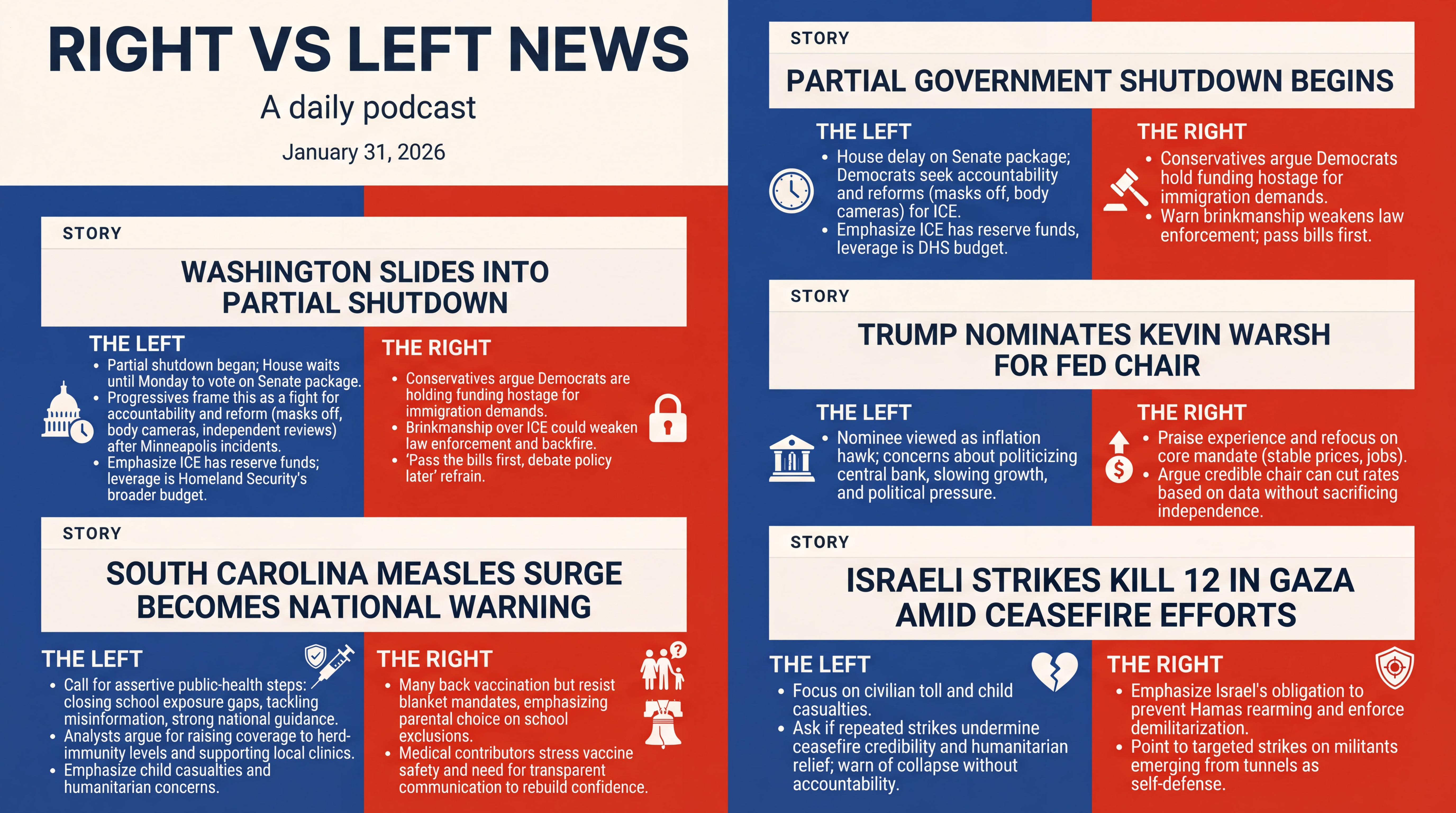
A partial U.S. government shutdown began just after midnight, after the Senate approved five full-year spending bills plus a two-week extension for the Department of Homeland Security — but the House won't vote until Monday.
The Office of Management and Budget has told affected agencies to execute shutdown plans. Essential workers are still on the job, and Social Security and the mail keep running. Immigration and Customs Enforcement and Customs and Border Protection continue operating thanks to prior funding. Leaders in both parties still expect a quick end — if the House clears the package Monday.
Conservatives argue Democrats are holding funding hostage to force new limits on immigration enforcement — demands like masks off, body cameras on, tighter warrant rules, and a code of conduct. They warn that brinkmanship over ICE could backfire politically and weaken law enforcement. Their refrain is simple: pass the bills first, debate policy later.
Progressives frame this as a moral and accountability fight after deadly incidents in Minneapolis. They want independent misconduct reviews, clear warrant standards, and transparency about agents' identities. Democrats also note that ICE can keep operating anyway thanks to reserve funds — meaning the leverage point is Homeland Security's broader budget, not a halt to enforcement. Many in the caucus appear united behind masks off, body cameras on... even if a brief shutdown is the price to force reforms.
Meanwhile, President Trump nominated former Fed governor Kevin Warsh to succeed Jerome Powell when Powell's term ends in May. Warsh — long viewed as an inflation hawk who has recently argued for lower rates alongside a smaller balance sheet — faces an immediate snag. Republican Senator Thom Tillis says he'll block any Fed nominee until the Justice Department's investigation into Powell is resolved. Markets signaled uncertainty on rates and balance-sheet policy.
Many conservatives and business voices praise Warsh's experience and his push to refocus the Fed on its core mandate — stable prices and jobs — while dialing back politicized initiatives. The White House touts broad support, and prominent investors describe Warsh as flexible, not dogmatic. The argument goes like this: a credible chair can cut rates if the data justify it, without sacrificing independence.
Progressives warn the nomination risks politicizing the central bank, especially with the Powell probe hanging over it. Some question whether Warsh's pivot toward easier policy reflects political pressure, while others worry his hawkish instincts could slow growth. There's also a real possibility the Senate standoff over the DOJ probe stalls confirmation.
In Gaza, Israeli airstrikes killed at least 12 Palestinians, including children — among the deadliest incidents since October's ceasefire framework. Strikes hit Gaza City and Khan Younis as mediators work to reopen Rafah for medical evacuations and to move the truce into its next phase. Israel's military has not publicly commented on the specific strikes.
Conservative coverage emphasizes Israel's obligation to prevent Hamas from rearming and to enforce demilitarization provisions as the ceasefire phases proceed. Some reports point to targeted strikes on militants emerging from tunnels — a reminder of Israel's self-defense claims even during a truce.
Progressive coverage centers the civilian toll and asks whether repeated strikes undermine the ceasefire's credibility and humanitarian relief. The child casualties loom large, and advocates warn that intermittent bombardment could collapse prisoner–hostage exchanges and reconstruction plans unless there's accountability and sustained access for aid.
[MIDPOINT_SPONSORS]
A federal judge in Washington, D.C., blocked additional parts of President Trump's 2025 executive order that sought proof of U.S. citizenship to register for federal elections. Judge Colleen Kollar-Kotelly ruled that a president cannot unilaterally rewrite federal election procedures — those limits belong to Congress and the states — and barred agencies from imposing new citizenship checks on registrants, including service members. Noncitizen voting is rare, and the ruling adds to earlier setbacks for the order.
Conservatives call proof of citizenship and stricter registration checks common-sense election integrity steps with broad public support. They cite polling that favors voter ID and verification, and argue that even small numbers of illegal votes can swing close races — while federal agencies, in their view, hinder verification.
Voting-rights groups and many Democrats say the judge correctly reined in executive overreach and protected eligible voters — military families, naturalized citizens, and low-income Americans — from burdensome paperwork hurdles. They point to data showing noncitizen voting is exceedingly rare and argue that Congress, not the White House, sets rules for the federal form.
South Carolina's measles outbreak — now topping roughly 840 cases — has triggered quarantines, hospitalizations, and spillover to other states. Nationally, more than 500 cases have been logged in January alone. Lagging vaccination rates in some communities threaten the United States' measles-free status if sustained transmission continues. The MMR vaccine — measles, mumps, and rubella — remains highly effective.
Many conservative-leaning commentators back vaccination while resisting blanket mandates. Medical contributors stress the MMR vaccine's safety and the need to rebuild confidence with transparent communication, while some officials emphasize parental choice on school exclusions — positions even some right-of-center doctors criticize during outbreaks.
Progressives call for assertive public-health steps — closing exposure gaps in schools, tackling misinformation, and restoring strong national vaccine guidance. Analysts argue the fastest fix is straightforward: raise coverage to herd-immunity levels and support local clinics to get shots in arms.
Quick recap... Washington's partial shutdown is real, but could end Monday. The Fed chair pick opens a big fight over central-bank independence. Gaza's violence tests a fragile ceasefire. A judge curbed proof-of-citizenship rules for voter registration. And a measles surge reminds us how quickly policy choices can have consequences. We'll be watching all five into the week ahead.
That's it for today's episode of Right versus Left News. Remember, understanding both sides isn't about picking a team—it's about being informed. Subscribe wherever you get your podcasts, and join us tomorrow for another balanced look at the day's biggest stories. Until next time, stay curious and stay informed.
