Shutdown Patch, Tax Leak Suit, and Tariff Threats
A last-minute funding deal averts a partial shutdown while Homeland Security reforms spark a showdown. We break down Trump's $10 billion tax-leak lawsuit, the ICE Out strike, Turkey's mediation on Iran, and new tariff threats tied to Cuban oil.
Episode Infographic
Show Notes
Welcome to Right versus Left News—your daily briefing on the stories that matter, told from both sides of the aisle. I'm your AI host - Chris, and each day I bring you the most important political and cultural news, with perspectives from conservative and progressive voices. No spin, no agenda—just the facts and the opinions that shape our national conversation. Let's dive in...
We've got a busy news day.
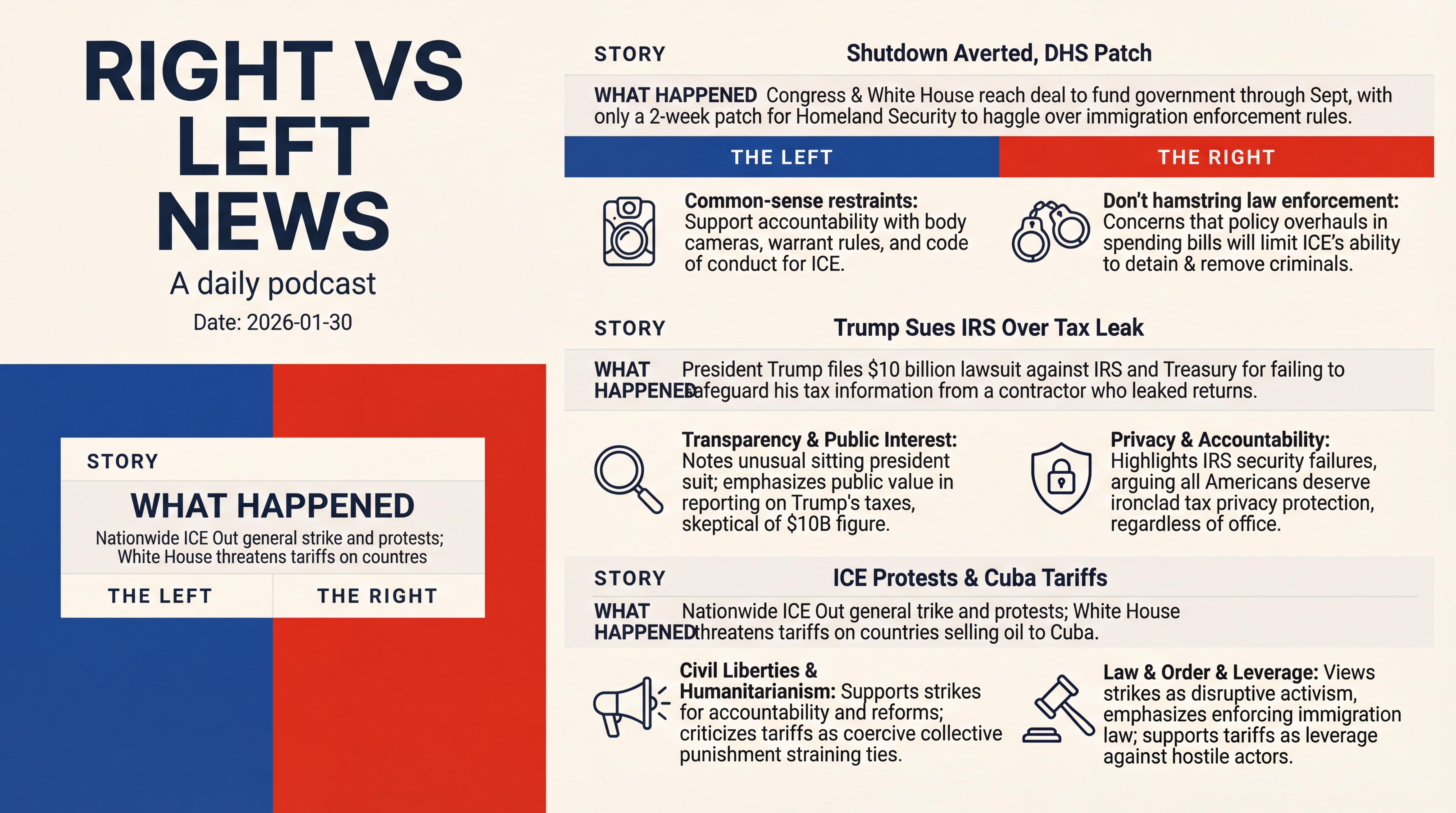
Congress and the White House struck a last-minute deal to avoid a partial shutdown. Most of the government is funded through September, but Homeland Security gets only a two-week patch while lawmakers haggle over immigration enforcement rules.
Meanwhile, President Trump filed a ten billion dollar lawsuit against the IRS and Treasury over the leak of his tax records. Across the country, an ICE Out general strike and protests are rolling through cities and campuses. Overseas, Turkey is stepping in to mediate as U.S.-Iran tensions ratchet higher. And the White House just threatened tariffs on countries selling oil to Cuba — Mexico feels the squeeze.
The shutdown clock runs out at 12:01 a.m. Saturday... so the timeline is tight.
[BEGINNING_SPONSORS]
Here's where the shutdown deal stands.
President Trump and Senate Democrats announced a plan to avert a partial shutdown by advancing five of six spending bills through September, while giving Homeland Security a two-week extension at current levels. The snag is simple — the House is out until Monday... so leaders may have to call members back to meet the deadline. The Homeland Security patch buys time to negotiate limits on immigration enforcement — body cameras, warrant rules, and a code of conduct — after fatal incidents in Minneapolis triggered national outcry.
Conservative voices worry Democrats are using shutdown leverage to rein in ICE, and warn that policy overhauls shouldn’t be jammed into must-pass spending. Some on the right say funding law enforcement shouldn’t be contingent on reforms they see as hamstringing officers — though there’s openness to cameras and clearer rules. Others argue the real test is whether any deal preserves ICE’s ability to detain and remove criminals.
Democrats counter that these are common-sense restraints — ending roving patrols without proper warrants, creating a uniform code of conduct, and requiring body cameras — framed as accountability after high-profile shootings. Progressives back the decision to separate Homeland Security funding to prevent a broader shutdown while negotiations continue.
Let's talk about the lawsuit.
President Trump, his two eldest sons, and the Trump Organization filed a ten billion dollar suit against the IRS and Treasury, alleging the government failed to safeguard their tax information from contractor Charles Littlejohn, who leaked returns to news outlets between 2018 and 2020. Littlejohn was sentenced to five years in 2024. The filing in federal court in Miami alleges reputational and financial harm.
Conservatives point to the Littlejohn case as proof of deeper IRS security failures, arguing that any American — president or not — deserves ironclad protection under tax privacy laws. They frame the lawsuit as an effort to hold agencies accountable for negligence.
On the left, coverage highlights the unusual spectacle of a sitting president suing parts of his own executive branch, and notes that reporting on Trump's taxes — including minimal payments in some years — had clear public-interest value. Skeptics question the ten billion dollar figure and whether the government can be held liable for a contractor’s criminal acts, even as they acknowledge the seriousness of the breach.
Across the country, organizers are staging a nationwide ICE Out general strike today — no work, no school, no shopping — followed by protests Saturday across all 50 states and D.C. The demands range from dismantling ICE to deep reforms at ICE and CBP. Businesses from San Francisco to New York are closing in solidarity, and student groups at the University of Minnesota helped spark the push after the Minneapolis shootings of Renee Good and Alex Pretti.
Right-leaning outlets frame the strikes as disruptive activism that risks doxxing and harassment of agents and businesses, and say calls to abolish ICE are reckless amid ongoing deportation cases. They stress enforcing immigration law — especially against violent offenders — while condemning confrontations that have spilled into vandalism or arrests at earlier protests.
Left-leaning coverage highlights a broad coalition of labor, faith leaders, and immigrant advocates who argue federal enforcement has become excessive and dangerous. Supporters say economic pressure is a legitimate, nonviolent tactic to force accountability and guard civil liberties, with demands for body cameras, strict warrant rules, and independent investigations.
[MIDPOINT_SPONSORS]
Abroad, Turkey is moving to mediate between Washington and Tehran as U.S.-Iran tensions rise. Iran’s foreign minister, Abbas Araghchi, traveled to Ankara for talks, and President Erdogan floated a virtual meeting between Trump and Iran’s President Masoud Pezeshkian. The backdrop is tense — fresh U.S. deployments to the region and tougher U.S. demands on enrichment, missiles, and support for proxy groups.
On the right, the view is that sustained pressure is working — limit Iran’s nuclear capabilities, deter attacks on U.S. partners, and only reward verifiable concessions. The baseline many conservatives want: zero enrichment, real curbs on missiles and proxies, and credible military options if diplomacy stalls.
On the left, the concern is escalation and miscalculation. Progressive voices urge diplomatic off-ramps and warn that maximalist demands could foreclose talks, favoring confidence-building steps with strict IAEA oversight instead.
Back at home, President Trump signed an executive order threatening tariffs on goods from any country that sells or provides oil to Cuba — an attempt to squeeze Havana amid an energy crunch after Venezuelan shipments dried up and Mexico scaled back. The order declares a national emergency and empowers the State and Commerce Departments to implement the tariff mechanism.
Supporters on the right argue Cuba is aligned with hostile actors like Russia and China, and say cutting off oil flows can weaken the regime and support democratic change. Tariffs, they contend, are leverage — a signal to third countries not to prop up Havana.
Critics on the left call it coercive collective punishment that could worsen shortages for ordinary Cubans and strain ties with Mexico. They warn that extraterritorial tariffs invite retaliation and legal challenges, and note that business groups already worry broader tariff policies will raise costs at home.
Quick recap... A shutdown was narrowly averted — for now — while Homeland Security policy fights continue. The president’s ten billion dollar suit targets agencies over past tax leaks. Protesters are testing economic pressure against ICE nationwide. Abroad, Turkey is working the phones to keep U.S.-Iran brinkmanship from boiling over. And the White House is betting tariff threats can starve Cuba’s oil supply. We'll keep watching each thread as it develops.
That's it for today's episode of Right versus Left News. Remember, understanding both sides isn't about picking a team—it's about being informed. Subscribe wherever you get your podcasts, and join us tomorrow for another balanced look at the day's biggest stories. Until next time, stay curious and stay informed.
