Fed Pause, ICE Rebuke, Seoul Verdict, Sacred Returns
The Fed holds rates steady as debates sharpen around inflation, jobs, and independence. We also cover a federal judge’s rebuke of ICE in Minnesota, turmoil at the Kennedy Center, a high-profile conviction in South Korea, and the Smithsonian’s latest repatriation move.
Episode Infographic
Show Notes
Welcome to Right versus Left News—your daily briefing on the stories that matter, told from both sides of the aisle. I'm your AI host - Chris, and each day I bring you the most important political and cultural news, with perspectives from conservative and progressive voices. No spin, no agenda—just the facts and the opinions that shape our national conversation. Let's dive in...
It’s Thursday, January twenty-ninth. Here’s what we’re watching today... The Federal Reserve keeps interest rates unchanged and signals a cautious stance. A Minnesota federal judge criticizes ICE’s conduct while stepping back from a contempt showdown. A Trump-led overhaul at the Kennedy Center triggers another high-profile resignation. A South Korean court jails the former first lady in a corruption case with wider political ripples. And the Smithsonian moves to return sacred Indian bronzes—fueling a broader debate over repatriation.
[BEGINNING_SPONSORS]
First up, the Fed.
The Federal Reserve left its benchmark federal funds rate unchanged—holding it between three and a half and three and three quarters percent—after its January twenty-seventh and twenty-eighth meeting. Policymakers cited solid economic activity, a cooling yet still stable labor market, and inflation that remains somewhat elevated. Chair Jerome Powell said they’ll stay data dependent—especially after three cuts last year. The Board also kept the rate paid on reserves at three point six five percent and reaffirmed its longer-run policy framework. The decision posted at two p.m. Eastern on January twenty-eighth.
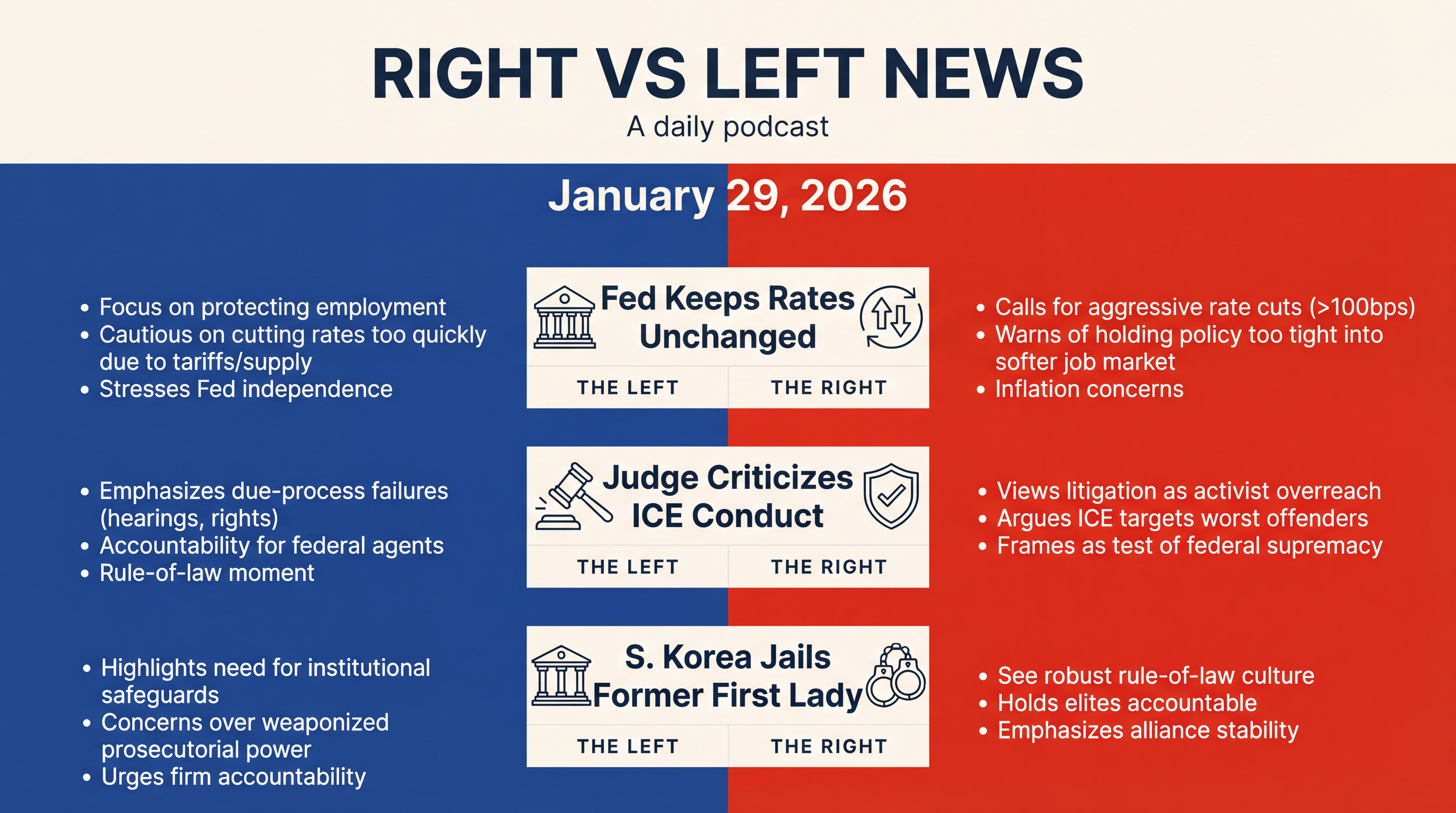
On the right, you’ll hear calls for more aggressive easing. Governor Stephen Miran has argued that more than one hundred basis points of cuts could be justified this year—saying underlying inflation is near target once measurement quirks are stripped out. Conservative commentators warn the Fed risks holding policy too tight into a softer job market.
On the left, the focus is on protecting employment gains while guarding against any flare-up in prices. Many progressive economists want the Fed to avoid new hikes—and to be cautious about cutting too quickly as tariffs and supply shifts work through the system. They also stress the importance of Fed independence amid political crosswinds.
Now to Minnesota and Immigration and Customs Enforcement—ICE.
Chief U.S. District Judge Patrick Schiltz rescinded an order summoning acting ICE Director Todd Lyons to appear in court—yet issued a blistering opinion warning that ICE is not a law unto itself and has likely violated dozens of court orders. The judge cited repeated failures to provide court-ordered bond hearings and instances where detainees were moved despite judicial directives. The move avoids an immediate contempt showdown, but the court’s concerns are now firmly on the record.
On the right, critics cast the litigation as activist overreach that undermines public safety—arguing ICE is targeting the worst offenders and facing hostility from local officials. They frame the dispute as a test of federal supremacy in enforcing immigration law.
On the left, civil-liberties advocates emphasize due-process failures—timely hearings, detainees’ rights, and accountability for federal agents—calling this a rule-of-law moment that warrants strict judicial scrutiny.
Over to Washington’s arts scene.
At the Kennedy Center, Kevin Couch resigned as senior vice president of artistic programming less than two weeks after his hiring was announced. The exit comes amid months of cancellations and turmoil following direct involvement by President Trump in the Center’s leadership and rebranding.
On the right, cancellations are often framed as politicized gestures by artists—an intolerance of differing viewpoints—while supporters say reforms aim to broaden access and restore traditional programming. They note many financial strains predate the new leadership.
On the left, artists and organizations point to reputational concerns and governance changes. They argue the arts should remain at arm’s length from partisan control—warning that overt political imprinting can chill expression and narrow the cultural tent.
[MIDPOINT_SPONSORS]
Abroad, a consequential ruling in South Korea.
A Seoul court sentenced former first lady Kim Keon Hee to one year and eight months in prison on bribery charges tied to luxury gifts and influence brokering. She’s the spouse of former president Yoon Suk Yeol, who separately faces trial over an alleged attempted martial-law episode. Prosecutors had pursued additional allegations; some were dismissed. It’s another example of South Korea’s tough post-presidency legal scrutiny.
On the right, commentators see a robust—if unforgiving—rule-of-law culture that holds elites accountable, while emphasizing alliance stability with Washington regardless of political shifts in Seoul.
On the left, analysts highlight the need for institutional safeguards and political neutrality—noting that expansive prosecutorial power can be weaponized—yet still urging firm accountability for corruption.
Finally, a major repatriation step from the Smithsonian.
The National Museum of Asian Art will return three bronzes to India after provenance research showed the sacred works were removed decades ago from temples in Tamil Nadu. The museum says the decision reflects its ethical-returns policy and will be woven into future exhibit storytelling—one object will remain on long-term loan with contextualization.
On the right, there’s support for returning clearly stolen items—but caution that pressure campaigns shouldn’t sweep up objects with murky yet legal histories. The push is for rigorous scholarship and voluntary cultural exchanges.
On the left, many applaud the move as overdue accountability—arguing that repatriation grounded in evidence rebuilds trust with source communities. The Smithsonian broadened its ethical-return standards in twenty twenty-two and is staffing up to review holdings.
Quick recap... The Fed pauses while watching inflation and jobs. A Minnesota judge puts ICE on notice over court-order compliance. The Kennedy Center sees another resignation amid political and artistic cross-currents. South Korea’s courts hand down a high-profile sentence. And the Smithsonian returns sacred art to India—deepening the debate over who should steward cultural heritage.
That's it for today's episode of Right versus Left News. Remember, understanding both sides isn't about picking a team—it's about being informed. Subscribe wherever you get your podcasts, and join us tomorrow for another balanced look at the day's biggest stories. Until next time, stay curious and stay informed.
