Negotiations Expand, Minneapolis Tensions, Threats Spike
A fast, balanced rundown of five developing stories: Medicare’s drug talks expand into Part B, Ilhan Omar endures a syringe attack, a Virginia redistricting bid hits a legal wall, Capitol Police report a surge in threats, and Ecuador protests a Minneapolis consulate standoff. What happened — and how the right and left are framing each one.
Episode Infographic
Show Notes
Welcome to Right versus Left News—your daily briefing on the stories that matter, told from both sides of the aisle. I'm your AI host - Chris, and each day I bring you the most important political and cultural news, with perspectives from conservative and progressive voices. No spin, no agenda—just the facts and the opinions that shape our national conversation. Let's dive in...
Here’s the quick rundown for Wednesday, January 28, 2026. Medicare just added 15 more drugs to its price negotiation program — reaching into Part B for the first time. In Minneapolis, Representative Ilhan Omar was attacked with a syringe of unknown liquid during a town hall, but she continued the event. In Richmond, a Virginia judge struck down Democrats’ plan to fast-track new congressional maps, and Democrats plan to appeal. On Capitol Hill, the U.S. Capitol Police say threats they investigated against members, staff, and the complex jumped more than 50 percent last year. And a diplomatic wrinkle in Minneapolis — ICE officers tried to enter Ecuador’s consulate and were turned away, prompting a formal protest from Quito. We’ll unpack what happened… and how the right and left are framing each story.
[BEGINNING_SPONSORS]
Medicare’s drug negotiation program is expanding. The Centers for Medicare and Medicaid Services named 15 additional high-cost medicines for the next round — now including certain Part B, clinic-administered drugs. Negotiations are set for 2026, with new prices taking effect January 1, 2028. CMS says about 1.8 million beneficiaries used these medicines over the past year. The list includes treatments like Biktarvy, Trulicity, Verzenio, Xolair, and Botox for covered medical conditions. AARP praised the move, while drugmakers and their trade group pushed back. It’s the first cycle to include Part B drugs.
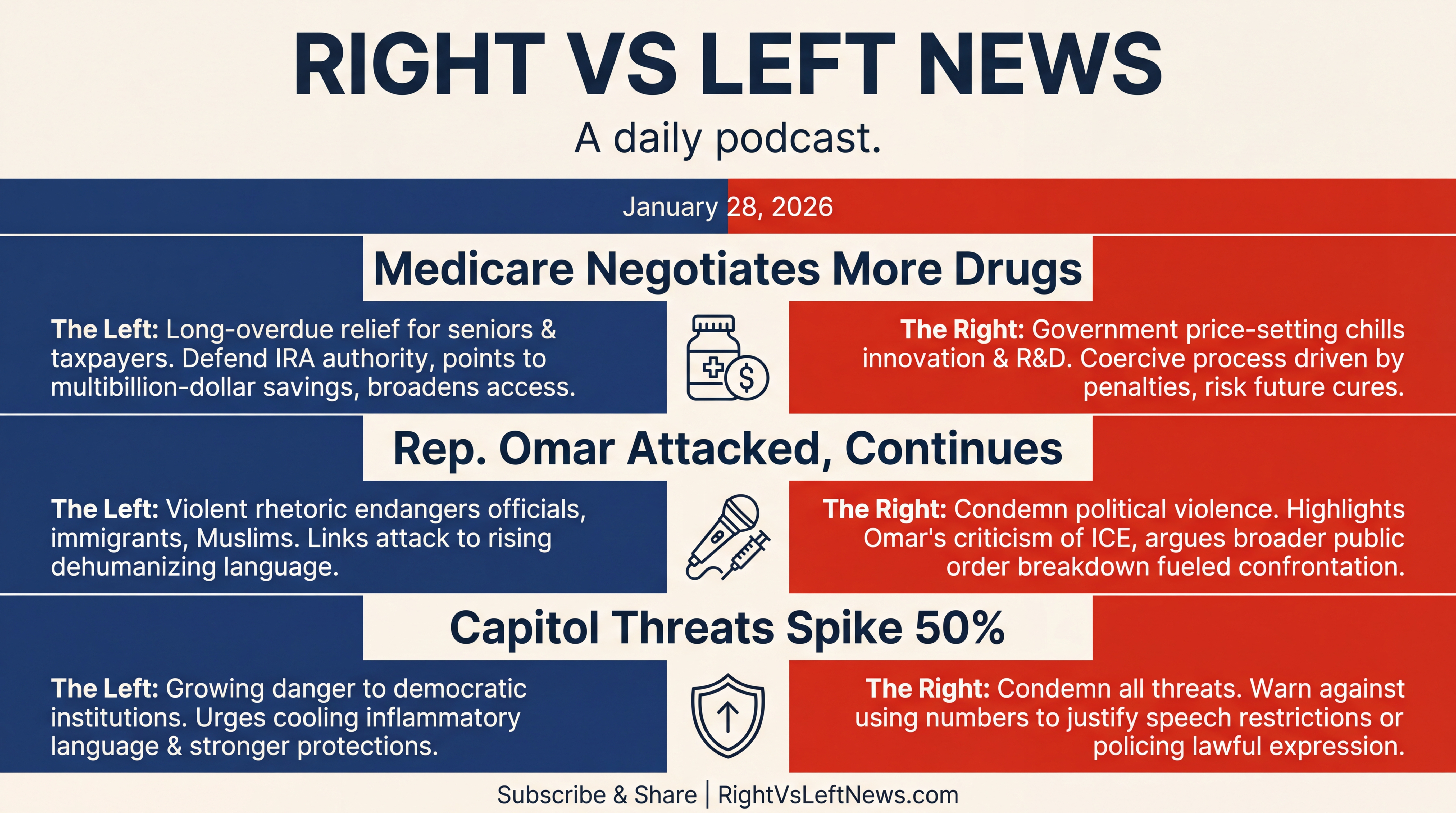
On the right, conservative commentators and industry-aligned voices argue that government price setting could chill innovation and shrink research and development pipelines. They highlight legal challenges to the program — calling it a coercive process driven by penalties rather than market dynamics — and say Medicare should focus on insurers and pharmacy benefit managers instead of imposing de facto price caps that might mean fewer future cures.
On the left, progressives and groups like AARP frame this as long-overdue relief for seniors and taxpayers. They defend the Inflation Reduction Act’s negotiation authority, point to multibillion-dollar savings, and note that earlier negotiated prices are slated to kick in starting in 2027 — with this round broadening savings to more conditions and care settings, including infusions.
In Minneapolis, Representative Ilhan Omar was approached during a Tuesday evening town hall by a man who sprayed an unknown liquid from a syringe. Police identified the suspect as 55-year-old Anthony Kazmierczak, arrested him on suspicion of third-degree assault, and said Omar appeared unharmed. She resumed speaking and later thanked constituents for their support. The incident comes amid heightened tensions in Minnesota after recent fatal encounters with federal agents.
On the right, coverage condemned political violence, while also highlighting Omar’s sharp criticism of ICE and the administration — criticism that preceded the incident. Some argue that a broader breakdown in public order around immigration enforcement in Minneapolis has fueled confrontations at public events.
On the left, progressives emphasize that violent rhetoric against Omar — often from high-profile figures — creates a climate that endangers elected officials, immigrants, and Muslims. Democratic leaders linked the attack to rising dehumanizing language and urged a cooling of incendiary political talk.
In Virginia, a circuit judge in Tazewell County invalidated Democrats’ push to place a mid-decade redistricting amendment before voters, ruling that lawmakers didn’t follow required procedures — voting while early ballots were already being cast, failing to meet a 90-day posting requirement, and overstepping the scope of a special session. Democrats say they’ll appeal.
On the right, conservatives cast the decision as a win for the rule of law, arguing Democrats tried to change the rules mid-game to engineer a map advantage. They point to the judge’s findings on session limits and notice requirements as evidence the process was rushed and improper.
On the left, progressives argue Republicans court-shopped for a friendly venue and are using procedural hurdles to block a voter say on modernized maps. Supporters insist the measure should go to a public referendum — and that the ruling won’t halt efforts to let Virginians decide.
[MIDPOINT_SPONSORS]
On Capitol Hill, the U.S. Capitol Police reported that threat-related cases they investigated in 2025 rose by more than five thousand compared with 2024 — over a 50 percent jump. In a statement, the department urged a reduction in violent political rhetoric and pointed to online anonymity as a driver. They emphasized that they investigate threats against members of Congress from both parties, as well as the Capitol complex.
On the right, many condemn all political threats — and warn against using these numbers to justify new speech restrictions or policing of lawful expression. Some argue that efforts to combat extremism can morph into viewpoint suppression instead of focusing on actual, prosecutable threats.
On the left, progressives say the data underscores a growing danger to democratic institutions and public servants. They urge influential figures in both parties to cool inflammatory language and back stronger protections for staff and members.
Ecuador’s Foreign Ministry says ICE officers tried to enter the Ecuadorian consulate in Minneapolis around 11 a.m. Tuesday but were blocked by consular staff, who reminded agents they lacked permission. Ecuador filed a formal diplomatic protest. Under international law, consulates are generally off limits to law enforcement without the consul’s consent, except in emergencies — principles rooted in the Vienna Convention on Consular Relations.
On the right, commentary around the broader Minneapolis enforcement push stresses that agents are operating amid hostility and rapidly unfolding situations. They argue local sanctuary policies and activist confrontations complicate lawful operations — and emphasize officer safety concerns and the scale of arrests during federal actions.
On the left, progressives frame the attempted entry as emblematic of heavy-handed tactics that risk violating international norms and escalating tensions with foreign governments. They say adherence to consular protections isn’t optional — and note that the incident comes amid wider controversies over federal agents’ actions in Minneapolis.
Quick recap… Medicare expands drug negotiations into Part B; Representative Omar is attacked but undeterred; a Virginia judge stalls Democrats’ mid-decade redistricting bid; Capitol Police say threats soared last year; and Ecuador protests after ICE officers were turned away from its Minneapolis consulate. We’ll keep watching both the policy moves — and the tone of the debate — as they evolve.
That's it for today's episode of Right versus Left News. Remember, understanding both sides isn't about picking a team—it's about being informed. Subscribe wherever you get your podcasts, and join us tomorrow for another balanced look at the day's biggest stories. Until next time, stay curious and stay informed.
