Powell’s Pause, Rutte’s Warning, X Under Fire
The Fed signals patience as markets parse Powell’s tone, the Senate weighs support for pregnant students, Honduras swears in Tito Asfura, NATO’s Rutte urges more European defense spending, and the EU probes X’s Grok over AI deepfakes. Fast, balanced context to start your day.
Episode Infographic
Show Notes
Welcome to Right versus Left News—your daily briefing on the stories that matter, told from both sides of the aisle. I'm your AI host - Chris, and each day I bring you the most important political and cultural news, with perspectives from conservative and progressive voices. No spin, no agenda—just the facts and the opinions that shape our national conversation. Let's dive in...
It’s Tuesday, January 27, 2026. Here’s what we’re watching...
The Federal Reserve opens a two-day meeting that could shape borrowing costs and market psychology for months. The U.S. Senate plans an evening vote on whether to proceed with the Pregnant Students’ Rights Act. In Central America, Honduras inaugurates conservative businessman Nasry Asfura — widely known as Tito — amid lingering election disputes. In Brussels, NATO’s new secretary general, Mark Rutte, bluntly warns Europe it can’t defend itself without the United States. And the European Union launches a fresh investigation into Elon Musk’s platform X over sexualized deepfakes generated by its Grok AI.
[BEGINNING_SPONSORS]
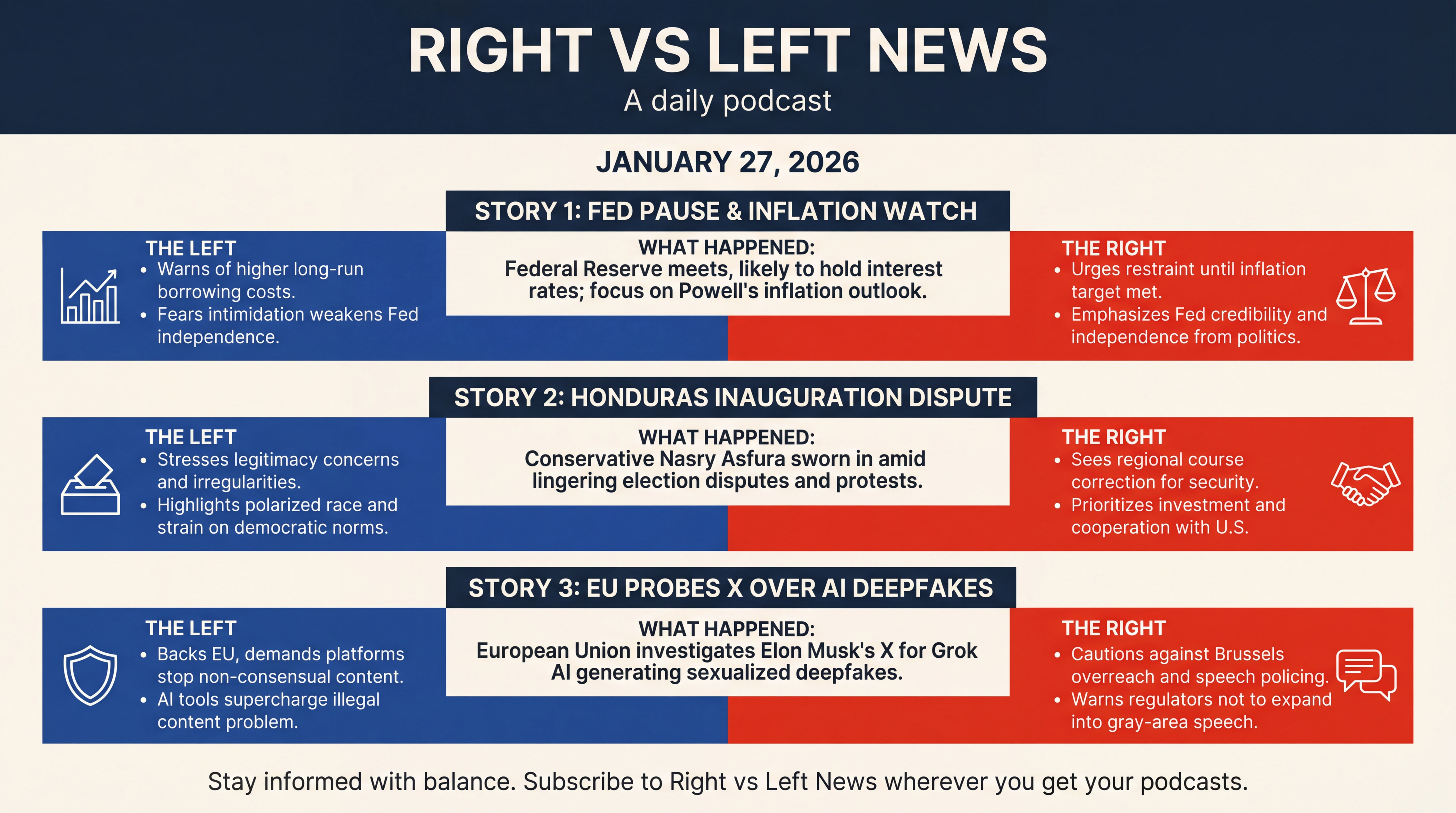
The Fed meets today and tomorrow, with a press conference on Wednesday. Markets mostly expect no rate change after three cuts last year — the focus is how Chair Jerome Powell describes inflation progress and the path ahead. The data is mixed, arguing for patience, and the committee wants to keep options open.
On the right, conservative and market-friendly voices emphasize credibility and urge restraint on cuts until inflation is clearly moving to target. The Wall Street Journal has echoed Republican unease about politicizing the central bank — and underscored the importance of independence.
On the left, progressive outlets focus on the pressure campaign around the Fed. Vox frames recent legal and political fights as a stress test for independence — warning that intimidation could mean higher long-run borrowing costs and weaker guardrails on executive power.
The Senate is set for an evening vote on whether to proceed with the Pregnant Students’ Rights Act. The bill would require colleges to share information about rights and accommodations for pregnant students. It was introduced earlier this month, then moved quickly onto the calendar.
Supporters on the right present it as practical help for women who want to continue their studies while carrying a pregnancy — from excused absences, to modified schedules, to campus resources. Republican backers say universities should proactively communicate those protections.
From the left, women’s rights advocates call it a Trojan horse — light on real support and paired with broader efforts to limit reproductive healthcare on campus. The National Women’s Law Center argues it could undercut existing Title IX protections while failing to fund childcare, housing, or healthcare that pregnant and parenting students need.
In Central America, Honduras inaugurates Nasry Asfura, a conservative former mayor of Tegucigalpa, after a narrow and contested November vote. His team chose a modest swearing-in at the National Congress instead of the national stadium — a signal of austerity after a tense certification process.
Conservative media casts the transition as a regional course correction — prioritizing security, courting investment, and deepening cooperation with Washington on migration and counternarcotics. Fox News has emphasized his win and outreach to the U.S., portraying stability-minded voters rejecting left-wing governance.
Progressive outlets stress legitimacy concerns, citing irregularities, opposition objections, and international criticism. The Guardian has highlighted disputes over the tally, and European coverage describes a polarized race with democratic norms under strain. Expect close scrutiny of human rights and anti-corruption moves in Asfura’s early months.
[MIDPOINT_SPONSORS]
In Brussels, NATO Secretary General Mark Rutte told lawmakers that anyone who thinks Europe could defend itself without the U.S. should keep on dreaming. He pressed for more burden-sharing, warned about Ukraine’s air-defense shortages, and addressed Arctic security tensions tied to U.S.–Europe frictions over Greenland.
On the right, many argue Rutte’s candor validates years of pressure on allies to spend more. Right-leaning analysis points to rising European defense budgets — and says deterrence works best when members hit or exceed targets. Commentary in the Wall Street Journal also links Greenland-related rifts to alliance risks — another reason, in this view, for Europe to invest more and close ranks.
On the left, progressives warn that transatlantic security is being buffeted by U.S. political crosswinds — tariff threats, Greenland disputes, and rhetorical broadsides that complicate unity while Ukraine still needs support. The Guardian’s coverage reflects concern that European defense shouldn’t be whiplashed by U.S. domestic politics, even as leaders acknowledge the need for higher spending.
And in tech and regulation, the European Commission has opened a formal investigation into X — formerly Twitter — over Grok, its AI assistant, after reports that it generated sexualized deepfakes, including content possibly involving minors. Under the Digital Services Act, the probe could lead to fines or mandated changes if X failed to assess and mitigate systemic risks.
From the right, some caution against Brussels overreach and speech policing — arguing that heavy fines and rulemaking can morph into pressure on U.S. tech platforms. Others say a focus on illegal content is appropriate, but warn regulators not to expand into gray-area speech.
From the left, progressive and consumer-protection voices largely back the EU move — insisting platforms must stop non-consensual sexual images and child-exploitation content at the source, especially as AI tools supercharge the problem. Investigators see earlier platform tweaks as insufficient, and strong enforcement could ripple across social media’s AI features.
To close it out... the Fed meets through tomorrow, with rates likely on hold. The Senate tests support for the Pregnant Students’ Rights Act. Honduras swears in Asfura under close watch. NATO’s Mark Rutte urges Europe to keep the U.S. close — and keep spending. And the EU’s new probe puts X’s AI in the regulatory crosshairs.
That's it for today's episode of Right versus Left News. Remember, understanding both sides isn't about picking a team—it's about being informed. Subscribe wherever you get your podcasts, and join us tomorrow for another balanced look at the day's biggest stories. Until next time, stay curious and stay informed.
