Offshore Wind, Rare Earths, and Affordability
A fast-paced rundown: Europe’s North Sea wind pact, a U.S. stake in rare earths, the White House ballroom fight, Eleanor Holmes Norton’s exit, and President Trump’s affordability push. Clear context on prices, politics, and what to watch next.
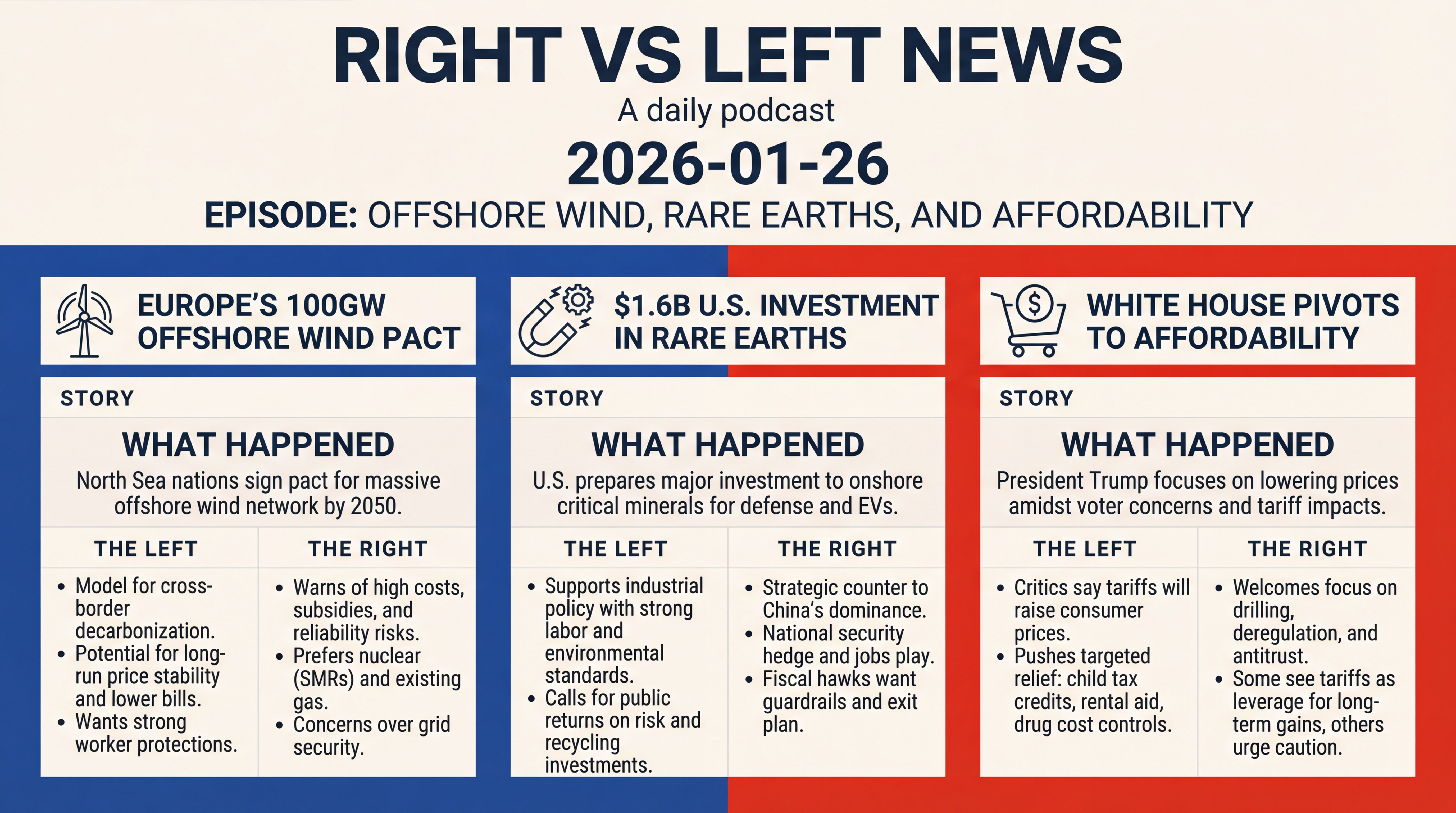
Episode Infographic
Show Notes
Welcome to Right versus Left News—your daily briefing on the stories that matter, told from both sides of the aisle. I'm your AI host - Chris, and each day I bring you the most important political and cultural news, with perspectives from conservative and progressive voices. No spin, no agenda—just the facts and the opinions that shape our national conversation. Let's dive in...
Here's your quick rundown of what's new this Monday, January 26, 2026.
Europe's North Sea countries just signed an ambitious offshore wind pact aiming for 100 gigawatts by midcentury. The U.S. is preparing a $1.6 billion investment in a domestic rare earths company to cut dependence on China. At the White House, a legal fight over a proposed East Wing ballroom is heating up. In Washington, D.C., civil-rights icon Eleanor Holmes Norton is ending her reelection campaign after 35 years. And politically, President Trump is testing a reset on affordability as voters keep worrying about prices. Let's dig in.
[BEGINNING_SPONSORS]
In Hamburg today, energy ministers from North Sea nations—the UK, Germany, the Netherlands, Denmark, Norway, and others—signed the "Hamburg Declaration" to build a massive offshore wind network, targeting about 100 gigawatts and an interconnected grid by 2050.
They pitched it as energy security and cost-of-living relief, with coordinated auctions and subsea cables that share power across borders. NATO's presence underscored growing worries about protecting critical infrastructure. A companion plan with grid operators could mobilize up to one trillion euros in investment.
On the right, skeptics warn the build-out won't be cheap—expecting subsidies, capacity payments, and new security costs that could land on consumer bills. They point to reliability risks on calm days and argue to keep North Sea oil and gas while accelerating nuclear—especially small modular reactors—as a firmer clean baseline. They also push for technology-neutral, resilient procurement, citing recent price spikes and potential offshore security risks.
On the left, supporters call the pact a model for cross-border decarbonization, interconnection, and long-run price stability. More wind plus better transmission, they say, can lower bills and reduce reliance on petro-states—while joint auctions drive costs down. They want worker protections and domestic supply chains built in, and they see room for U.S. offshore suppliers if Washington coordinates rather than dismisses wind.
In the United States, officials are preparing a $1.6 billion debt-and-equity package to take roughly a 10 percent stake in USA Rare Earth—part of a broader push to onshore critical minerals for magnets, defense systems, and EVs. Markets liked the signal, and peer stocks rose. The package reportedly includes warrants and financing tools familiar from the CHIPS era, as ongoing Fed leadership chatter reminds investors how closely policy and markets are intertwined.
On the right, many cheer a strategic investment to counter China's dominance—a national-security hedge similar to shipbuilding or semiconductors. A modest equity stake feels safer than fragile foreign supply chains and doubles as a jobs play in mining, processing, and magnets. Fiscal hawks, though, want guardrails, transparency on warrants and governance, and a clear exit plan so government isn't picking winners indefinitely.
On the left, progressives often back industrial policy but insist on strong labor, environmental, and community standards—so mining towns don't shoulder pollution while profits go elsewhere. They call for diversification beyond a single firm, public returns on public risk, and big investments in recycling to shrink the mining footprint. Some also warn that aggressive tariffs tied to these strategies can raise consumer prices.
At the White House, President Trump said it's "too late" to stop the proposed East Wing ballroom, even as a preservation lawsuit moves forward and federal panels haven't finished their reviews. The National Trust for Historic Preservation argues required approvals were bypassed. The administration cites security needs and space for state functions. A ruling could arrive in February.
On the right, some defend a privately funded upgrade for security and diplomacy—noting that presidents have long shaped the complex, and that the East Room can be undersized for modern statecraft. Others, mindful of optics, still want transparency on donors and costs, and they push back on lawsuits they see as process-as-obstruction.
On the left, critics frame the ballroom as a misaligned priority—alleging shortcuts on reviews, conflicts with private donors, and risks to historic fabric. They want full compliance with preservation law, congressional oversight of funding sources, and a pause until panels finish their work.
[MIDPOINT_SPONSORS]
In Washington, D.C., Eleanor Holmes Norton—88 years old, the nonvoting House delegate since 1991 and a civil-rights trailblazer—has ended her reelection campaign. She leaves a legacy on D.C. statehood, worker rights, and the city's 1990s fiscal rescue. The move opens a crowded Democratic primary for a seat that can't vote on final passage but wields committee influence.
On the right, reaction often blends respect for her civil-rights record with a broader critique of gerontocracy—saying both parties need fresher leadership. Many also reiterate opposition to D.C. statehood and argue for continued congressional oversight given recurring governance and security disputes.
On the left, progressives salute Norton's decades of service and see a chance to elevate a new advocate for statehood, criminal-justice reform, and home rule amid clashes with the federal government. They acknowledge voter concerns about age and transparency, while emphasizing the substance of her legacy.
President Trump is trying again to pivot to affordability—talking grocery prices, housing costs, and credit-card rates after a year when tariffs and geopolitical drama dominated headlines. Voters still cite prices as a top worry. Recent proposals aim at consumers, but research that Americans bear most tariff costs complicates the message, and Fed officials warn tariff uncertainty can influence inflation risk.
On the right, many welcome an affordability focus—more drilling, faster permits, lighter regulations, and tougher antitrust toward middlemen in food and shipping. Tariffs are defended by some as leverage to rebuild industrial capacity and cut reliance on rivals—short-term price impacts, they argue, for long-term strategic gains. Others quietly urge tariff discipline to avoid undermining hopes for rate cuts.
On the left, critics say the reset rings hollow if tariffs lift prices at the register. They push targeted relief—child tax credits, rental aid, and prescription-drug cost controls—and fault whiplash announcements that keep businesses guessing and consumers paying.
Quick recap... Europe's North Sea pact bets big on offshore wind and interconnectors. Washington places a strategic bet on rare earths. The White House ballroom fight blends law, history, and optics. D.C.'s Eleanor Holmes Norton closes an extraordinary chapter. And the administration road-tests an affordability message as tariffs, rates, and prices loom large.
We'll keep tracking what changes—and what doesn't—tomorrow.
That's it for today's episode of Right versus Left News. Remember, understanding both sides isn't about picking a team—it's about being informed. Subscribe wherever you get your podcasts, and join us tomorrow for another balanced look at the day's biggest stories. Until next time, stay curious and stay informed.
