
Minneapolis Fallout, Shutdown Standoff, and Rafah Stakes
A fatal shooting in Minneapolis ignites nationwide protests and a funding showdown in Washington, while U.S. envoys press Israel on the next phase of the Gaza ceasefire. Plus, a White House film screening sparks an optics fight and new documents revive controversy over third-country deportations.
Episode Infographic
Show Notes
Welcome to Right versus Left News—your daily briefing on the stories that matter, told from both sides of the aisle. I'm your AI host - Chris, and each day I bring you the most important political and cultural news, with perspectives from conservative and progressive voices. No spin, no agenda—just the facts and the opinions that shape our national conversation. Let's dive in...
Here’s the plan for today... In Minneapolis, the fatal shooting of ICU nurse Alex Pretti by federal agents has set off protests from coast to coast — and a clash between Minnesota officials and Washington.
On Capitol Hill, Senate Democrats say they’ll block Homeland Security funding in response, raising real shutdown risks this week.
Abroad, U.S. envoys met with Israel’s prime minister to push Phase Two of the Gaza ceasefire, with the Rafah crossing at the center.
Back in Washington, the White House hosted a private screening of “Melania,” drawing fire over priorities.
And new documents show South Sudan sought sanctions relief after agreeing to take U.S. deportees — stirring a fresh fight over third-country removals. According to reporting from the Associated Press, the Washington Post, the Wall Street Journal, Fox News, and others... these are the stories moving fast on Sunday, January 25.
[BEGINNING_SPONSORS]
First, Minneapolis.
On Saturday, January 24, a U.S. Border Patrol agent fatally shot 37-year-old nurse Alex Pretti during a federal immigration operation. DHS says an armed man resisted and agents fired in self-defense. Bystander videos circulating widely appear to show Pretti filming, being pepper-sprayed, then tackled before shots were fired.
Protests quickly swelled. The Minnesota National Guard deployed, and state officials accused federal authorities of blocking access to evidence. Minnesota is now seeking a state-led probe. Several outlets describe footage that seems to undercut parts of DHS’s account.
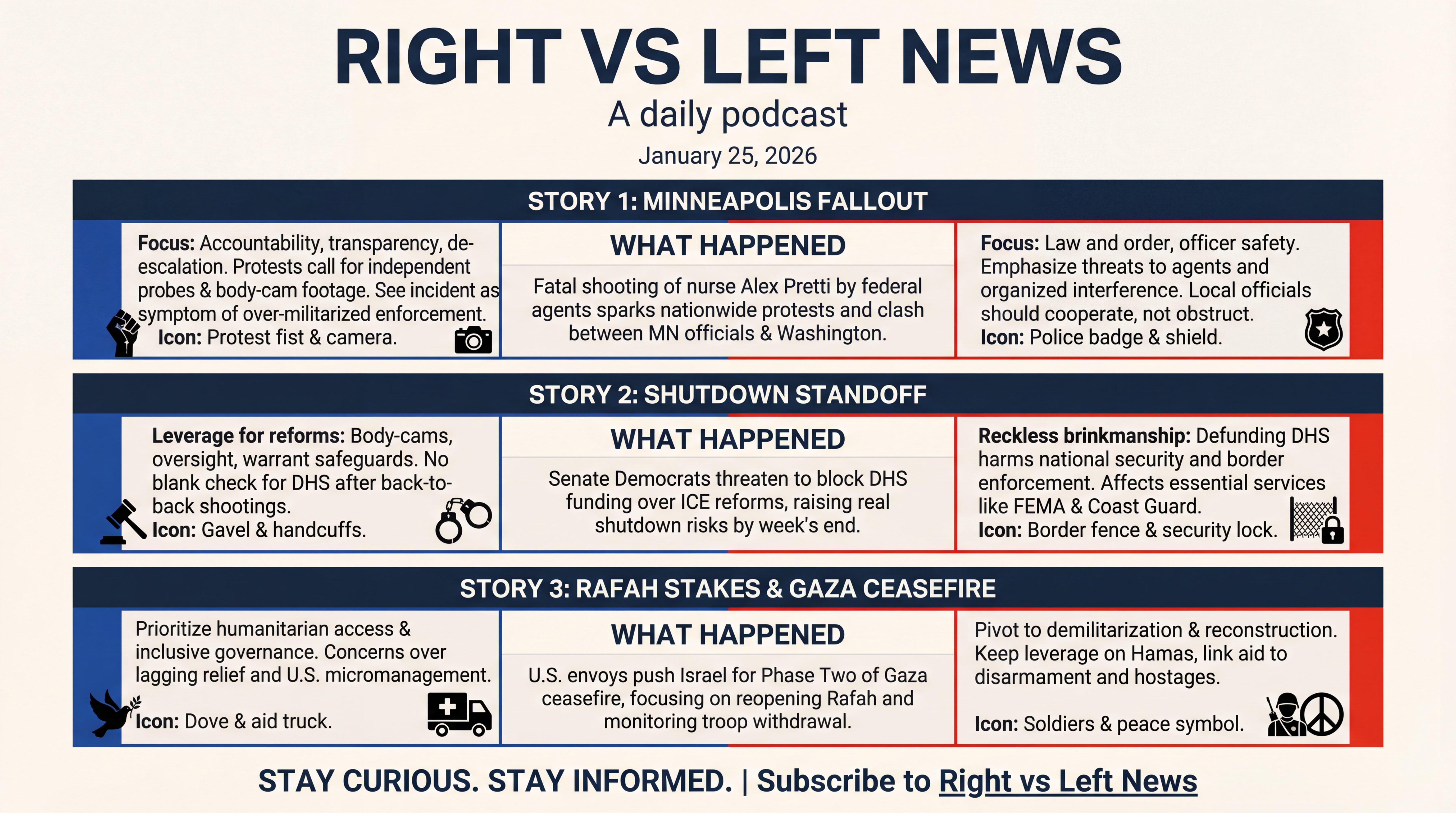
On the right, conservative outlets emphasize law and order and the hazards officers face. They cite DHS statements that earlier Minneapolis confrontations included violence against agents — arguing interference with arrests has become organized and dangerous. The framing is that agents must be allowed to enforce immigration law. Local officials should cooperate, not obstruct. And premature conclusions based on viral clips risk politicizing a split-second use-of-force decision.
On the left, progressive voices focus on accountability, de-escalation, and transparency. Reporting outlines how DHS under Secretary Kristi Noem has shifted resources toward aggressive interior enforcement, while nationwide protests call the killing unacceptable and demand body-camera footage and independent investigations. The argument is that this is a symptom of an over-militarized deportation push that endangers civil liberties.
On Capitol Hill, the fallout hit fast.
Senate Democrats say they’ll block the upcoming government funding package unless the DHS portion is changed or split off — putting a partial shutdown on the table by week’s end. The Wall Street Journal reports Chuck Schumer is lining up votes to stop the bill if ICE reforms aren’t included. The Washington Post says the standoff centers on about 64.4 billion dollars for DHS, including 10 billion for ICE. Fox News notes some Democrats are breaking with previous positions to oppose DHS funding, citing the shootings.
On the right, conservatives frame the blockade as reckless brinkmanship that would reward unrest and hamstring border enforcement. They warn that defunding DHS amid mass removals would undermine national security. Some also argue the broader package covers FEMA, TSA, and the Coast Guard — essential services they say shouldn’t be held hostage to an ICE fight.
On the left, progressives counter that leverage is the point of a funding vote — that without binding constraints, the status quo will continue. Proposals include body-cams, stronger oversight of detention facilities, arrest-warrant safeguards, and clearer limits on interior raids. Their bottom line: no blank check for DHS after back-to-back shootings.
Abroad, U.S. envoys Steve Witkoff and Jared Kushner met with Prime Minister Benjamin Netanyahu, urging Israel to move into Phase Two of the Gaza ceasefire. The clearest signal would be reopening Rafah between Gaza and Egypt and coordinating a monitoring presence as Israeli forces pull back from certain corridors.
Netanyahu is under pressure to wait until Hamas returns the remains of the last Israeli hostage. U.S. officials, meanwhile, want momentum now to stabilize the truce.
On the right, coverage casts Phase Two as a needed pivot — from ceasefire to demilitarization and reconstruction under a technocratic administration. The case is to keep leverage on Hamas, verify corridors like Rafah and Netzarim, and link aid to disarmament and hostages.
On the left, progressive voices raise conflict-of-interest optics and humanitarian access. They spotlight concerns that reopening Rafah and true civilian relief are lagging, and warn that U.S. micromanagement without broad Palestinian buy-in could stall any plan. The focus is to prioritize humanitarian corridors and inclusive, credible governance — not just security benchmarks.
[MIDPOINT_SPONSORS]
Back in Washington, as the Minneapolis fallout grew, President Trump and First Lady Melania Trump hosted a private White House screening of “Melania,” an Amazon MGM Studios documentary about the 20 days leading to the 2025 inauguration.
Democrats blasted the optics amid protests and a potential shutdown fight. Supporters counter that a first-lady documentary is hardly unusual — accusing critics of performative outrage while ignoring policy wins. They frame the project as a rare, behind-the-scenes look at an influential East Wing, arguing the administration can govern and promote a film at the same time. Progressives say the screening underscores misplaced priorities during a national crisis and distracts from accountability over DHS actions.
Overseas policy is back in the spotlight.
Newly surfaced State Department documents show that after South Sudan accepted a small group of U.S. deportees last year, its government asked Washington for benefits — including sanctions relief for a former vice president and help against a political rival. AP reports the eight deportees were staged in Djibouti before relocation to Juba, and rights groups warned the third-country scheme could expose people to abuse or refoulement — forced return to danger.
On the right, immigration hawks argue that third-country removals are a lawful, pragmatic tool to restore deterrence — urging incentives that speed returns rather than endless litigation. The thrust is that if partners will take deportees, the U.S. should make deals that protect taxpayers and public safety.
On the left, human-rights advocates warn that opaque agreements risk unlawful detention and onward return. They point to countries with troubling records and call for transparency, due-process safeguards, and independent monitoring. The bottom line is that secrecy and refoulement risks make these deals unacceptable.
Quick recap...
A contested federal shooting in Minneapolis catalyzed protests and a funding showdown in Washington. U.S. envoys pushed Israel to implement the next Gaza ceasefire phase. The White House’s “Melania” screening stoked an optics debate. And new documents reignited the fight over third-country deportations.
We’ll keep tracking the evidence, the votes, and the diplomacy as the week unfolds.
That's it for today's episode of Right versus Left News. Remember, understanding both sides isn't about picking a team—it's about being informed. Subscribe wherever you get your podcasts, and join us tomorrow for another balanced look at the day's biggest stories. Until next time, stay curious and stay informed.
