
Ukraine Talks, Musk Money, Midwest Moves
From rare Ukraine negotiations in Abu Dhabi to Elon Musk’s political spending and Amy Klobuchar’s gubernatorial move, we break down five fast-moving stories. Plus, a campus free speech ruling and a House DHS vote with big implications.
Episode Infographic
Show Notes
Welcome to Right versus Left News—your daily briefing on the stories that matter, told from both sides of the aisle. I'm your AI host - Chris, and each day I bring you the most important political and cultural news, with perspectives from conservative and progressive voices. No spin, no agenda—just the facts and the opinions that shape our national conversation. Let's dive in...
Here's a quick rundown of today's five biggest stories.
First, the United States, Ukraine, and Russia are beginning rare, U.S.-backed talks in Abu Dhabi about the war in Ukraine. Second, Elon Musk is jumping back into electoral politics with fresh money and organizing muscle ahead of the 2026 midterms. Third, a federal judge warned the administration against changing immigration status for plaintiffs in a First Amendment case tied to campus protests. Fourth, the House passed a Department of Homeland Security funding bill that keeps ICE funded despite progressive pushback. And fifth, Senator Amy Klobuchar just took a formal step toward running for governor of Minnesota.
[BEGINNING_SPONSORS]
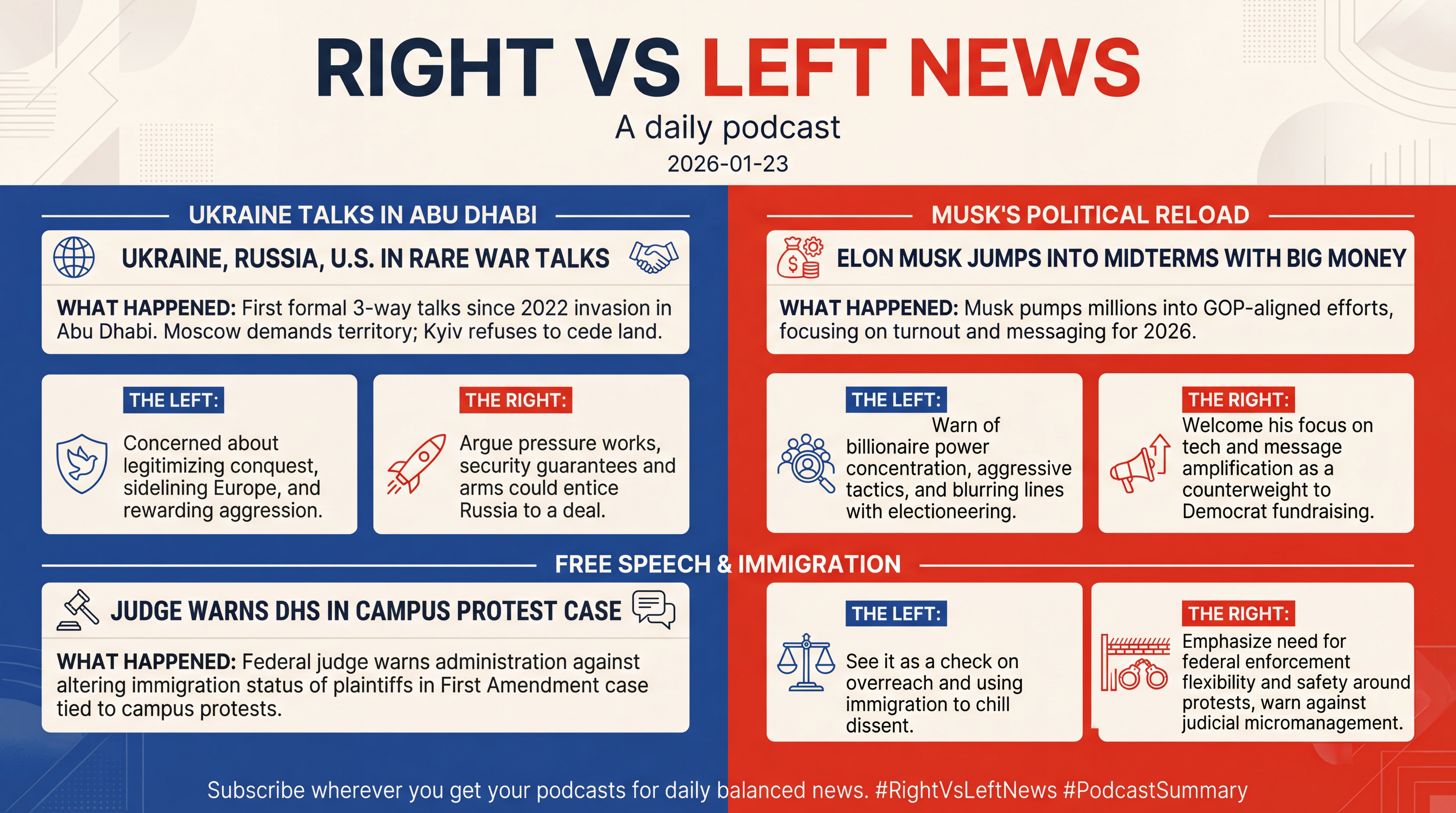
First up — here's what happened. The Financial Times and The Guardian report that delegations from the U.S., Ukraine, and Russia are convening in Abu Dhabi for the first formal three-way talks since the 2022 invasion. Moscow is still demanding that Kyiv cede occupied territory, while President Volodymyr Zelenskyy says any deal can't surrender sovereign land. U.S. envoys Steve Witkoff and Jared Kushner reportedly met with Vladimir Putin before the talks, and the Kremlin is touting a new security-focused working group. Sessions are expected to last through the weekend, with the format still in flux. According to the AP, the Kremlin's stance remains that the war ends only if territorial issues are settled in Russia's favor.
Now — what's the right saying about this? Conservatives point to the talks as proof that pressure is working, arguing that pushing NATO membership off the table — while offering Article Five style security guarantees — could entice Russia toward a deal, paired with strong deterrent arms for Ukraine. National Review has framed earlier briefings as optimistic about a narrow path to a ceasefire if Kyiv accepts robust guarantees short of NATO.
And what about the left? Progressive outlets emphasize the risks of legitimizing territorial conquest and sidelining Europe. The Guardian highlights skepticism over U.S. mediation and concerns that any agreement freezing front lines rewards aggression and undercuts international law. The Financial Times notes Ukraine's insistence that sovereignty and borders can't be traded away.
Let's move to the second story...
Here's what happened. The Wall Street Journal reports that Elon Musk is re-engaging in U.S. politics, building a midterms operation and pumping millions into GOP-aligned efforts — including a ten million dollar boost to a Senate race and new digital voter-mobilization plans. He's aligning with PACs like America PAC and promoting issues such as federal spending restraint and proof of citizenship voting requirements.
What's the right saying? Many conservatives welcome Musk's focus on turnout tech and message amplification. They see his money as a needed counterweight to Democratic small-dollar and union fundraising. The Journal underscores GOP hopes that Musk can supercharge down-ballot races and energize Trump-aligned voters.
And the left? Progressives warn that Musk's spending could further concentrate political power among billionaires — pointing to reporting about aggressive tactics, past legal scrutiny tied to voter registration efforts, and attempts to influence judicial and state races. They argue his platforms and PAC network risk blurring lines between activism, amplification, and electioneering.
On to story three...
Here's what happened. In a First Amendment case tied to pro-Palestinian campus activism, U.S. District Judge William Young warned the administration not to retaliate by altering the immigration status of noncitizen plaintiffs while litigation proceeds. The Washington Post notes the court shielded members of academic groups from adverse immigration actions without clear legal grounds, and the AP reports the judge had already found earlier deportation attempts violated free speech rights.
What's the right saying? Conservative media emphasize that federal agents need flexibility to enforce immigration law and maintain safety around protests — warning against judicial micromanagement of law enforcement.
And the left? Progressives see the ruling as a necessary check on government overreach — arguing that immigration authorities were being used to chill dissent. They want stronger congressional oversight and more transparency around ICE policies.
Quick breather... then to the Hill.
[MIDPOINT_SPONSORS]
Here's what happened. The House passed a DHS funding bill, 220 to 207, with seven Democrats joining most Republicans — keeping ICE operations funded as the broader spending package moves to the Senate. Fox News and The Guardian report the vote came amid progressive anger after a fatal ICE-involved shooting in Minnesota and calls for tighter guardrails. The bill includes body-camera funding and reduced bed counts, but not the deeper limits the left sought.
What's the right saying? Conservatives frame the vote as a necessary step to avoid another shutdown and maintain border enforcement — arguing the package already trims some costs and that restraining ICE would undercut public safety. Speaker Mike Johnson is pushing to steady funding and move the remaining bills.
And the left? Progressives argue Democrats shouldn't bankroll aggressive ICE tactics without stronger accountability. The Guardian notes Senate Democrats may try to tighten oversight language, but many members still feel boxed in by the deadline to keep the government open.
Finally — state politics with national stakes.
Here's what happened. Axios reports that Senator Amy Klobuchar filed fundraising paperwork and formed a committee — an early, formal step toward running for Minnesota governor after Governor Tim Walz said he won't seek reelection. The Washington Post reports she could announce soon, potentially reshaping both the governor's race and, if she wins, control of a Senate seat in 2027.
What's the right saying? Conservative outlets like the New York Post cast Klobuchar's move as a response to Democratic vulnerability in Minnesota — arguing she's trying to steady the party amid welfare fraud scandals and clashes over immigration enforcement that GOP candidates plan to spotlight.
And the left? Progressives see a pragmatic bid to keep the governorship blue and minimize a messy primary. The Post notes Democrats view Klobuchar as a stabilizing figure who could contain fallout from recent state controversies and preserve their broader statehouse agenda.
That's today's snapshot... high-stakes Ukraine talks, a billionaire's big political bet, a speech rights ruling with immigration implications, a DHS funding fight moving through the House, and a marquee governor's race taking shape. We'll keep tracking how each of these develops in the hours ahead.
That's it for today's episode of Right versus Left News. Remember, understanding both sides isn't about picking a team—it's about being informed. Subscribe wherever you get your podcasts, and join us tomorrow for another balanced look at the day's biggest stories. Until next time, stay curious and stay informed.
