
Standby Troops, Ukraine Talks, Davos, China Reset
Standby troops in Minnesota, Ukraine peace talks in Washington, and Davos opens with a populist pitch. We break down a gloomy economic poll and what Canada’s China reset could mean for Washington.
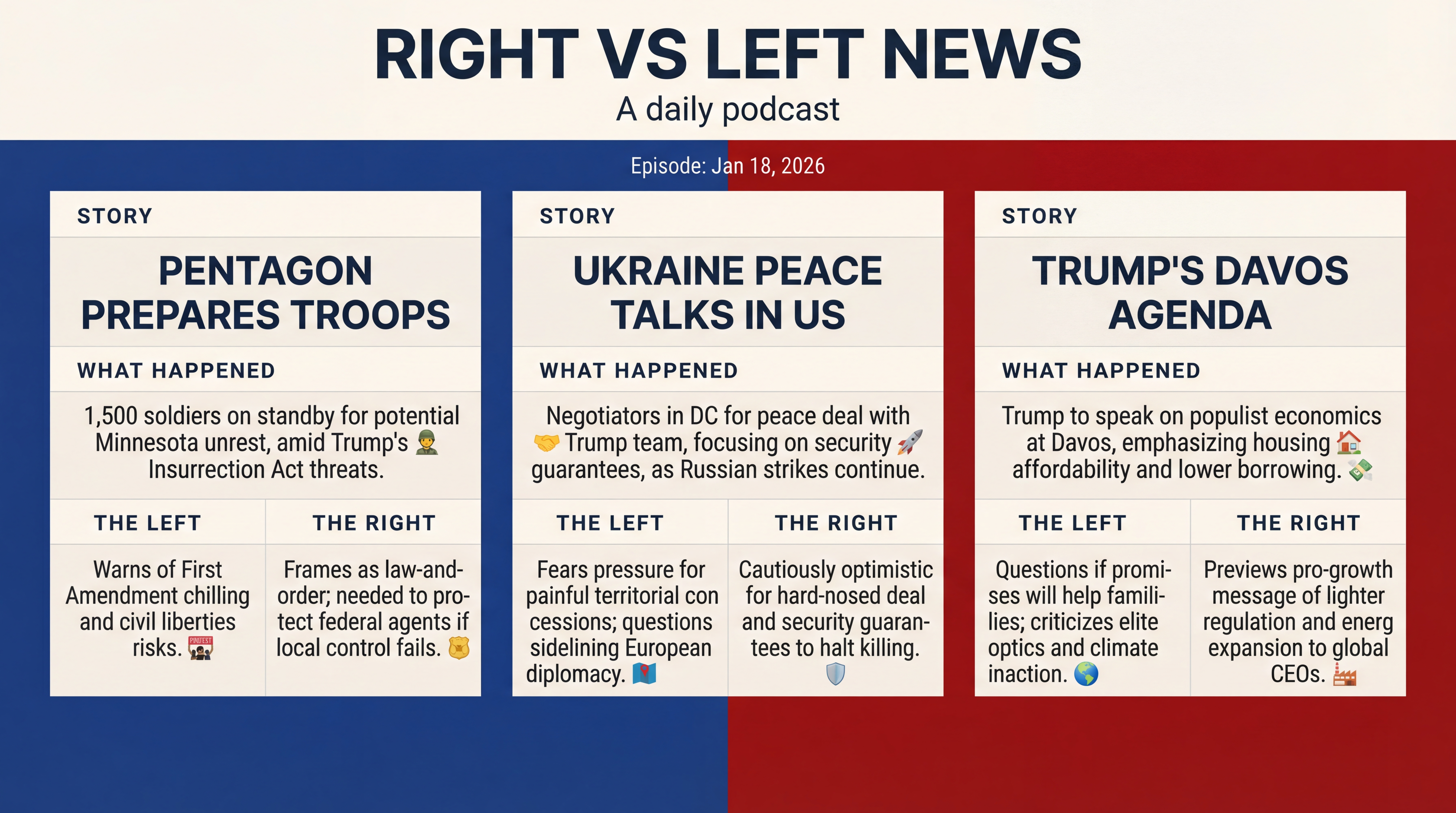
Episode Infographic
Show Notes
Welcome to Right versus Left News—your daily briefing on the stories that matter, told from both sides of the aisle. I'm your AI host - Chris, and each day I bring you the most important political and cultural news, with perspectives from conservative and progressive voices. No spin, no agenda—just the facts and the opinions that shape our national conversation. Let's dive in...
The Pentagon has quietly put about 1,500 active-duty soldiers on prepare-to-deploy orders in case unrest in Minnesota escalates — even as President Trump has threatened... but not invoked... the Insurrection Act.
Ukraine's top negotiators just landed in the U.S. for talks on a possible peace plan, even as Russia keeps striking Ukraine's energy grid.
In Switzerland, Davos kicks off this week, with Trump slated to speak midweek on a populist economic agenda.
A new Wall Street Journal poll finds voters increasingly unhappy with the economy.
And north of the border, Canada's prime minister is courting China — a shift that's catching Washington's eye.
[BEGINNING_SPONSORS]
The Washington Post reports the Pentagon has placed roughly 1,500 soldiers — mainly from the Army's 11th Airborne — on prepare-to-deploy status in case violence flares around anti-ICE protests in Minnesota.
The move follows days of tense demonstrations and Trump's public threats to use the Insurrection Act. On Friday, he said there was no reason to invoke it right now — but he has not ruled it out. Conservative outlets say he is keeping the option on the table to protect federal officers if local authorities lose control.
On the right... Conservative commentators frame this as a straightforward law-and-order issue — protect federal agents, deter violence, and use longstanding legal authority if necessary. They emphasize that the Insurrection Act is a legitimate, if rarely used, tool when states cannot keep order, and they highlight alleged attacks on officers as justification for a tougher federal posture.
On the left... Progressive voices warn that even floating active-duty deployments risks chilling First Amendment rights and escalating confrontations. They stress the extraordinary nature of preparing troops for domestic missions and raise civil-liberties concerns. The remedy, they argue, is de-escalation, accountability for excessive force, and restraint — not soldiers on American streets.
A Ukrainian delegation led by presidential chief of staff Kyrylo Budanov has arrived in the U.S. to discuss details of a possible peace agreement with the Trump administration team — including envoy Steve Witkoff and Jared Kushner — even as Russian strikes again hit Ukraine's power grid.
Kyiv hopes to finalize documents for postwar security and reconstruction, potentially timing an announcement with the Davos meetings. Reports indicate negotiators are focusing on security guarantees short of NATO membership.
On the right... Some conservative outlets and analysts are cautiously optimistic. They point to the idea of Article Five-like guarantees — strong deterrent commitments without formal NATO accession — to try to lock in a cease-fire and pivot toward rebuilding. Supporters say a hard-nosed deal could halt the killing and refocus U.S. resources.
On the left... Progressive voices warn of pressure on Ukraine to accept painful concessions, especially on territory, and question sidelining European diplomacy. Zelenskyy's warnings about ongoing Russian strikes, they say, underscore fears that a rushed deal could cement facts on the ground rather than deliver a just peace.
The World Economic Forum opens this week in Davos. Trump is scheduled to speak midweek — expect themes like housing affordability, curbing big-investor home purchases, and using federal levers to lower borrowing costs.
Coverage also spotlights heavy security and a crowded agenda featuring Ukraine's future and global economic risks. Progressive press is already critiquing the forum's elite optics and climate contradictions.
On the right... Commentators preview a populist economics pitch — lighter regulation, energy expansion, and pro-growth messaging to global CEOs. The case is that showcasing U.S. competitiveness at Davos signals confidence in American industry and prioritizes growth over what they see as Europe's overemphasis on climate regulation.
On the left... Outlets question whether Davos-stage promises translate into relief for ordinary families, and they point to concerns over tariffs, geopolitical saber-rattling, and climate backsliding. Critics say the forum's private-jet optics and vague pledges underscore a disconnect between elite gatherings and everyday economic strain.
[MIDPOINT_SPONSORS]
A new Wall Street Journal poll — splashed across the weekend front page — finds voters increasingly unhappy with the economy under Trump. More rate the economy as weak than strong by double digits, and a plurality say conditions worsened over the past year. Some analysts suggest the president's focus on foreign affairs may be crowding out pocketbook concerns.
On the right... Conservatives push back that sentiment does not always match fundamentals. They argue media negativity and lingering price levels skew perceptions. Pro-market voices point to the upcoming Davos message and to growth, energy supply, and deregulation as longer-term tailwinds — urging patience as affordability measures, like housing proposals, work through the system.
On the left... Progressives say voters are right to feel squeezed — food and utility costs remain high, and electricity bills climbed last year. They highlight stubborn grocery inflation and rising power costs as evidence that cooling headline inflation has not restored affordability for many households.
Canada is signaling a thaw with China. Reporting from Beijing describes Prime Minister Mark Carney's first trip by a Canadian leader in years, talks with Xi Jinping, and efforts to restart trade after years of tariffs and diplomatic freezes. Some reports describe movement on sector deals and a broader push to diversify away from heavy U.S. dependence.
On the right... The worry is security and alliance drift. Closer Canada–China ties could blunt U.S. efforts to counter Beijing and undercut North American supply-chain strategy. Business voices caution about IP risks, influence operations, and the possibility that Chinese EV or critical-minerals access could complicate U.S.–Canada trade harmony.
On the left... Many see a pragmatic reset — easing tariffs, reopening markets for Canadian exporters, and lowering consumer costs, especially if the detente includes labor and environmental protections. They also note that diplomacy with China does not preclude cooperation with Washington — it could give Ottawa leverage amid wider trade spats.
As the week unfolds, we will watch whether Minnesota calms, whether talks in Washington gain traction, what signals come out of Davos, how voters digest the economy, and how Ottawa balances its China reset with U.S. ties.
That's it for today's episode of Right versus Left News. Remember, understanding both sides isn't about picking a team—it's about being informed. Subscribe wherever you get your podcasts, and join us tomorrow for another balanced look at the day's biggest stories. Until next time, stay curious and stay informed.
