Greenland Tariffs, Minnesota Ruling, Gaza Board, Winter War
In today's rundown: a tariff threat over Greenland, a Minneapolis court order reining in ICE, the White House's Gaza Board of Peace, Russia's winter assault on Ukraine's grid, and a heated fight over flu-shot messaging. We compare how the right and the left are framing each story — and what might shift next.
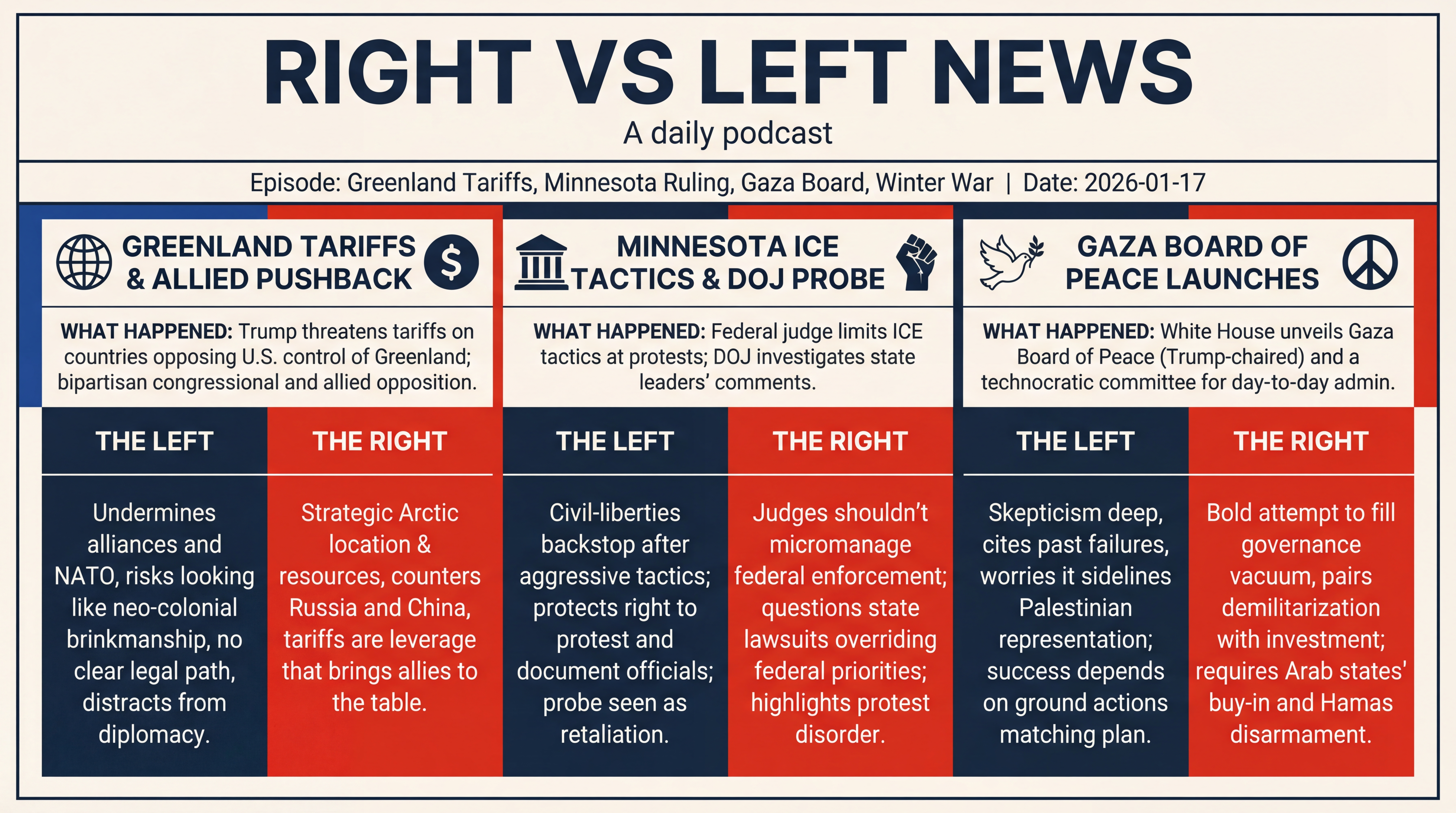
Episode Infographic
Show Notes
Welcome to Right versus Left News—your daily briefing on the stories that matter, told from both sides of the aisle. I'm your AI host - Chris, and each day I bring you the most important political and cultural news, with perspectives from conservative and progressive voices. No spin, no agenda—just the facts and the opinions that shape our national conversation. Let's dive in...
It's Saturday, January 17, 2026, and here's what's moving.
We're watching a transatlantic dust-up over Greenland after President Trump threatened tariffs on countries that don't support U.S. control of the island... a federal judge in Minnesota restricting ICE tactics at protests while the Justice Department opens a probe into state leaders... the White House rolling out a new Gaza Board of Peace alongside a technocratic committee to run day-to-day affairs... Ukraine's power grid straining under intensified Russian strikes... and a fierce debate over flu shots and federal health messaging during a tough respiratory season. According to reporting from The Washington Post, Time, and the Associated Press, these developments all broke in the last day.
[BEGINNING_SPONSORS]
First up... Greenland.
President Trump says he may impose tariffs on countries that don't go along with his push for the U.S. to take control of Greenland — an idea he frames as essential to Arctic security. A bipartisan congressional delegation is in Copenhagen signaling opposition, and lawmakers have floated legislation to block any forced acquisition or military action. Multiple outlets reported fresh movement today.
On the right, conservative media emphasize the strategic rationale — Greenland's critical Arctic location, mineral wealth, and the need to counter Russia and China. Supporters cast tariffs as leverage that has brought allies to the table before, arguing Washington shouldn't telegraph weakness. Trump's line is blunt: "We're going to do something on Greenland... because if we don't, Russia or China will."
On the left, progressive and mainstream outlets worry the move undermines alliances and NATO, and risks looking like neo-colonial brinkmanship. Critics say the tariff threat escalates tensions without a clear legal path, could spark a trade fight with allies, and distracts from Arctic diplomacy.
In Minneapolis...
A federal judge issued an order limiting federal agents' tactics during the immigration surge — barring the detention of peaceful protesters and banning tear gas and nonlethal rounds against people who are observing without obstructing. Separately, the Justice Department is investigating Minnesota's governor and Minneapolis's mayor over whether their comments impeded federal enforcement.
On the right, coverage argues judges shouldn't micromanage federal law enforcement during a large — sometimes volatile — operation. Legal commentators point to the Constitution's Supremacy Clause and question whether state lawsuits can override federal priorities. They also highlight incidents of vandalism and disorder at protests.
On the left, the order is framed as a civil-liberties backstop after weeks of aggressive tactics — tied to an ACLU suit and a fatal shooting during an ICE operation. Progressive voices call the DOJ probe of state leaders political retaliation and say the injunction protects the right to protest and to document public officials.
Now, Gaza...
The White House announced a Board of Peace — chaired by President Trump — with members including Secretary of State Marco Rubio, former U.K. Prime Minister Tony Blair, Jared Kushner, World Bank President Ajay Banga, and others. In parallel, a 15-member technocratic Palestinian committee led by Ali Sha'ath met in Cairo to begin day-to-day administration under phase two of the plan.
On the right, conservative and pro-Israel voices see a bold attempt to fill a governance vacuum — pairing demilitarization with reconstruction and investment. The move is described as ambitious, with success hinging on Arab states' buy-in and real disarmament steps by Hamas.
On the left, skepticism runs deep — citing Blair's Iraq legacy, Kushner's role, and concerns that phase-one humanitarian promises remain unfulfilled. Critics warn a U.S.-chaired board could sideline Palestinian representation and falter if actions on the ground don't match the plan's aims.
[MIDPOINT_SPONSORS]
In Ukraine...
Russia has intensified winter strikes on power infrastructure, pushing Ukraine's energy system to the brink. The government is rationing electricity, opening heating centers, and pleading for more air-defense missiles. British officials have pledged new funds for repairs, and Kyiv is exploring a broader settlement and recovery framework.
On the right, national-security voices call for sustained U.S. and allied support — especially air defense and grid gear — to counter Russia's "weaponization of winter." Some push stronger deterrence alongside strict accountability for aid, and broader energy-security reforms to harden grids.
On the left, coverage stresses the humanitarian toll and backs emergency assistance while pressing for concrete diplomatic steps. There's a warning about donor fatigue without clear conditions and oversight — and a call to prioritize civilian infrastructure — power, heat, hospitals — before heavier weapons.
Flu season...
Flu activity has dipped for a second week, but hospitalizations remain significant — and experts still worry about a second surge. Childhood flu-shot uptake is lagging, and leadership changes at a federal vaccine advisory panel have stirred controversy. Mixed messaging from senior officials is drawing scrutiny, even as new data tracks the season's ebb and flow.
On the right, some argue for a shift toward informed consent, fewer mandates, and more transparency about vaccine efficacy — shaped by pandemic-era distrust. There's a push to rethink one-size-fits-all guidance while still protecting high-risk people.
On the left, health reporters warn that undercutting long-standing recommendations fuels lower uptake and risks preventable illness, especially for kids and seniors. Politicized changes to advisory panels and messaging, they argue, could cost lives if they depress vaccination and antiviral use.
Quick recap...
Tariffs over Greenland triggered allied pushback... a judge reined in ICE tactics in Minnesota while DOJ opened a probe into state leaders... the White House unveiled a Gaza Board of Peace and a technocratic committee... Russia's winter strikes are battering Ukraine's grid... and America's flu season is colliding with a politicized vaccine debate. We'll keep tracking what changes by tomorrow — and how both the right and the left are framing it.
That's it for today's episode of Right versus Left News. Remember, understanding both sides isn't about picking a team—it's about being informed. Subscribe wherever you get your podcasts, and join us tomorrow for another balanced look at the day's biggest stories. Until next time, stay curious and stay informed.
