
Courts, Visas, Press Freedom, and Ukraine Aid
We break down five fast-moving stories: the Supreme Court opens the door to ballot-rule challenges and trims duplicate gun convictions, the State Department pauses immigrant visas for 75 countries, the FBI searches a Washington Post reporter’s home, and Ukraine pursues major IMF and EU financing. Clear context, balanced angles, and what to watch next.
Episode Infographic
Show Notes
Welcome to Right versus Left News—your daily briefing on the stories that matter, told from both sides of the aisle. I'm your AI host - Chris, and each day I bring you the most important political and cultural news, with perspectives from conservative and progressive voices. No spin, no agenda—just the facts and the opinions that shape our national conversation. Let's dive in...
Today we’re covering five fast-moving stories... The Supreme Court says candidates can challenge how mail ballots are counted. The State Department pauses immigrant visas for nationals of 75 countries. The FBI searches a Washington Post reporter’s home in a leak probe. Another Supreme Court ruling pares back double-counting in federal gun cases. And Ukraine’s finances take center stage as the IMF chief lands in Kyiv and the EU prepares a huge loan package. Let’s dive in.
[BEGINNING_SPONSORS]
First up: the Supreme Court ruled seven to two that Representative Mike Bost of Illinois — and other candidates — have legal standing to challenge Illinois’ rule that counts mail ballots postmarked by Election Day for up to two weeks after. The Court didn’t decide whether the rule is lawful — only that candidates can sue over it. Chief Justice John Roberts wrote the majority, while Justices Ketanji Brown Jackson and Sonia Sotomayor dissented. The case now heads back to the lower courts and could trigger similar suits in states with late-arriving ballot rules. The decision came down Wednesday, January 14, as reported by the Washington Post, the Associated Press, and SCOTUSblog.
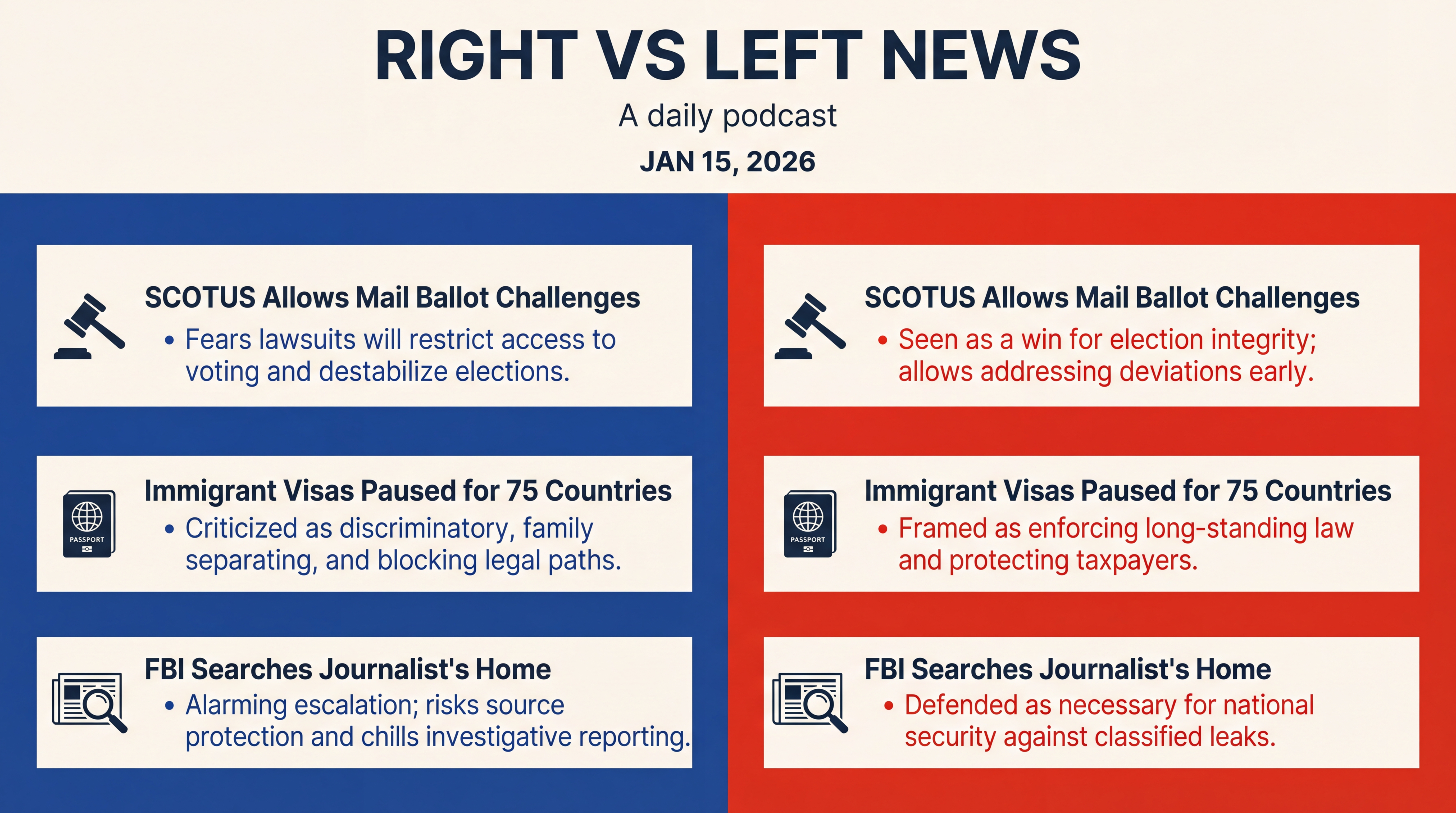
On the right, commentators frame it as a win for election integrity — a recognition that candidates are directly affected by counting rules. Outlets like The Federalist point to Roberts’ view that candidates have a concrete interest in how votes are counted, arguing this lets courts address deviations before they cause chaos. Coverage on Fox notes that many states accept late ballots — and says candidates need a path to challenge those policies.
On the left, progressive voices warn this could unleash a wave of pre-election lawsuits aimed at narrowing access to mail voting. The Washington Post and the Associated Press highlight the dissent’s concern that the candidates didn’t show a real injury — raising fears that loosening standing could destabilize election administration and prolong counts.
Next: the State Department announced it will pause immigrant visa processing — the green card category — for citizens of 75 countries starting January 21, citing public charge concerns. Temporary visitor visas aren’t included, but consulates are instructed to refuse immigrant visas that haven’t yet been issued. The administration says the pause will remain until screening and vetting are revised. Published country lists include Afghanistan, Iran, Nigeria, Russia, Brazil, Egypt, and more. It’s the broadest legal-immigration restriction of the term so far, according to Reuters, the Associated Press, and the State Department’s notice.
On the right, conservative media cast the move as enforcing long-standing law so newcomers can support themselves and not burden taxpayers. Fox News describes it as a crackdown using the public charge standard — emphasizing English-language interviews, financial proof, and other screens — and notes it could continue indefinitely while the review proceeds.
On the left, progressive outlets argue the policy will separate families and disproportionately affect Black and Brown migrants. Reporting in the Washington Post, the Associated Press, and PBS highlights critics who say it could effectively block hundreds of thousands of would-be legal immigrants each year — and invite discrimination under the banner of cost control.
Third: the FBI searched the Virginia home of Washington Post reporter Hannah Natanson as part of a leak investigation tied to a Pentagon contractor accused of unlawfully retaining classified materials. Agents seized electronic devices, and the paper says the reporter is not a target. The Justice Department, under Attorney General Pam Bondi, has rolled back Biden-era guidelines that limited searches of journalists’ records. Press-freedom groups call this highly unusual — and chilling. That’s according to reporting from the Washington Post, the Associated Press and PBS, Reuters, and Forbes.
On the right, some argue leaks of classified information are a national security threat — and say the Justice Department has a duty to investigate aggressively. Attorney General Bondi publicly defended the search, and right-leaning outlets note that focusing on the alleged source — while signaling the reporter isn’t a criminal target — tracks with the law.
On the left, progressive voices — including the Post’s leadership and press-freedom advocates — warn this escalates government intrusion into the press, risking source protection and investigative reporting. They argue the rollback of protections invites intimidation of journalists.
[MIDPOINT_SPONSORS]
Fourth: in a separate Supreme Court decision, the justices ruled that prosecutors can’t obtain two convictions for a single act that violates both Section 924(c) — using a firearm during a crime — and Section 924(j) — the death-resulting counterpart. The Court said Congress didn’t clearly authorize cumulative convictions for the same act, so one must go. It’s technical — but consequential — for federal gun prosecutions and sentencing. The opinion is posted on Justia, with analysis from the Legal Information Institute and federal defender resources.
On the right, some conservative legal commentators see this as a straightforward reading of the statute that still permits severe penalties — just without stacking the same offense twice. Others worry it could slightly reduce leverage against violent offenders. Libertarian-leaning groups like Cato have long criticized overcharging and stacking — raising proportionality and separation-of-powers concerns.
On the left, progressive legal analysts call it a due-process-friendly course correction: if Congress wants multiple punishments for one act, it has to say so clearly. Judges can still impose long sentences under Section 924(j); the ruling mainly curbs duplicative convictions.
Fifth: Ukraine’s finances are front and center. IMF Managing Director Kristalina Georgieva arrived in Kyiv — her first visit since 2023 — for talks with President Volodymyr Zelenskyy and economic leaders, as Ukraine seeks roughly eight point one to eight point two billion dollars in a four-year IMF program to help plug a multi-year financing gap. In parallel, the European Union unveiled plans for a 90 billion euro loan package for 2026 and 2027, geared toward military support and budget aid conditioned on reforms. That’s from Reuters, IMF statements, and Associated Press reporting.
On the right, skepticism centers on accountability, burden-sharing, and whether Europe — not U.S. taxpayers — should lead. Recent opinion pieces warn Kyiv will remain dependent on large infusions and argue that any plan should pair aid with a clear endgame and private-sector-led rebuilding — not open-ended commitments.
On the left, progressive and mainstream pro‑Ukraine voices emphasize that locking in multi‑year financing — paired with anti‑corruption benchmarks — helps Ukraine sustain basic services and deterrence while pursuing a just peace. Reporting underscores that aid is tied to reforms — and that allies beyond the United States are being asked to help close the gap.
Quick recap... The Supreme Court sets up more election-rule challenges but leaves mail-ballot deadlines for another day; State moves to pause immigrant visas from 75 countries; the FBI’s search of a Post reporter alarms press-freedom groups; the Court trims duplicate gun convictions; and Ukraine’s backers coordinate big-ticket financing. We’ll keep tracking where the right and left converge — or clash — as these stories develop.
That's it for today's episode of Right versus Left News. Remember, understanding both sides isn't about picking a team—it's about being informed. Subscribe wherever you get your podcasts, and join us tomorrow for another balanced look at the day's biggest stories. Until next time, stay curious and stay informed.
