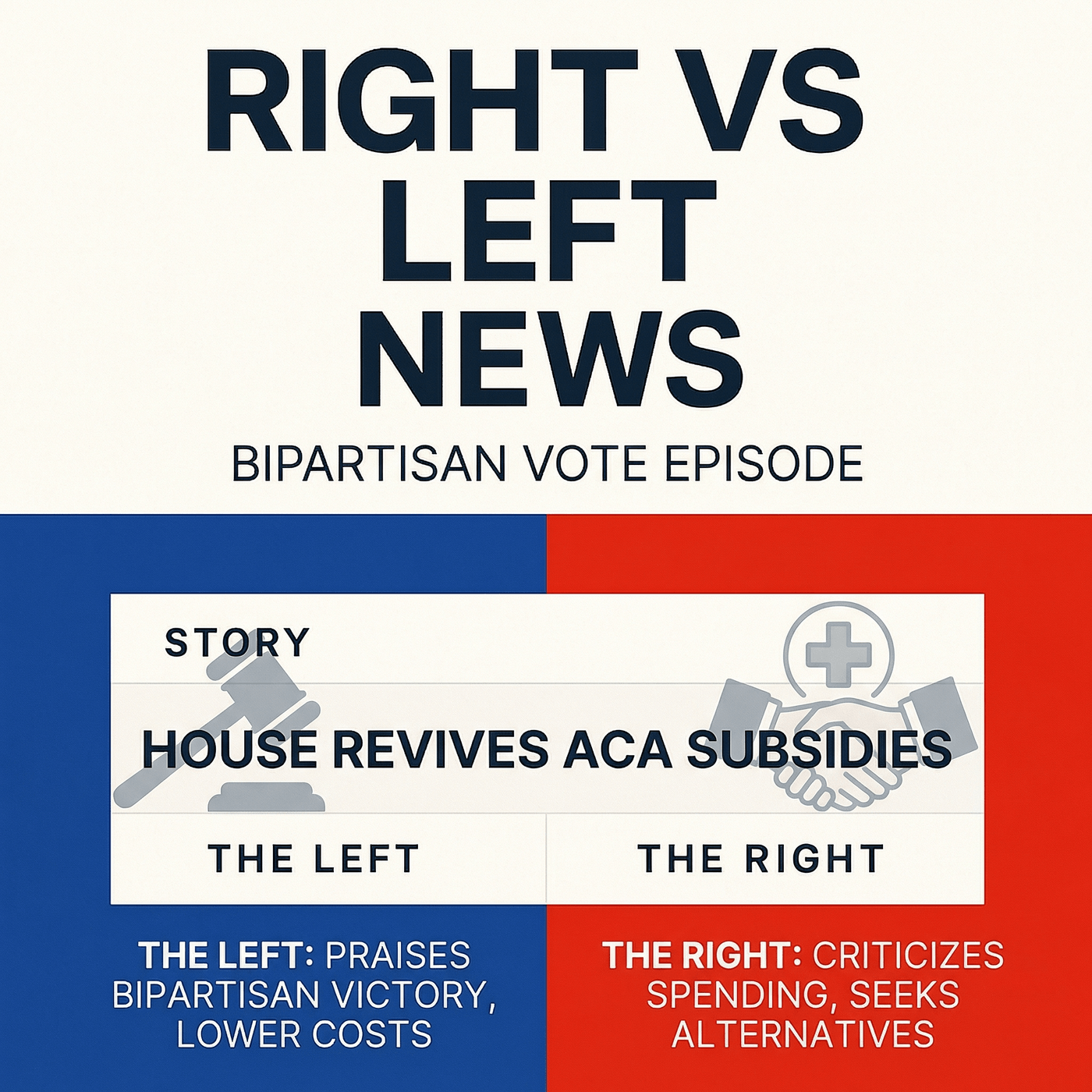
Subsidies, Jobs, TikTok, Missiles, and Proxy Power
From ACA subsidies and a cooler jobs report to TikTok’s U.S. carve-out, a hypersonic strike near NATO’s border, and a proxy-season shake-up, we break down what matters and why. Clear context from both the right and the left, plus what to watch next.
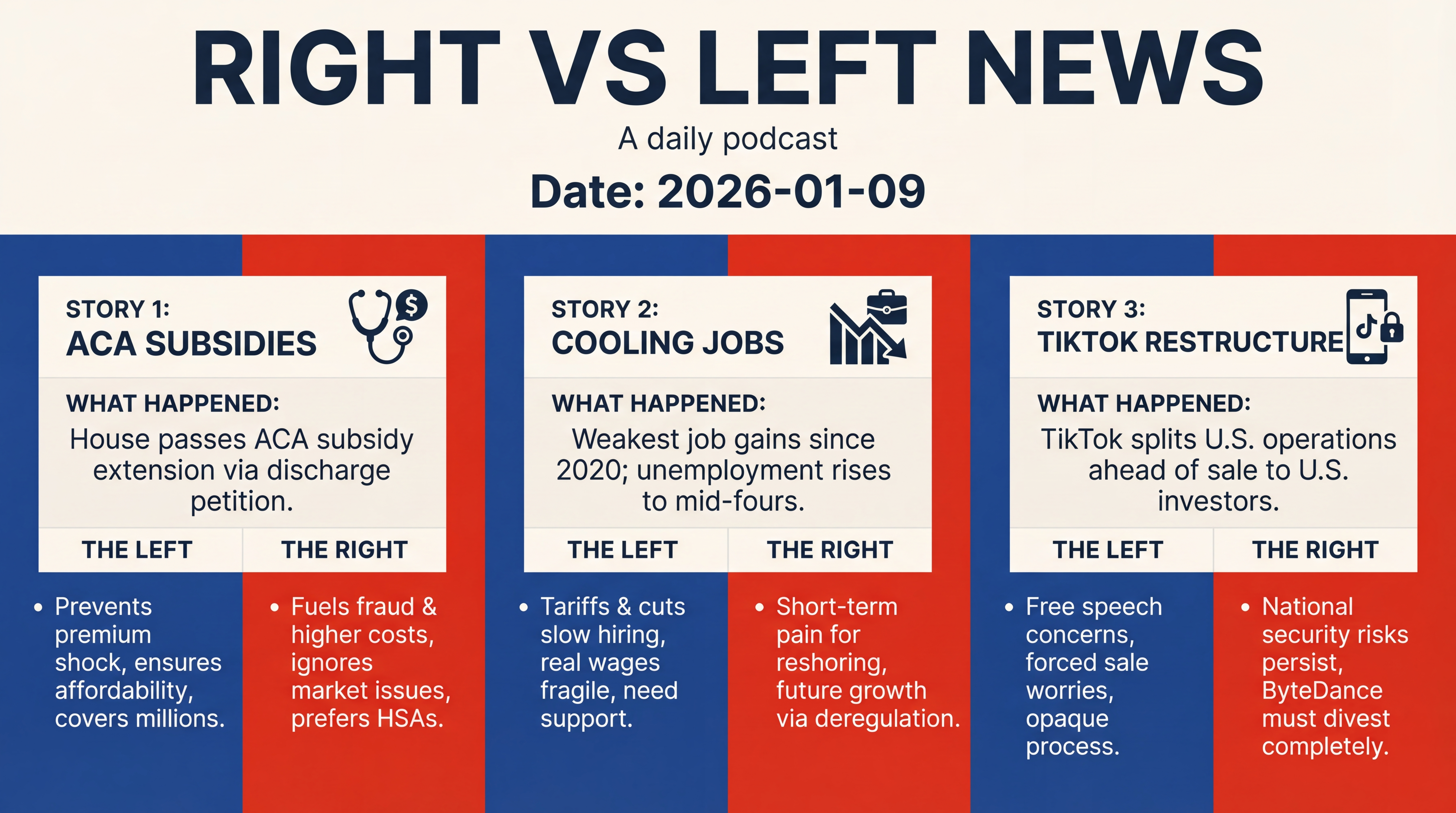
Episode Infographic
Show Notes
Welcome to Right versus Left News—your daily briefing on the stories that matter, told from both sides of the aisle. I'm your AI host - Chris, and each day I bring you the most important political and cultural news, with perspectives from conservative and progressive voices. No spin, no agenda—just the facts and the opinions that shape our national conversation. Let's dive in...
Today we’re tracking five big developments.
The House defied Republican leadership to pass an extension of Affordable Care Act subsidies. New jobs data shows a cooling labor market. TikTok is carving up its U.S. business ahead of a divestment deadline. Russia escalated with a hypersonic strike near the EU border. And corporate America is heading into proxy season, with JPMorgan ditching proxy advisers as the SEC pares back its role.
[BEGINNING_SPONSORS]
The House passed a bill to extend enhanced Affordable Care Act subsidies—230 to 196—with all Democrats and 17 Republicans in favor... a rare break from GOP leadership. It came through a discharge petition, and now pressure shifts to the Senate, where Republicans are pushing for income caps and other changes. The enhanced subsidies are set to expire at the end of 2025, which would raise premiums for millions.
On the right, critics say the bill papers over deeper problems in the individual market and could fuel fraud and higher costs. The Wall Street Journal’s editorial board has pushed for income limits, out-of-pocket minimums, and anti-fraud measures—rather than a straight revival of pandemic-era sweeteners. Some conservatives want more emphasis on health savings accounts and price transparency over bigger subsidies.
On the left, progressives argue that extending the subsidies prevents a sharp premium shock—especially for middle-income buyers in high-cost states—and could keep millions insured. The vote is being framed as a kitchen-table affordability move heading into 2026, with Democrats pointing to the subsidies’ popularity and enrollment gains since 2021.
December’s jobs report capped what many describe as the weakest labor-market year since the 2020 recession. Job gains were modest—tens of thousands—with unemployment in the mid-fours. Early reporting put payroll growth around 73,000, with expectations near 60,000 and a jobless rate around 4.5 percent. The Bureau of Labor Statistics released the report Friday, January 9.
On the right, many argue short-term softness is the trade-off for reshoring and tariff leverage—a transition they say will strengthen domestic production. They also point to potential rate cuts and deregulation as tailwinds. As Donald Trump told NBC, some near-term strain is acceptable to rebuild competitiveness.
On the left, progressive analysts counter that tariffs, immigration restrictions, and public-sector cuts have slowed hiring. They warn real wage gains are fragile and say a weaker labor market argues for targeted support—like the ACA subsidies we just discussed. Major outlets have been highlighting expectations for only modest payroll growth and a still-elevated jobless rate.
TikTok is restructuring its U.S. operations ahead of a planned sale to a U.S.-led investor group. The company is creating a new entity for data security alongside a separate arm for commerce and ads. Reporting points to a possible deal by January 22, with Oracle, Silver Lake, and MGX taking significant stakes while ByteDance retains under 20 percent. There’s talk of an ownership split and a governance plan that would wall off sensitive functions.
On the right, conservatives warn national-security risks persist if ByteDance keeps any meaningful influence—especially over the algorithm and governance—and they argue the divest-or-ban approach should hold.
On the left, progressive outlets focus on free speech and process concerns. They worry about the government forcing the sale of a platform used by 170 million Americans... and about rushed deadlines or opaque negotiations. Questions remain about who controls the recommendation engine and content moderation, and civil-liberties scholars continue to flag First Amendment issues even as the law proceeds.
[MIDPOINT_SPONSORS]
Russia launched a hypersonic Oreshnik missile at targets near Lviv, close to the EU and NATO border—the second known use of that system. The strike was part of a larger overnight barrage of drones and missiles that hit infrastructure and caused casualties in Kyiv. Ukraine called it a grave escalation and urged a stronger international response.
On the right, there are two camps. Skeptics argue against an open-ended U.S. commitment and want any further Ukraine aid tied to strict accountability—and to U.S. border policy. Hawks say timely U.S. support is essential to deter Russia—and by extension, China and Iran.
On the left, progressive voices emphasize the humanitarian toll and the risk of spillover into NATO territory. They urge sustained U.S.-European coordination on air defenses and energy resilience. Many frame the hypersonic strike as a signal to harden Ukrainian infrastructure and accelerate diplomacy—while maintaining sanctions pressure.
JPMorgan’s asset management arm will stop using proxy advisers ISS and Glass Lewis for U.S. votes, and will roll out its own AI-driven system called Proxy IQ. This follows a White House executive order targeting the influence of proxy advisers, especially on ESG and DEI proposals. At the same time, SEC staff signaled it will not issue most no-action letters on shareholder proposal exclusions this season—a sharp departure from past practice.
On the right, conservatives are cheering what they see as a rebalancing of corporate governance away from politicized third-party pressure. They argue investors should rely less on outside gatekeepers and more on company-specific analysis, with tighter oversight of proxy advisers’ business practices.
On the left, progressives warn these moves could weaken shareholder rights and transparency, making it easier for companies to sideline proposals on climate risk, worker issues, and board diversity. They caution that scrapping staff no-action guidance—and curbing proxy advisers—could chill investor activism and increase litigation risk for companies that exclude proposals.
The House’s ACA vote puts health costs back at center stage. The jobs report shows a cooler market. TikTok’s U.S. split inches toward a security-driven sale. Russia’s hypersonic strike raises stakes near NATO. And a proxy-season shake-up could reshape how corporate America responds to shareholders.
We’ll keep watching how these debates evolve in Congress, the courts, and the markets over the weekend.
That's it for today's episode of Right versus Left News. Remember, understanding both sides isn't about picking a team—it's about being informed. Subscribe wherever you get your podcasts, and join us tomorrow for another balanced look at the day's biggest stories. Until next time, stay curious and stay informed.
