Global Pullback, Sanctions Sledgehammer, Visa Bonds, Texas Bar
We break down the U.S. exit from dozens of international bodies and a bipartisan Russia sanctions bill, plus expanded visa bonds, Iowa's new education flexibility, and Texas reshaping law school accreditation. What it means for U.S. influence, alliances, travelers, classrooms, and the legal pipeline.
Episode Infographic
Show Notes
Welcome to Right versus Left News—your daily briefing on the stories that matter, told from both sides of the aisle. I'm your AI host - Chris, and each day I bring you the most important political and cultural news, with perspectives from conservative and progressive voices. No spin, no agenda—just the facts and the opinions that shape our national conversation. Let's dive in...
It's Thursday, January 8, 2026. Here's what we're tracking today... a sweeping U.S. pullback from dozens of international organizations—most notably the U.N. climate treaty—and a bipartisan Russia sanctions push the White House now supports.
We'll also look at a State Department visa-bond expansion affecting travelers from 25 additional countries, a first-of-its-kind federal education waiver giving Iowa broader spending flexibility, and a Texas move to end the ABA's monopoly over which law schools count for bar admission. Let's get into it.
[BEGINNING_SPONSORS]
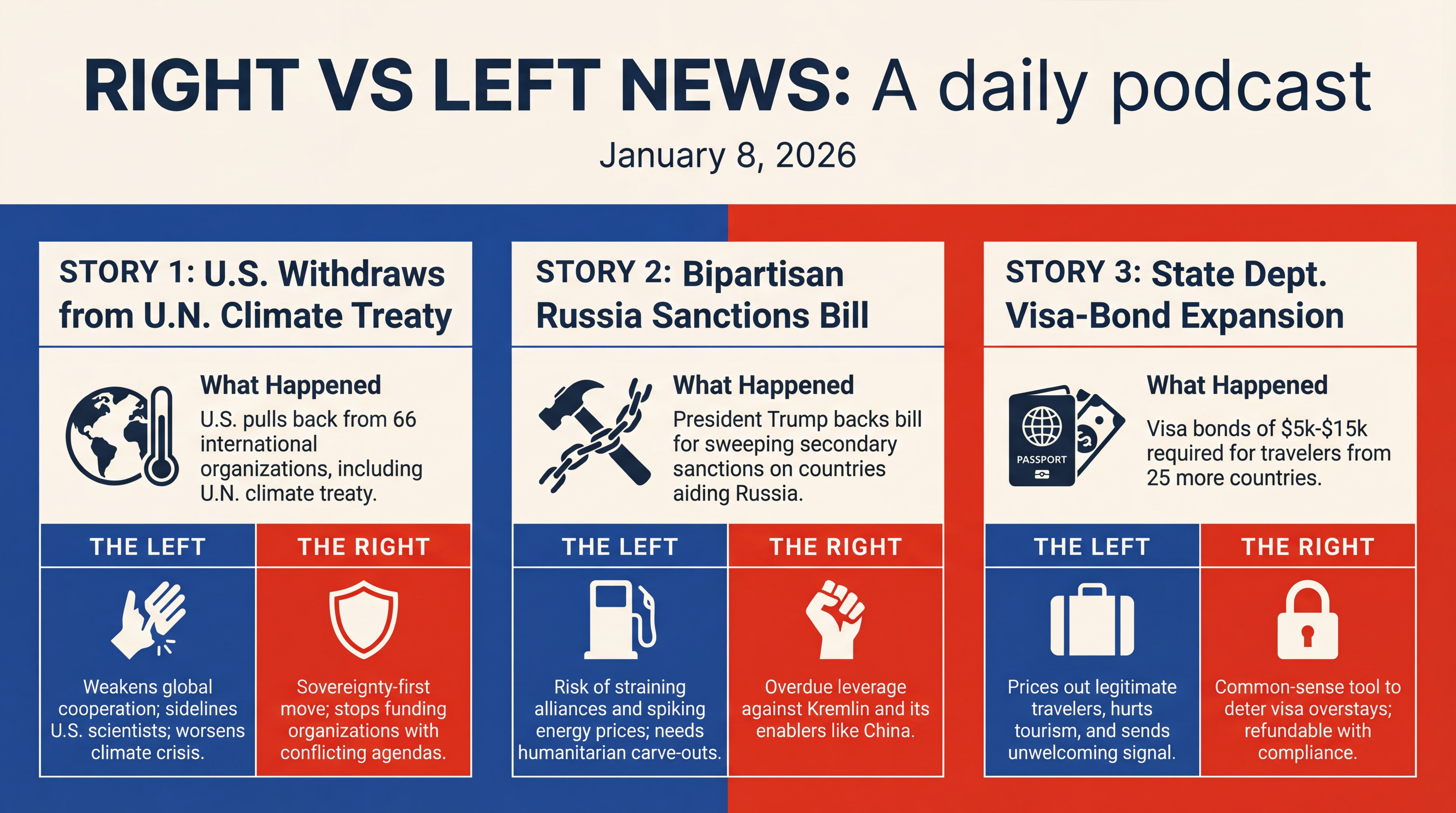
First up... the administration says the U.S. will withdraw from 66 international organizations and U.N. bodies, including the U.N. Framework Convention on Climate Change—the foundational treaty behind the Paris Agreement. The White House argues many of these groups push agendas that conflict with U.S. interests and sovereignty—and that leaving will redirect taxpayer funds. Reports from Reuters and the Washington Post say the list ranges from climate and migration forums to U.N. agencies like UNFPA, with officials signaling reduced participation or funding where the law allows. Critics warn the move could diminish U.S. influence and cede ground to rivals like China. The directive was signed Wednesday, according to a White House fact sheet and major outlets.
On the right... supporters call these exits long-overdue course corrections—arguing the U.N. and related bodies are bloated, politicized, and biased, and that the U.S. shouldn't bankroll organizations that undermine its interests. Fox News coverage echoes a sovereignty-first rationale and skepticism of migration and cultural programs. Backers say reasserting control lets Washington bargain from strength and avoid entangling obligations.
On the left... progressive voices—from environmental groups to major newspapers—call leaving the U.N. climate treaty an abdication of climate leadership that weakens global cooperation just as extreme weather worsens. Outlets like the Washington Post and the Guardian, along with groups such as NRDC, warn that leaving sidelines U.S. scientists and negotiators—and could complicate any future reentry. Some also question whether unilaterally leaving a Senate-ratified treaty is legal.
Next... President Trump has greenlit a bipartisan sanctions bill crafted by Senators Lindsey Graham and Richard Blumenthal. Reports from the Associated Press and Reuters say the proposal would allow sweeping penalties—not just on Russia, but on countries that bankroll Moscow by buying its oil, gas, uranium, and other exports. A Senate vote could come as early as next week—though timing may depend on the funding calendar. The White House had previously sought more flexibility, but now says the president supports moving the bill forward.
On the right... conservatives long skeptical of Kremlin aggression argue tougher secondary sanctions are overdue—and give Washington leverage without deploying troops. CBS News highlighted Graham's "sledgehammer" framing, saying the bill would pressure China and India in particular. Some also argue sanctions should be paired with weapons for Ukraine and tougher energy policies at home.
On the left... many progressives support tightening the screws on Russia and its customers—but caution that broad secondary sanctions can strain alliances, spike energy prices in the Global South, and complicate peace talks. They want strong humanitarian carve-outs and guardrails on executive authority. Associated Press coverage also flags concerns that enforcement and waiver powers would remain in the president's hands.
Third... the State Department expanded its visa-bond program, adding 25 countries to a list whose citizens must post refundable bonds—$5,000, $10,000, or $15,000—when applying for short-term B-1 and B-2 visas. Reuters reports the change, effective January 21, lifts the total to 38 countries, many in Africa, with additions including Venezuela, Bangladesh, and Nigeria. Officials say the bonds are designed to deter overstays—paying doesn't guarantee a visa, and the money is refunded with compliance or denial.
On the right... supporters call it a common-sense tool to enforce the rules without blanket bans—if applicants follow their terms, they get the money back. They also say the policy targets overstay risk rather than nationality writ large.
On the left... immigrant rights groups and many progressives warn the bonds will price out legitimate travelers, hurt family visits and tourism, and send an unwelcoming signal to developing nations. Critics call it a paywall for entry that could be applied arbitrarily at consulates—raising fairness and due process concerns.
[MIDPOINT_SPONSORS]
Fourth... Iowa just became the first state to win a federal waiver letting it pool several education funding streams into a more flexible block—about nine and a half million dollars—through 2028. The U.S. Department of Education and the Associated Press say the waiver mostly affects state-level administrative funds from programs serving teacher training, English learners, after-school activities, and academic enrichment. Iowa argues it will redirect roughly eight million dollars in staff time from compliance to classrooms. The Washington Post reports other states may follow.
On the right... supporters who favor returning education to the states say flexibility lets Iowa target literacy, teacher pipelines, and local priorities—rather than Washington paperwork. They see it as a pilot for broader federalism in K-12.
On the left... progressives warn that loosening categorical rules can dilute resources for vulnerable students, including English learners and low-income kids, and can erode accountability. Outlets like the Washington Post and PBS note Democrats in Congress have urged the Department to reject broad block grants, citing risks to equity and oversight.
Finally... the Texas Supreme Court has finalized a plan to end reliance on the American Bar Association for law school accreditation in bar admissions—making Texas the first state to do so. Reuters reports Texas will approve schools using simple, objective, ideologically neutral criteria, while aiming to preserve degree portability with other states. The ABA says it will cooperate to maintain national mobility, and Texas public radio emphasizes there's no immediate change to the current school list.
On the right... free-market and antitrust-minded conservatives—including staff at the Federal Trade Commission in a recent letter—argue the ABA's gatekeeping power raises costs and limits competition, keeping tuition high and new models out. Supporters say Texas's move could open the door to innovative, lower-cost legal education pathways.
On the left... progressive legal voices and many law deans worry decoupling from ABA standards could threaten quality and bar-passage outcomes, and eventually complicate interstate practice. They caution that ideologically neutral criteria may still invite political interference and uneven student protections. Coverage from Texas public radio and the ABA underscores ongoing concern about maintaining consistent national standards.
Quick recap... a U.S. pullback from dozens of international bodies—especially the U.N. climate treaty—dominated today's headlines. The White House backed a tough, bipartisan Russia sanctions bill. Visa bonds expanded to more countries. Iowa won a first-of-its-kind education flexibility waiver. And Texas upended the ABA's long-standing accreditation role. We'll keep tracking what passes, what pauses, and what pivots... tomorrow.
That's it for today's episode of Right versus Left News. Remember, understanding both sides isn't about picking a team—it's about being informed. Subscribe wherever you get your podcasts, and join us tomorrow for another balanced look at the day's biggest stories. Until next time, stay curious and stay informed.
