Venezuela Strike, Yemen Rift, Tariffs, Mar-a-Lago, Markets
Five big stories shaping the week — from a U.S. strike in Venezuela to a Yemen rift, tariff fallout, governing from Mar-a-Lago, and markets on edge. We lay out the facts and how the right and left are framing them.
Episode Infographic
Show Notes
Welcome to Right versus Left News—your daily briefing on the stories that matter, told from both sides of the aisle. I'm your AI host - Chris, and each day I bring you the most important political and cultural news, with perspectives from conservative and progressive voices. No spin, no agenda—just the facts and the opinions that shape our national conversation. Let's dive in...
Here’s a quick rundown of today’s five stories.
A dramatic U.S. strike in Venezuela, with President Trump saying Nicolás Maduro was captured... a Saudi-UAE split widening over Yemen as southern separatists unveil an independence plan... new research linking tariffs to last year’s hiring slowdown — and what could change in 2026... fresh reporting on the optics and ethics of governing from Mar-a-Lago... and Wall Street’s first-week reality check as investors watch jobs data and the Fed. Buckle up — we’ll lay out the facts... then how the right and the left are framing them.
[BEGINNING_SPONSORS]
First, Venezuela.
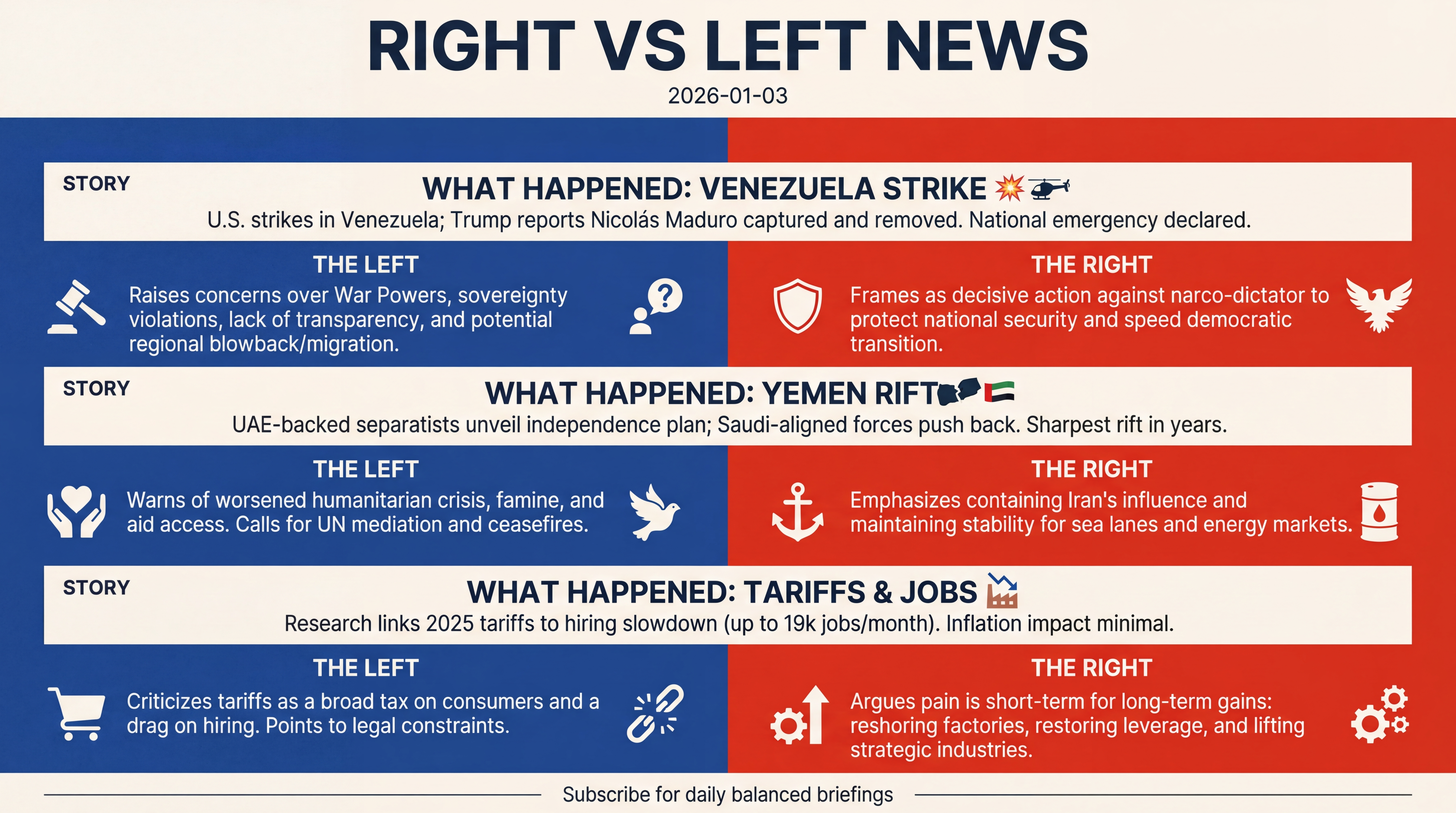
Overnight, explosions rocked Caracas and several Venezuelan states. The Associated Press and Reuters report the U.S. launched strikes. President Donald Trump posted that Nicolás Maduro and his wife were captured and flown out of the country. Venezuela declared a national emergency and condemned what it called military aggression. The FAA barred U.S. flights over Venezuelan airspace. The Pentagon referred questions to the White House. The Washington Post described blasts near La Carlota air base and widespread power outages.
On the right, this is framed as a long-promised clampdown on a narco-dictator tied to cartel networks — a move supporters say protects U.S. security and could speed a democratic transition. Fox News has highlighted months of congressional sparring over limits on unauthorized strikes, while backers argue the president has authority against terrorist-linked threats. Expect arguments that decisive force deters adversaries and reassures Latin American allies.
On the left, critics focus on law, risk, and precedent — raising War Powers concerns, sovereignty violations, and the danger of open-ended conflict without a clear endgame. The Washington Post stresses the lack of formal Pentagon detail and potential regional blowback. Time underscores casualty and legality questions after earlier sea strikes. The critique: Congress wasn’t clearly notified, the legal basis is murky, and escalation could fuel migration and instability.
Now, Yemen.
Yemen’s map is shifting. The UAE-backed Southern Transitional Council announced a two-year transition and a referendum plan for southern independence, while Saudi-aligned government forces moved to claw back positions. The UAE publicly urged restraint. Reuters and the AP say the rift between Riyadh and Abu Dhabi — once core partners against the Houthis — is the sharpest in years. Saudi Arabia says it will host comprehensive talks in Riyadh. Oil policy in OPEC-plus is expected to stay steady despite the turmoil.
On the right, analysts emphasize containing Iran’s influence and keeping sea lanes stable. Some frame Saudi efforts as necessary to prevent a fragmented south that could empower the Houthis and jihadists. Others note that even with intra-Gulf tensions, markets prize OPEC-plus steadiness. Expect calls to align U.S. policy with partners focused on security first — and to discourage any vacuum that could spike energy risk premia.
On the left, voices center human costs and diplomatic de-escalation — warning that coalition infighting worsens famine and aid access. International coverage details how a separatist push could deepen partition and complicate humanitarian relief. Expect calls for UN mediation, ceasefires, and accountability for airstrikes regardless of faction.
Third, tariffs and jobs.
A new Barron’s readout on Kansas City Fed research finds that tariffs in 2025 didn’t spike inflation — but they did crimp hiring, subtracting up to nineteen thousand jobs a month and nudging unemployment up by about a tenth of a percentage point. The piece argues 2026 could improve as uncertainty fades, and notes a potential Supreme Court ruling on tariff authority that could matter. The White House has defended tariff power as a strategic advantage, and some planned hikes on consumer goods were delayed.
On the right, pro-tariff conservatives argue the pain is short-term — and that tariffs reshore factories, restore leverage, and lift strategic industries. Fox Business features Republicans touting local gains and framing reciprocal tariffs as fairness. The argument: hang tough, and investment follows.
On the left, economists and center-left outlets warn that sweeping tariffs act like a broad tax on consumers and a drag on hiring. The Wall Street Journal’s editorial page — often conservative, but critical of tariff overreach — has blasted the zigzags. Others point to softer jobs trends since mid-2025 and stress legal constraints on unilateral moves.
[MIDPOINT_SPONSORS]
Now, governing from Mar-a-Lago.
The Washington Post reports that President Trump has blended high-profile diplomacy with personal pursuits during an extended stretch at Mar-a-Lago — drawing criticism from watchdogs who say governing from a private club blurs public and private interests. The report recounts meetings with foreign leaders alongside social events and donor buzz, and flags questions about access and influence.
On the right, supporters shrug — arguing modern presidents can work from anywhere, secure communications are routine, and the Winter White House label is overblown. Conservative-leaning coverage of the festivities portrays a confident presidency, high-dollar philanthropy, and a magnet for business interest and foreign dignitaries — less a scandal than a stage.
On the left, critics see ethics land mines — unvetted access to the president at a members’ club, opportunities for pay-to-play, and security risks that don’t exist inside the White House complex. Commentators fold it into a broader narrative about transparency and conflicts of interest.
Finally, Wall Street’s first week.
Markets open 2026 with a thin calendar turning busy. Reuters points to a soft December jobs consensus next week, high equity valuations after a strong 2025, and uncertainty about the Fed’s path and a coming chair nomination. With energy jitters in the background and earnings season arriving, desks see room for volatility as data and policy collide.
On the right, you’ll hear that a pro-growth agenda, lighter regulation, and reciprocal trade pressure can extend the rally once rate relief arrives. Republicans argue tariffs will ultimately concentrate investment and jobs in the U.S., and that markets may be underpricing a capital spending cycle.
On the left, the emphasis is on fragility — slower hiring in late 2025, tariff-related uncertainty, and the need to protect the Fed’s independence as a new chair is picked. Some warn that any perceived politicization of monetary policy could unsettle investors alongside affordability worries.
Quick recap... The U.S. strike in Venezuela is the flashpoint — legal and strategic questions now loom. The Gulf split over Yemen raises humanitarian and energy risks. Tariffs weighed on 2025 hiring even as the administration doubles down. Mar-a-Lago governance stokes ethics debates. And Wall Street starts 2026 balancing optimism with caution. We’ll be watching what’s fact, what’s spin... and what moves policy and markets next.
That's it for today's episode of Right versus Left News. Remember, understanding both sides isn't about picking a team—it's about being informed. Subscribe wherever you get your podcasts, and join us tomorrow for another balanced look at the day's biggest stories. Until next time, stay curious and stay informed.
