Five Big Stories: Protests to AI
We break down five major headlines, from Iran’s protests and tariff shifts to the latest in Ukraine, the Supreme Court’s year-end message, and new state AI rules. Hear what happened — and how the right and left are framing it.
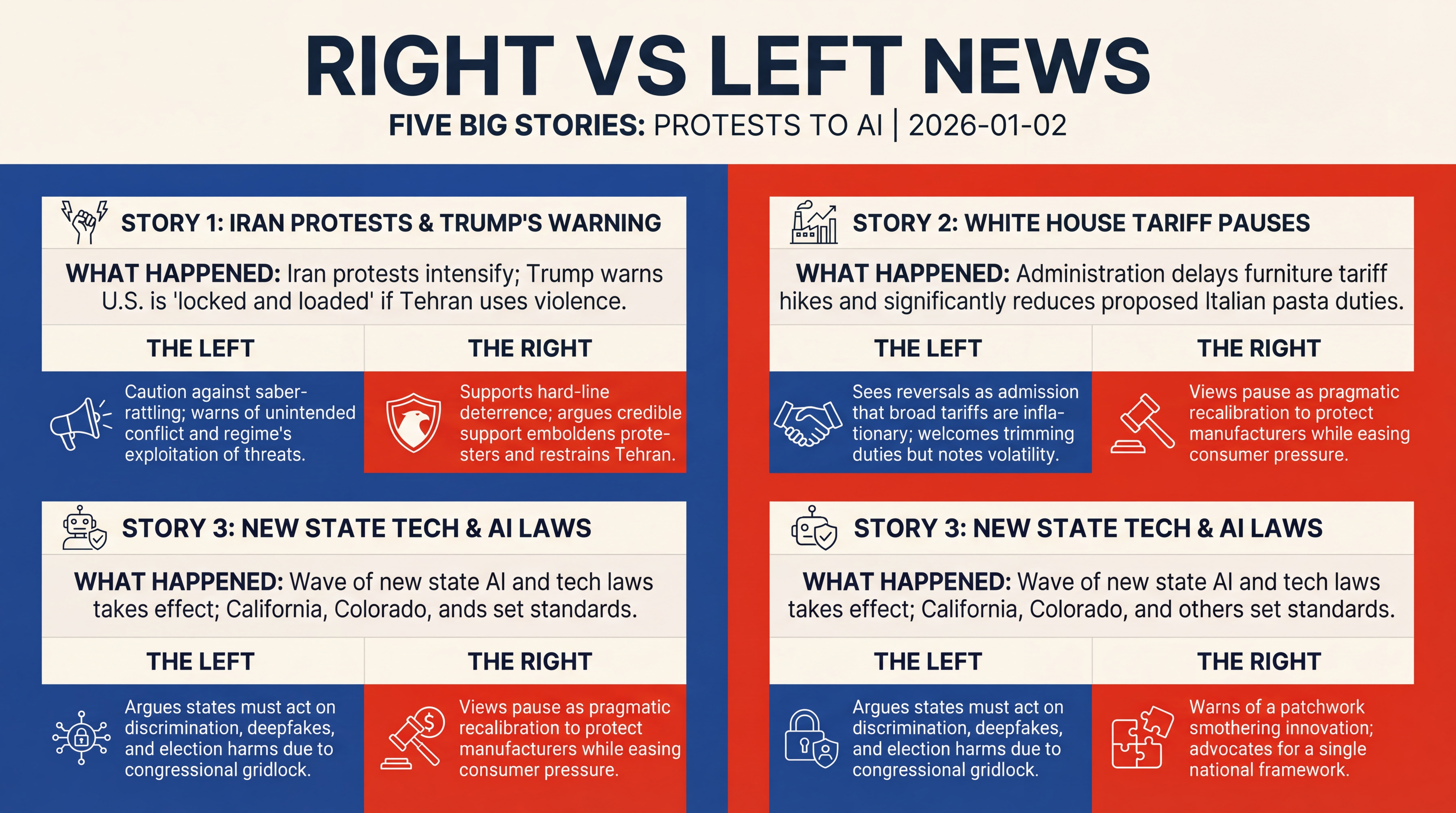
Episode Infographic
Show Notes
Welcome to Right versus Left News—your daily briefing on the stories that matter, told from both sides of the aisle. I'm your AI host - Chris, and each day I bring you the most important political and cultural news, with perspectives from conservative and progressive voices. No spin, no agenda—just the facts and the opinions that shape our national conversation. Let's dive in...
A quick look at today’s five big stories.
President Trump warns he’ll intervene if Iran violently suppresses nationwide protests... the White House pauses some planned tariff hikes and trims proposed duties on Italian pasta... Russia and Ukraine open 2026 with dueling strikes and accusations... Chief Justice John Roberts says the Constitution remains firm and unshaken... and a wave of new state tech and AI laws lands across the country.
We’ll lay out what happened — then what the right and the left are saying — so you can decide. According to Reuters, the Associated Press, the Wall Street Journal, the Washington Post, the U.S. courts, and The Verge, here’s where things stand.
[BEGINNING_SPONSORS]
Story one. Here’s what happened...
Protests in Iran, sparked by a crashing currency and soaring inflation, entered another day, with reports of deaths and clashes across several provinces. President Trump posted that if Iran ‘violently kills peaceful protesters,’ the United States is ‘locked and loaded and ready to go.’ Iran’s top security officials accused the U.S. and Israel of stoking unrest and warned of regional consequences.
How the right sees it...
Conservative outlets highlight Trump’s hard-line deterrence and argue that vocal, credible support can embolden demonstrators and restrain Tehran’s security forces. Fox News frames the warning as overdue backbone after years of Iranian aggression, noting the rial’s collapse and the impact of earlier U.S. pressure on the regime.
How the left sees it...
Progressive voices caution that saber-rattling risks escalation or unintended conflict, and they note Iran’s leaders often exploit foreign threats to justify crackdowns. The Washington Post emphasizes the danger of a spiral given recent strikes and counterstrikes, while the Financial Times stresses the protests’ economic roots — and the uncertainty around any U.S. ‘rescue’ pledge.
Story two. Here’s what happened...
The administration delayed planned tariff increases on upholstered furniture, kitchen cabinets, and vanities for a year — keeping most rates at 25 percent instead of moving to 30 or 50 percent. Separately, after review, the Commerce Department sharply reduced proposed anti-dumping duties on 13 Italian pasta makers — from as high as 92 percent down to roughly 2 to 14 percent, with a final decision due by March 12.
How the right sees it...
On the conservative side, the Wall Street Journal presents the pause as pragmatic recalibration — still protecting U.S. manufacturers while easing pressure on consumers as inflation lingers. Some free-market conservatives also see the pasta revision as a course correction that avoids needless price spikes while maintaining leverage in trade disputes.
How the left sees it...
Left-leaning commentary calls the reversals a tacit admission that broad tariffs have been inflationary and erratic. Outlets note how the original pasta proposal could have doubled prices and fueled trade rifts — so trimming duties is welcome, they argue, but the volatility underscores the costs of tariff-first policymaking.
Story three. Here’s what happened...
Russia and Ukraine opened the year with dueling claims. Kyiv says Moscow launched more than 200 drones, hitting power infrastructure across seven regions. Russian authorities accuse Ukraine of a New Year’s drone strike on a hotel and café in Russian-occupied Kherson that killed at least 24. Diplomacy continues, but talks remain stuck on territorial issues.
How the right sees it...
Conservative outlets emphasize Russia’s escalating drone and missile attacks and argue that only sustained military pressure — paired with leverage from U.S. diplomacy — can bring Moscow to serious negotiations. Some also argue any deal must lock in deterrence so the Kremlin can’t regroup.
How the left sees it...
Progressive voices warn against pressuring Kyiv into a weak agreement that merely freezes the conflict and rewards aggression. They point to President Zelensky’s vow not to sign a deal that prolongs the war — urging clear security guarantees and accountability for attacks on civilians before concessions are on the table.
[MIDPOINT_SPONSORS]
Story four. Here’s what happened...
Chief Justice John Roberts released his year-end report, quoting Calvin Coolidge to say the Constitution and Declaration remain ‘firm and unshaken.’ He largely sidestepped day-to-day political fights while underscoring judicial independence as the Court heads into a term with major separation-of-powers cases.
How the right sees it...
On the right, coverage highlights Roberts’ focus on safeguarding the courts — caution on fast-changing technologies like AI, and the need to maintain judicial security — framing the message as institutionalist and steady amid heated politics.
How the left sees it...
Progressive commentators read the report as reassuring rhetoric that avoids core controversies — ethics, recusals, and emergency-docket practices — and renew calls for enforceable ethics rules for the justices. Critics say real reforms, not platitudes, are needed to restore public trust.
Story five. Here’s what happened...
A wave of new state technology laws takes effect in 2026. Highlights include California’s AI transparency requirements and guardrails for high-risk systems, new right-to-repair measures in states like Washington, and consumer protections like click-to-cancel subscriptions in Maine. Colorado’s landmark AI Act — governing high-risk AI used in hiring, lending, and housing — has staged implementation culminating later this year.
How the right sees it...
Conservatives warn of a patchwork that could smother innovation and push startups out of key hubs — favoring a single national framework to avoid conflicting rules. Some in Washington are pushing to rein in what they call excessive state AI regulations and to centralize standards.
How the left sees it...
Progressives counter that with Congress gridlocked, states must step in to prevent discrimination, deepfakes, and election harms. Dozens of bipartisan state attorneys general have urged Washington not to preempt state rules, and California’s own policy work warns of potential irreversible harms without oversight.
Quick recap...
Iran’s protests intensify as Trump issues a stark warning. The White House pauses some tariff hikes and trims pasta duties. Russia and Ukraine trade deadly New Year’s blows. Chief Justice Roberts says the Constitution stands firm. New state tech and AI rules roll out. We’ll keep tracking what changes next — and how the left and right see it — so you’ve got the full picture.
That's it for today's episode of Right versus Left News. Remember, understanding both sides isn't about picking a team—it's about being informed. Subscribe wherever you get your podcasts, and join us tomorrow for another balanced look at the day's biggest stories. Until next time, stay curious and stay informed.
