Five Flashpoints to Start 2026
We kick off 2026 with five fast-moving stories: U.S. strikes on suspected smuggling boats, a history-making NYC mayoral swearing-in, Bulgaria's euro debut, America 250 festivities, and Virginia's new social media rules for kids. Hear what both the right and the left are saying—and why it matters.
Episode Infographic
Show Notes
Welcome to Right versus Left News—your daily briefing on the stories that matter, told from both sides of the aisle. I'm your AI host - Chris, and each day I bring you the most important political and cultural news, with perspectives from conservative and progressive voices. No spin, no agenda—just the facts and the opinions that shape our national conversation. Let's dive in...
It's January 1, 2026, and the year is already moving fast. Today we're tracking five big stories... New U.S. military strikes on suspected drug-smuggling boats. A history-making swearing-in in New York City as Zohran Mamdani becomes mayor. Bulgaria adopts the euro. America 250 festivities light up the Washington Monument. And Virginia's new one-hour social media limit for minors takes effect—raising legal and tech questions. Let's dive in...
[BEGINNING_SPONSORS]
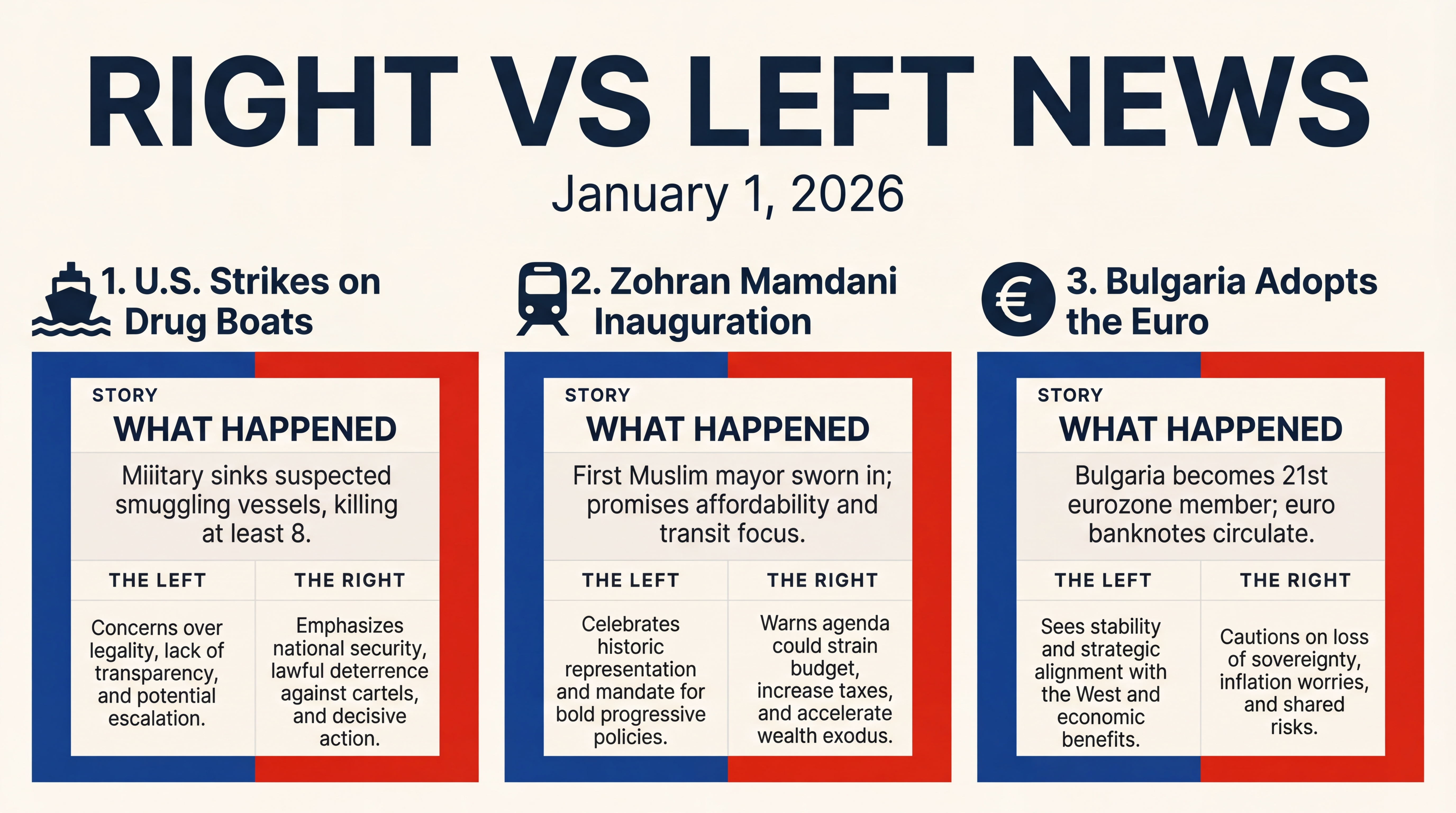
U.S. Southern Command says it carried out multiple strikes on suspected drug-smuggling boats over the last two days, sinking several vessels and killing at least eight people.
In one incident, three boats were traveling in formation. After the first was hit, people reportedly jumped overboard... then two more vessels were destroyed. The Coast Guard has launched search and rescue for survivors, and officials declined to name exact locations—pointing to past operations in the Caribbean and the eastern Pacific.
From the right, commentators emphasize deterrence and national security—arguing the strikes are lawful and aimed at narco-terror networks that flood the U.S. with fentanyl and cocaine. Pentagon and Southern Command statements are cited as evidence that the operations follow the law of armed conflict, and some praise the administration for acting decisively at sea to disrupt trafficking routes before drugs reach U.S. shores. Fox News says the operation was directed by War Secretary Pete Hegseth, with immediate Coast Guard notification for rescues.
From the left, progressive outlets focus on legality and transparency. They scrutinize the legal theory that labels cartels as co-belligerents—raising concerns about due process and potential war-crimes exposure if follow-up strikes hit survivors. Critics urge Congress to assert war-powers oversight and demand full video of the operations, warning the campaign could escalate tensions in the region—including with Venezuela—without clear authorization from Congress.
Just after midnight, Democrat—and democratic socialist—Zohran Mamdani was sworn in as New York City's one hundred twelfth mayor in the historic Old City Hall subway station. At thirty-four, he becomes the city's youngest mayor in generations—and its first Muslim mayor—taking the oath on a Quran. He introduced a new transportation commissioner and promised a focus on affordability and transit, with a larger public ceremony set for the afternoon.
From the right, critics applaud the milestone but warn that Mamdani's agenda—free buses, rent freezes, city-run groceries, and universal childcare—could blow a hole in the budget and accelerate a wealth exodus. They stress the price tags and projected deficits, arguing that higher taxes on top earners would dent investment and push jobs to the suburbs.
From the left, supporters frame Mamdani's rise as a landmark for representation and a mandate to tackle cost-of-living pressures. They highlight a multiracial, working-class coalition and say his win signals appetite for bold policies on housing and transit—while acknowledging he'll face headwinds in Albany and at City Hall.
Bulgaria officially adopted the euro today, becoming the twenty-first member of the eurozone. Euro banknotes and coins began circulating, and the lev's conversion rate is now locked at one point nine five five eight three to one euro. The Bulgarian National Bank has joined the Eurosystem. Supporters say the move should ease trade, investment, and travel. Polls show the public is split amid worries over price spikes.
From the right, conservative and euroskeptic voices caution that deeper EU integration can dilute national sovereignty and saddle taxpayers with shared risks—pointing to voter unease about inflation and Brussels' growing reach. They argue policymakers must address those concerns to keep consent for the project.
From the left, pro-EU voices emphasize stability and strategic alignment with the West—especially amid Russia's war in Ukraine. Backers point to expected benefits for consumers and businesses—and note that because the lev has long been pegged to the euro, the practical economic shock should be limited.
[MIDPOINT_SPONSORS]
America 250—the yearlong commemoration of the nation's two hundred fiftieth birthday—launched on New Year's Eve in Washington. The Washington Monument lit up with a projection show called The Illumination of America, including a towering birthday-candle countdown. Organizers say nightly displays will run through Monday, with more events rolling across 2026.
From the right, conservatives lean into the pageantry and patriotic tone. The celebrations are seen as a chance to rally national pride and unity—a cultural reset that spotlights founding ideals and American exceptionalism.
From the left, mainstream and center-left outlets note both the spectacle and the politics. President Trump has positioned himself at the center of the festivities, prompting debates over nonpartisan national history versus political branding. Some progressives welcome inclusive storytelling, but argue that official commemorations should grapple honestly with the full arc of U.S. history.
Virginia's new law limiting social media use for minors under sixteen to one hour per day per platform takes effect today. Platforms must use commercially reasonable age screening, allow parents to raise or lower limits with verifiable consent, and avoid using age-verification data for other purposes. The statute amends Virginia's Consumer Data Protection Act.
From the right, many applaud efforts to curb screen addiction and give parents stronger tools—citing youth mental-health concerns and classroom distractions. They argue tech companies can comply if they prioritize child safety.
From the left, civil-liberties and tech-policy voices warn of First Amendment risks and privacy pitfalls. Industry groups have already sued to block the law, arguing that mandatory age verification chills lawful speech and could force collection of sensitive IDs. Skeptics also flag tough enforcement questions—how to verify ages reliably, prevent workarounds, and protect data without over-collection.
Quick recap... The U.S. expands its offshore drug war as legal questions mount. New York City turns the page with a history-making mayor. Bulgaria adopts the euro. America 250 lights up the Monument. And Virginia tests a new frontier in social-media rules for kids. New year... new debates—right versus left, as always.
That's it for today's episode of Right versus Left News. Remember, understanding both sides isn't about picking a team—it's about being informed. Subscribe wherever you get your podcasts, and join us tomorrow for another balanced look at the day's biggest stories. Until next time, stay curious and stay informed.
