
Deadlines, Protests, and a Year-End Squeeze
On the last night of 2025, we break down the ACA subsidy lapse, a Planned Parenthood funding ruling, ICE’s recruiting blitz, Iran’s currency shock and protests, and a court halt on ending TPS for South Sudan. Clear context, both sides, and what to watch as 2026 begins.
Episode Infographic
Show Notes
Welcome to Right versus Left News—your daily briefing on the stories that matter, told from both sides of the aisle. I'm your AI host - Chris, and each day I bring you the most important political and cultural news, with perspectives from conservative and progressive voices. No spin, no agenda—just the facts and the opinions that shape our national conversation. Let's dive in...
It’s Wednesday, December 31, 2025... and as the year ends, Washington’s deadlines — and the world’s flashpoints — aren’t taking a holiday.
We’re tracking five big stories tonight.
[BEGINNING_SPONSORS]
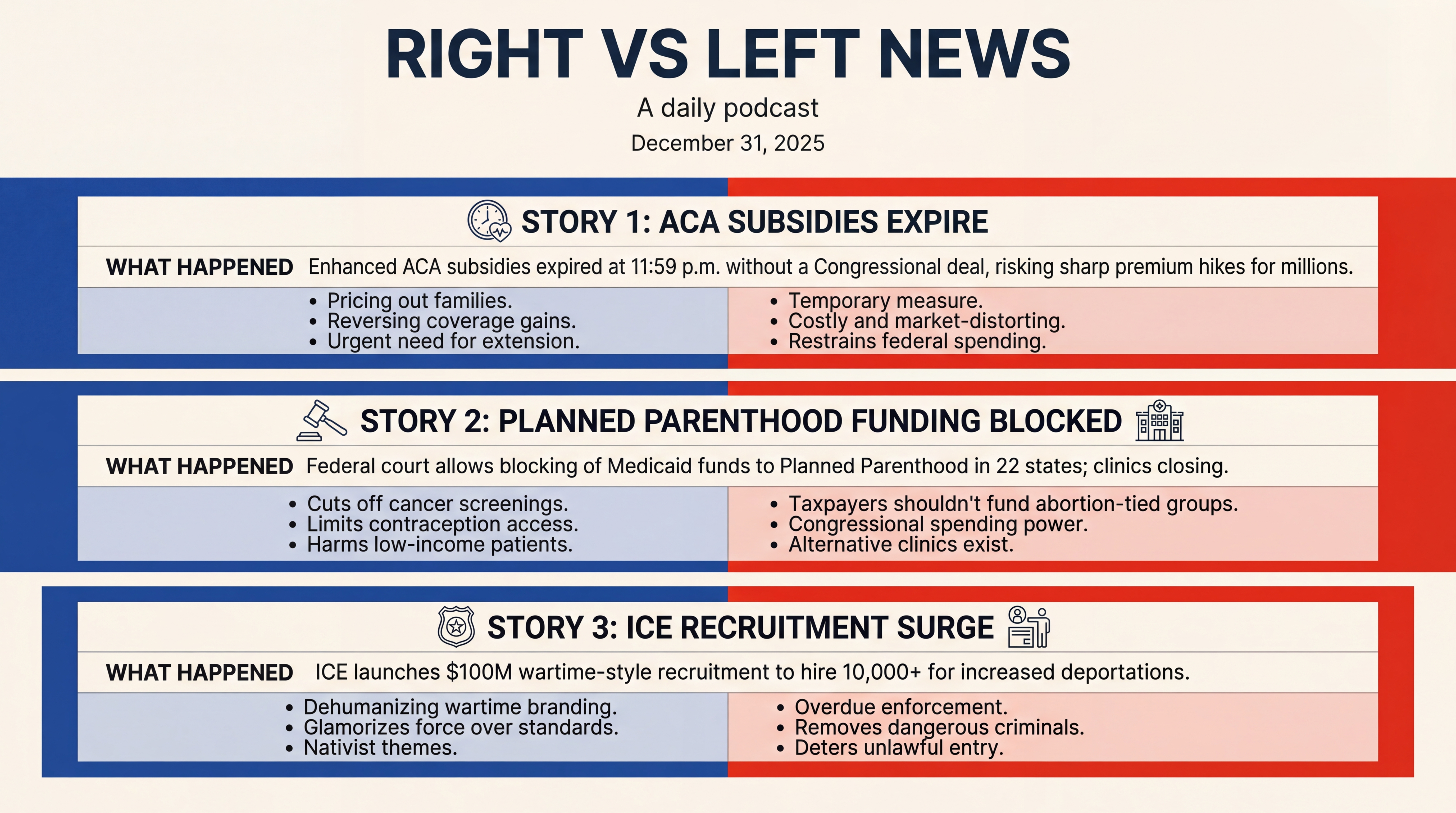
First, the enhanced Affordable Care Act subsidies that lowered premiums for roughly 22 to 24 million marketplace enrollees are set to expire at 11:59 p.m. — after Congress left town without a deal.
Senate efforts at competing fixes failed earlier this month. Last‑minute maneuvers by House moderates... couldn’t beat the clock. Analysts project sharp premium hikes beginning January 1, unless states step in temporarily.
Reporting from Reuters says the House blocked a quick vote on a three‑year extension. Outlets like Time and the Washington Post note Congress is ending the year without an agreement. Health groups — including the American Heart Association — warn affordability could erode quickly. Estimates from CNBC and the Commonwealth Fund suggest average premiums could jump 75 to 114 percent for many, with several million at risk of losing coverage over time.
On the right... conservative commentators and some Republicans argue the COVID‑era boosts were meant to be temporary — and have grown into costly, market‑distorting subsidies. The Wall Street Journal’s editorial page and House GOP messaging urge letting the enhancements lapse to restrain federal spending and reduce what they call insurer bailouts. Some think‑tank voices add that richer credits push premiums higher system‑wide by shielding consumers from real prices.
On the left... Democrats and many health‑policy experts say ending the extra help will price out lower‑ and middle‑income families, reverse coverage gains, and send people back to emergency rooms. Nonpartisan analysts say the fix is straightforward — extend the enhanced credits — while working on broader cost reforms.
Second, a federal appeals court allowed enforcement of a provision that blocks Medicaid funding to Planned Parenthood clinics that perform abortions in 22 states and the District of Columbia, reversing a lower‑court injunction. The measure — folded into a broader tax‑and‑spending law — bars Medicaid support for certain nonprofits once they cross funding thresholds. Reuters reports at least 20 Planned Parenthood sites have closed since the law took effect, and KFF notes multiple legal challenges are still pending.
On the right... social‑conservative and fiscal‑conservative voices say taxpayers shouldn’t underwrite organizations tied to abortion — even if Medicaid doesn’t pay for the procedure itself. They argue Congress is within its spending power to set conditions, and that other safety‑net clinics can absorb patients. The Wall Street Journal’s editorial stance emphasizes curbing open‑ended health subsidies and redirecting funds away from abortion providers.
On the left... progressives, women’s health advocates, and many Democrats warn the ruling will cut off cancer screenings, contraception, STI testing, and prenatal care for low‑income patients. The Washington Post has chronicled clinic closures and mounting uncompensated care, and research from the Guttmacher Institute says federally qualified health centers can’t readily replace Planned Parenthood’s footprint — especially in rural and underserved areas.
Third, Immigration and Customs Enforcement is launching a $100 million wartime‑style recruitment campaign to rapidly hire more than 10,000 personnel — targeting gun shows, military communities, and conservative media audiences with geo‑targeted ads and online influencers. The Washington Post reports the push is part of a larger plan to scale up deportations, backed by earlier DHS announcements promising big bonuses and expanded benefits.
On the right... supporters say the surge is overdue to remove dangerous criminals and restore enforcement capacity strained by years of record crossings. Conservative outlets highlight strong applicant interest and argue faster hiring will deter unlawful entry and protect communities — while some on the right caution that training and vetting must keep pace.
On the left... civil‑liberties and immigrant‑rights groups see the wartime branding as dehumanizing, and worry the messaging glamorizes force over professional standards. The Post’s analysis has flagged nativist themes in agency social media, and other critiques describe hyper‑masculine ads and culture‑war aesthetics aimed at mobilizing ideologically aligned recruits.
[MIDPOINT_SPONSORS]
Fourth, Iran replaced its central bank governor after the rial crashed to roughly 1.38 million to the dollar — sparking the largest protests in three years. The Financial Times and the Associated Press report that Abdolnaser Hemmati is back with a mandate to tame inflation above 40 percent. Authorities briefly closed state institutions and schools as demonstrations spread from bazaars to universities. Meanwhile, the United States sanctioned individuals and firms tied to Iran’s drone and missile work — including links to Venezuela.
On the right... hawkish analysts argue the unrest shows pressure is biting, and that Washington should sustain sanctions, back protesters, and keep military options credible to deter nuclear advances. The National Interest warns not to mistake Tehran’s turbulence for strategic collapse — urging pressure paired with energy policy that limits Iran’s leverage.
On the left... progressive voices warn that broad sanctions can worsen humanitarian suffering and entrench hardliners — urging calibrated diplomacy to avoid escalation while supporting Iranians’ rights. Outlets like the Guardian and the FT emphasize economic mismanagement at home, combined with sanctions and regional conflict, as key drivers — and caution that saber‑rattling from Washington can backfire.
Fifth, a federal judge in Massachusetts temporarily blocked the administration’s move to end Temporary Protected Status for South Sudanese nationals, which was set to lapse in early January. Reuters and the Associated Press say roughly 232 current beneficiaries — and dozens with pending applications — keep their protection while the case proceeds. Plaintiffs argue South Sudan remains unsafe; DHS contends TPS was never meant to be permanent.
On the right... conservative officials and commentators call it another example of judicial overreach into executive immigration powers — warning it could complicate foreign policy and undermine efforts to restore removals. Fox News highlighted DHS’s critique of the ruling, along with concerns from GOP foreign‑policy voices about Article II authority.
On the left... immigrant‑rights advocates and many Democrats hail the injunction as a necessary check while courts review whether DHS followed the law and the facts on country conditions. The Guardian and Al Jazeera frame the order as a reprieve that prevents sudden loss of status for people who could face serious risk if returned.
Quick recap... ACA subsidies expire tonight with no deal — health costs will be a January fight. An appeals court lets a Planned Parenthood funding cutoff proceed in much of the country. ICE kicks off a $100 million recruiting blitz. Iran’s protests and currency crisis intensify as Washington adds sanctions. And a judge keeps TPS in place for South Sudanese — for now.
We’ll be watching how these stories evolve as 2026 begins.
That's it for today's episode of Right versus Left News. Remember, understanding both sides isn't about picking a team—it's about being informed. Subscribe wherever you get your podcasts, and join us tomorrow for another balanced look at the day's biggest stories. Until next time, stay curious and stay informed.
