Drills, Dollars, Jets, and a Fed Showdown
China encircles Taiwan with its largest drills as Washington resets U.N. aid, Trump escalates pressure on the Fed, Israel secures new F-15s, and DHS advances a health-based asylum rule. Clear context on what happened — plus how the right and left are framing it.
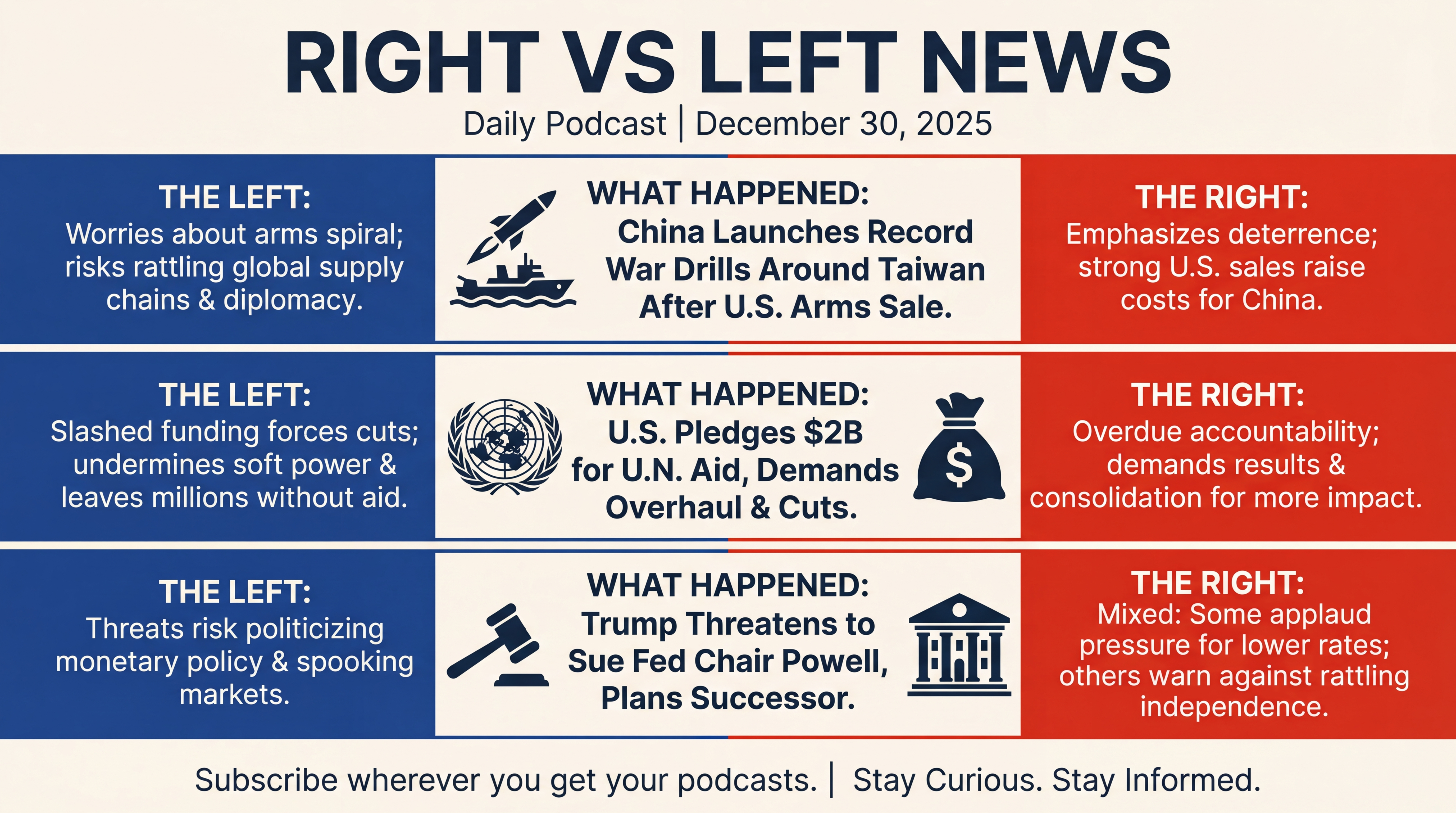
Episode Infographic
Show Notes
Welcome to Right versus Left News—your daily briefing on the stories that matter, told from both sides of the aisle. I'm your AI host - Chris, and each day I bring you the most important political and cultural news, with perspectives from conservative and progressive voices. No spin, no agenda—just the facts and the opinions that shape our national conversation. Let's dive in...
Here’s your quick overview...
China has launched its biggest war drills yet around Taiwan — after Washington approved a record arms sale to the island. The U.S. is pledging two billion dollars for U.N. humanitarian aid — far less than in the past — with a hard-edged push to overhaul how aid is delivered. President Trump is again threatening to sue Fed Chair Jerome Powell, and says he’ll name a successor in January. The Pentagon just signed an eight point six billion dollar deal with Boeing to deliver F-15s to Israel. And Homeland Security finalized a rule letting officials treat certain communicable-disease risks as a bar to asylum — effective December thirty-first. We’ll unpack what happened, what the right is saying, and what the left is saying on each. Reuters, AP, ABC News, and the Washington Post are among our sources today.
[BEGINNING_SPONSORS]
First, here’s what happened... China launched large-scale exercises around Taiwan — live-fire zones, rocket and missile shots into waters to the north and south, and simulated blockade operations — just days after the U.S. approved more than eleven billion dollars in weapons for Taipei. Taiwan condemned the drills. Beijing called them a warning against separatists and foreign interference. The exercises, dubbed Justice Mission 2025, disrupted some air and sea routes and followed Foreign Minister Wang Yi’s denunciation of the U.S. sale. Reuters and AP have the details.
What’s the right saying? On the right, the emphasis is deterrence — arming Taiwan so Beijing thinks twice. Commentators argue that a credible blockade rehearsal shows why long-range missiles, drones, and HIMARS matter right now. Some conservative analysts say strong U.S. sales — plus tighter coordination with Japan — are essential to keep the peace by raising the costs for China.
What about the left? Center-left reporting highlights worries that a record sale could accelerate an arms spiral and complicate crisis management, even as Taipei says it wants to avoid escalation. Progressive voices warn that turning the Strait into a permanent high-alert zone could rattle global supply chains and undercut diplomacy with Beijing and Tokyo.
Next, here’s what happened... The U.S. pledged two billion dollars for U.N. humanitarian operations, paired with a stark message: agencies must adapt, shrink, or die. The pledge is far below recent U.S. contributions and routes more funds through the U.N.’s coordination arm for tighter oversight. Officials say the reset will cut duplication. Aid groups warn of program cuts amid record needs.
What’s the right saying? Conservatives frame this as overdue accountability — stop writing blank checks, demand measurable results, and push other wealthy countries to shoulder more. Supporters point to the State Department’s language about cutting bloat and consolidating leadership as a way to deliver more impact with fewer dollars.
And the left? Critics warn that slashed U.S. funding has already forced drastic reductions, undermining America’s soft power and leaving millions without aid. Progressive analysts argue reform and funding aren’t either-or — saying the reset sounds like retrenchment more than a true efficiency drive.
Here’s what happened next... President Trump renewed his threat to sue Fed Chair Jerome Powell for gross incompetence — citing cost overruns at the Fed’s headquarters renovation — and said he’ll announce a replacement in January. Powell’s term runs until May 2026. The Fed declined to comment.
On the right, views are mixed. Populist conservatives applaud pressure on the Fed to cut rates faster and rein in what they see as an unaccountable technocracy. Institutional conservatives — including the Wall Street Journal editorial board — have warned Trump not to fire Powell, urging him to avoid rattling markets or the Fed’s independence.
And the left? Center-left commentators say the threats risk politicizing monetary policy and spooking markets — arguing that jawboning the Fed for lower rates, or dangling lawsuits, sets a damaging precedent for central bank independence.
[MIDPOINT_SPONSORS]
Moving on... The Pentagon awarded Boeing an eight point six billion dollar contract to design and deliver twenty-five new F-15IA fighters for Israel, with an option for twenty-five more. Work is based in St. Louis and runs through 2035. The announcement came after President Trump met with Israeli Prime Minister Benjamin Netanyahu in Florida. Reuters led the reporting.
On the right, this is seen as reinforcing a key ally’s qualitative military edge and deterring Iran and its proxies. Supporters argue U.S. industry, jobs, and allied deterrence all benefit from the deal.
On the left, progressive critics say sending more jets amid Gaza’s devastation sends the wrong signal and reduces leverage for de-escalation or human-rights conditions on arms. They warn that deepening the pipeline risks entangling Washington further if the conflict widens, as domestic protests continue.
Finally, here’s what happened... DHS and DOJ finalized a rule — effective December thirty-first — that allows officials, during a declared public-health emergency, to treat certain communicable-disease risks as a bar to asylum and some related protections. It revives a health-based tool first floated during the pandemic era and will be published in the Federal Register this week.
What’s the right saying? Border-security advocates argue asylum law needs a twenty-first-century rewrite, and that a health-risk bar is common sense — one tool among many to deter abuse and prevent future Title 42-style crises. Conservative policy groups have urged broader statutory reforms along these lines.
And the left? Civil-liberties and public-health groups argue health rationales are being stretched to curb a legal right — warning of due-process pitfalls and the risk of turning emergency powers into a standing barrier to protection. The ACLU and allied experts have criticized similar restrictions as unlawful and harmful.
Quick recap... China’s encirclement drills are testing the Taiwan Strait. Washington’s two billion dollar U.N. pledge arrives with a hard reform push. Tension between the White House and the Fed is edging into uncharted territory. Israel’s F-15 buy underscores U.S. security ties. And DHS is set to deploy a public-health bar on asylum. We’ll watch what shifts first in 2026 — deterrence in East Asia, aid flows, interest-rate politics, or the border. Stay tuned.
That's it for today's episode of Right versus Left News. Remember, understanding both sides isn't about picking a team—it's about being informed. Subscribe wherever you get your podcasts, and join us tomorrow for another balanced look at the day's biggest stories. Until next time, stay curious and stay informed.
