
Five Flashpoints: Ukraine, Gaza, DEI, Tech, Digital Yuan
We break down cautious Ukraine talks, a high-stakes Trump and Netanyahu meeting as Gaza’s ceasefire stalls, the Justice Department’s new scrutiny of corporate DEI, a Vance-brokered truce between Trump and Elon Musk, and China’s 2026 digital yuan rules. Clear context, quick takeaways, and what to watch next.
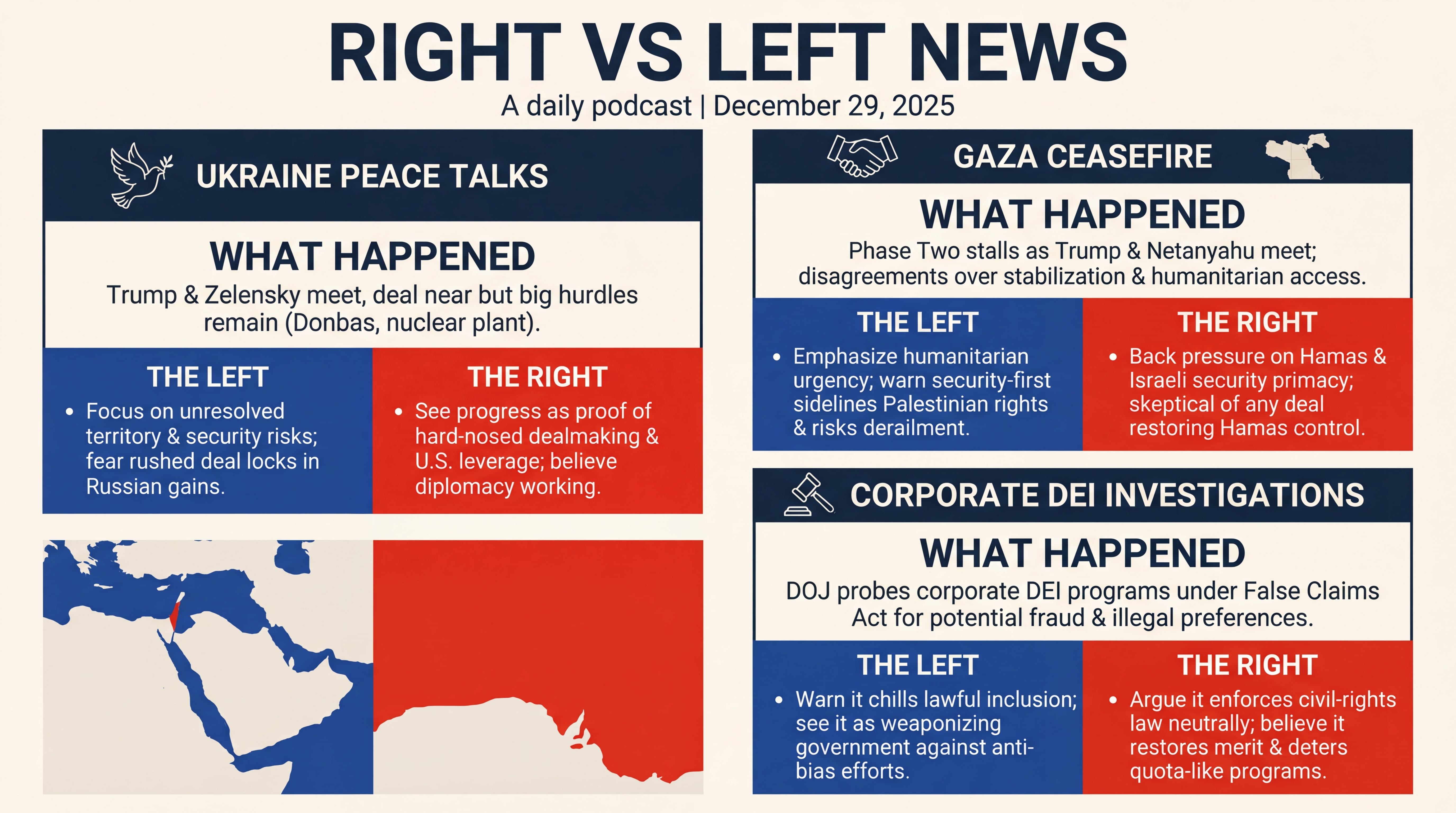
Episode Infographic
Show Notes
Welcome to Right versus Left News—your daily briefing on the stories that matter, told from both sides of the aisle. I'm your AI host - Chris, and each day I bring you the most important political and cultural news, with perspectives from conservative and progressive voices. No spin, no agenda—just the facts and the opinions that shape our national conversation. Let's dive in...
Today we’ve got five fast-moving stories... cautious progress, but no breakthrough, in Ukraine peace talks after President Trump met Volodymyr Zelensky in Florida. A high-stakes meeting between Trump and Benjamin Netanyahu as the next phase of the Gaza ceasefire stalls. The Justice Department opening a new front against corporate DEI programs. JD Vance smoothing tensions between Trump and Elon Musk. And China laying new ground rules for its digital yuan starting January 1, 2026. Let’s dive in.
[BEGINNING_SPONSORS]
First, Ukraine.
Here’s what happened... Trump and Volodymyr Zelensky met at Mar-a-Lago and said negotiations are close — Trump even called a deal 95 percent complete. But big sticking points remain: the future of Donbas, long-term security guarantees, and control of the Zaporizhzhia nuclear plant. The Kremlin, meanwhile, signaled that Ukraine should withdraw from parts of Donbas if it wants peace. So... no final agreement — more talks ahead.
On the right, the meeting is framed as proof that hard-nosed dealmaking and U.S. leverage are creating momentum — with only a few thorny issues left, and a belief that steady diplomacy with European partners is doing more than open-ended aid.
On the left, the focus is on the gaps: unresolved territory, long-term guarantees, and Moscow’s maximalist demands. Skeptics warn a rushed deal could lock in Russian gains.
Next, the Middle East.
Here’s what happened... Israeli Prime Minister Benjamin Netanyahu is meeting Trump in Florida just as Phase Two of the U.S.-backed Gaza ceasefire has stalled. Phase One secured major hostage releases and an Israeli pullback, but disagreements linger over an international stabilization force, a technocratic Palestinian authority to govern, and humanitarian access — all while Gaza reels from winter flooding and worsening camp conditions.
On the right, many back pressure on Hamas, insist on Israel’s security primacy, and see a phased plan as pragmatic leverage — with deep skepticism of any arrangement that restores Hamas control. Some also credit Israeli deterrence for making diplomacy possible.
On the left, voices emphasize humanitarian urgency and the risk that a security-first approach sidelines Palestinian political rights. Many push for a durable ceasefire tied to a credible path for Palestinian governance — and warn that Israeli politics and regional tensions could derail implementation.
Third, a domestic flashpoint — diversity, equity, and inclusion, or D-E-I.
Here’s what happened... The Justice Department has opened investigations into whether some corporate DEI programs violate the False Claims Act — a fraud law often used against government contractors and grant recipients. The push follows directives to target what the administration calls illegal preferences, and to encourage agencies to scrutinize DEI practices.
On the right, supporters argue the Justice Department is enforcing civil-rights law neutrally — that preferences tied to race or sex are unlawful — and that using False Claims Act tools could deter quota-like programs at firms benefiting from federal dollars. They see it as restoring merit and aligning corporate conduct with existing law.
On the left, progressives warn the campaign chills lawful inclusion efforts and weaponizes the government against anti-bias programs. They also note the legal hurdles the department faces in court, and point to civil-rights lawsuits arguing related executive actions restrict speech and equal opportunity.
Fourth, politics meets big tech.
Here’s what happened... Vice President JD Vance helped broker a truce between Trump and Elon Musk after a very public feud — with allies like David Sacks in the mix, and personnel moves, including a NASA leadership reversal, smoothing things over. The detente keeps a powerful tech voice inside the GOP tent as the 2026 midterms approach.
On the right, the renewed partnership is cast as a pragmatic win — uniting a pro-innovation White House with Silicon Valley’s most influential entrepreneur. Signs of a thaw are portrayed as good for growth and national competitiveness.
On the left, skeptics see a cautionary tale: billionaire influence over policy, blurred lines between private platforms and public power, and a style of disruption that frustrated career officials. With public opinion on Musk polarized, they also see political risk.
Fifth, China’s digital money shift.
Here’s what happened... China’s central bank is rolling out a new management action plan for the digital yuan, effective January 1, 2026 — tightening oversight as Beijing expands its central bank digital currency. It’s part of a broader push to scale the e-CNY at home and nudge wider adoption abroad.
On the right, many warn that state digital money can supercharge surveillance and geopolitical leverage — and argue the United States should resist a retail CBDC while strengthening dollar-based, private-sector payments and guardrails. Analysts often flag the e-CNY’s privacy trade-offs and the Party’s focus on what it calls controllable anonymity.
On the left, center-left policy circles see a competitive wake-up call — study the model, invest in privacy-preserving payment tech, and set global standards so democratic safeguards don’t lag authoritarian designs. Some say surveillance risks can be mitigated by design — but transparency and rights protections are non-negotiable.
[MIDPOINT_SPONSORS]
Quick recap... Ukraine talks inch forward, but key issues remain unresolved. Trump and Netanyahu huddle as Gaza’s next phase stalls amid humanitarian strain. The Justice Department opens a new battlefront over corporate DEI. A Vance-brokered truce between Trump and Musk reshapes the tech and politics axis. And China readies 2026 rules for its digital yuan. We’ll keep tracking these as the facts — and the politics — evolve.
That's it for today's episode of Right versus Left News. Remember, understanding both sides isn't about picking a team—it's about being informed. Subscribe wherever you get your podcasts, and join us tomorrow for another balanced look at the day's biggest stories. Until next time, stay curious and stay informed.
