Ballots, Blizzards, and California's Bullet Train
Three fraught elections collide with a Northeast winter storm and a California high-speed rail reset. We break down what happened and how the left and right see it — from power politics to climate resilience.
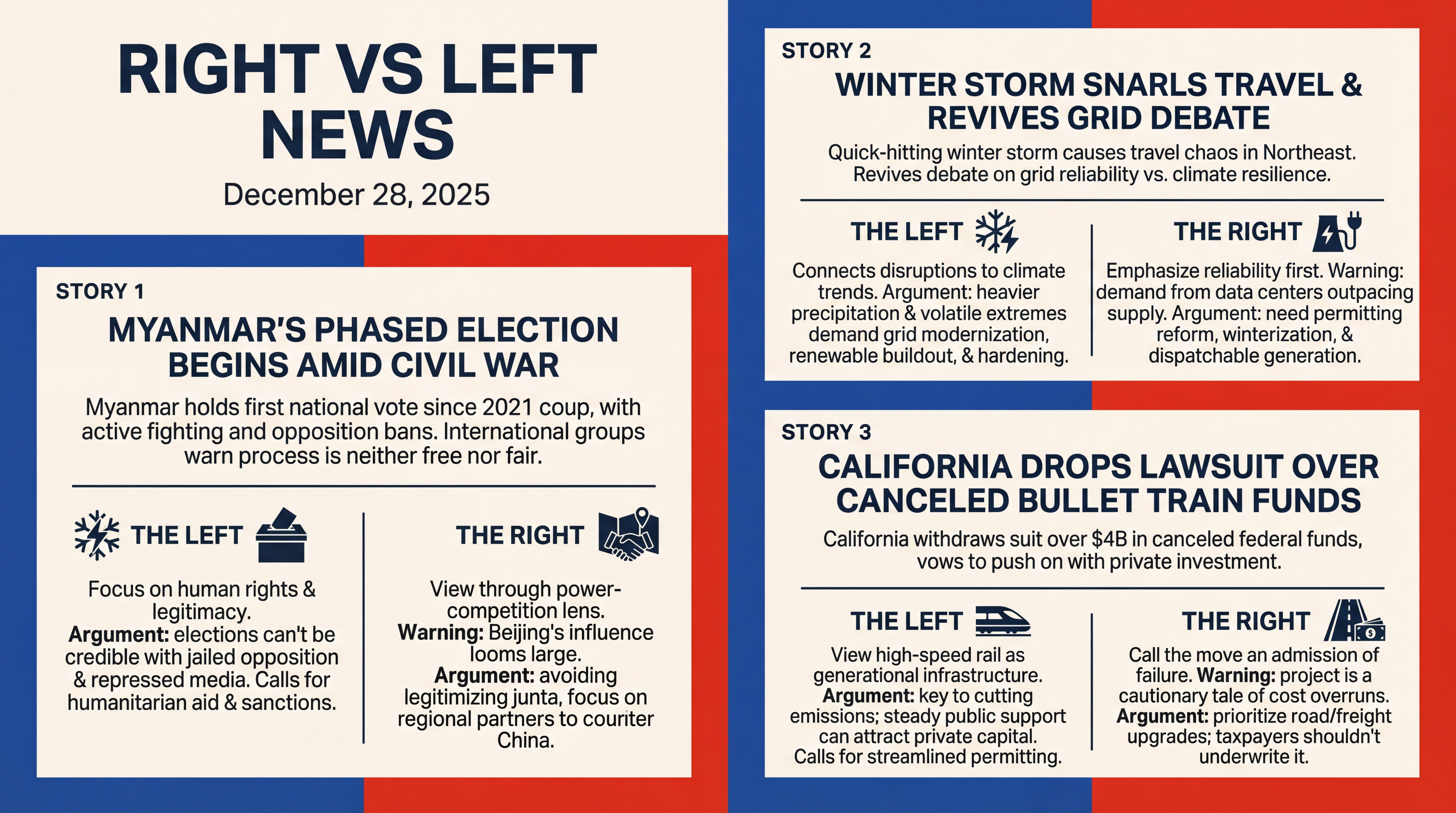
Episode Infographic
Show Notes
Welcome to Right versus Left News—your daily briefing on the stories that matter, told from both sides of the aisle. I'm your AI host - Chris, and each day I bring you the most important political and cultural news, with perspectives from conservative and progressive voices. No spin, no agenda—just the facts and the opinions that shape our national conversation. Let's dive in...
Here’s the quick rundown of today’s five stories... Myanmar just opened the first phase of long-promised national elections even as fighting rages. The Central African Republic and Guinea also headed to the polls — each with deep questions about legitimacy and outside influence. A fast-moving winter storm upended travel across the Northeast and reopened a debate about grid reliability versus climate resilience. And in California, the state quietly dropped its lawsuit over billions in canceled federal funds for its bullet-train project, vowing to push on without Washington’s help. Much of today’s on-the-ground reporting comes from Reuters and the Associated Press, with key context from the Federal Energy Regulatory Commission, the North American Electric Reliability Corporation, and Human Rights Watch.
[BEGINNING_SPONSORS]
First up — Myanmar’s phased election begins amid civil war.
Here’s what happened... Myanmar held the first stage of a multi-phase national vote — its first since the 2021 coup — despite active fighting, widespread displacement, and bans on major opposition parties. Officials have scheduled two more voting days in January. Turnout looked subdued, and large areas remain too insecure to vote. International groups, including the United Nations, warn the process is neither free nor fair. Authorities plan to use electronic voting machines and haven’t said when results will be announced. Human Rights Watch is urging foreign governments to reject the polls as a sham.
What’s the right saying about this? Conservative commentators view the vote through a great-power lens — warning that Beijing’s influence looms large and arguing Washington should avoid legitimizing junta-run elections while tightening coordination with regional partners to counter China’s role. Some also see expanding Russian and Chinese footprints across the region as a broader strategic warning sign for the United States.
And what about the left? Progressive voices focus on human rights and democratic legitimacy — arguing the elections can’t be credible when opposition leaders are jailed or exiled, independent media is repressed, and civilians face ongoing attacks. They call for more humanitarian aid, stronger refugee protections, and targeted sanctions against junta figures and their suppliers.
Let’s turn to another high-stakes vote in Africa...
Voters in the Central African Republic went to the polls with President Faustin-Archange Touadéra favored to secure a controversial third term after a 2023 referendum removed term limits. The opposition says the playing field is tilted, though two former prime ministers were allowed on the ballot. Security remains fragile, and Russian-linked Wagner mercenaries have supported the government for years.
What’s the right saying? On the right, you’ll hear a power-competition frame — that Russia’s Wagner network has profited from minerals and gained leverage, and that the U.S. and Europe should counter that influence to prevent Moscow from consolidating a strategic foothold.
And the left? Progressive analysis zeroes in on democratic backsliding and abuses — arguing that outside security assistance tied to resource concessions entrenches illiberal rule. They want accountability and support for civil society before any recognition of results.
Next — Guinea’s post-coup election tests democracy and stability.
Here’s what happened... Guinea also voted today, with junta leader Mamady Doumbouya widely expected to prevail after a new constitution reshaped the rules. Major opposition figures remain sidelined, raising fears the ballot will simply formalize military rule. Supporters, meanwhile, point to long-stalled mega-projects — especially the Simandou iron-ore development — as reasons to back continuity. Turnout looked steady, but skepticism ran high.
What’s the right saying? Many on the right prioritize stability and critical-minerals security — noting that predictable governance, however imperfect, could unlock investment in iron ore and bauxite that feed global supply chains. They also urge scrutiny of Chinese and Russian involvement in mining and infrastructure as part of a broader strategic contest.
And the left? Progressives warn that blessing a military-managed vote risks normalizing coups and shrinking civic space. They want strong conditions on aid, protections for journalists, and a credible roadmap back to civilian rule before deepening economic ties.
[MIDPOINT_SPONSORS]
On to the weather — a winter storm snarls travel and revives the grid-reliability debate.
Here’s what happened... A quick-hitting winter storm dropped snow and ice from the Midwest into the Northeast over the holiday weekend, prompting states of emergency in New York and New Jersey and leading to thousands of flight delays and cancellations at New York-area airports. Airlines issued change-fee waivers, while road crews battled slick conditions.
What’s the right saying? Conservative outlets emphasize reliability first — warning that soaring electricity demand, including from data centers, is outpacing firm power supply. They argue that permitting reform, winterization, and maintaining dispatchable generation are essential to prevent blackouts in extreme cold. Recent assessments from grid regulators have flagged elevated winter risks, and federal energy officials are pushing stronger cold-weather standards.
And the left? Progressive voices connect repeated winter disruptions to climate trends driving heavier precipitation and more volatile extremes — and they call for accelerated grid modernization, from transmission buildout to storage and distributed energy, alongside hardening infrastructure and better outage communications. Climate indicators show heavy one-day precipitation events have become more common, especially in the Northeast.
Finally — California drops its lawsuit over canceled federal high-speed rail funds.
Here’s what happened... California’s High-Speed Rail Authority has withdrawn its suit challenging the Trump administration’s decision to pull more than four billion dollars in federal funding. State officials say they’ll keep advancing the project — with new private investment efforts expected in 2026 — even as costs and timelines continue to shift.
What’s the right saying? Conservatives call the move a quiet admission that Washington won’t be a reliable partner for a project they view as a cautionary tale — pointing to cost overruns and missed deadlines as reasons to prioritize road and freight upgrades instead. They argue federal taxpayers shouldn’t underwrite it again.
And the left? Progressives counter that high-speed rail is the kind of generational infrastructure the U.S. chronically underbuilds — key to cutting traffic, pollution, and emissions — and that steady public support can crowd in private capital as segments open. They want streamlined permitting and stable funding to finish what’s started.
Quick recap... Three contentious elections — Myanmar, the Central African Republic, and Guinea — may reshape regional power dynamics and test democratic norms. A winter storm rekindled the fight over how to keep the lights on as the climate shifts, and California recalibrated its bullet-train legal strategy while trying to keep the project on track. We’ll keep watching both power and legitimacy — at the ballot box and on the grid.
That's it for today's episode of Right versus Left News. Remember, understanding both sides isn't about picking a team—it's about being informed. Subscribe wherever you get your podcasts, and join us tomorrow for another balanced look at the day's biggest stories. Until next time, stay curious and stay informed.
