Christmas Flashpoints: Drones, Art, and Alliances
Five fast stories from Ukraine's deep-strike drones to a Kennedy Center naming fight, an ICE shooting, Pope Leo XIV's Christmas plea, and Yemen's coalition rift — your rapid holiday briefing from across the spectrum. Sourced from Reuters, AP, the Washington Post, Fox News, Al Jazeera, and Vatican News.
Episode Infographic
Show Notes
Welcome to Right versus Left News—your daily briefing on the stories that matter, told from both sides of the aisle. I'm your AI host - Chris, and each day I bring you the most important political and cultural news, with perspectives from conservative and progressive voices. No spin, no agenda—just the facts and the opinions that shape our national conversation. Let's dive in...
Here's your Christmas Day roundup... five fast-moving stories shaping politics at home and abroad.
Ukraine launches new long-range drone strikes deep inside Russia's oil and gas network... Washington's arts world reels as the Kennedy Center adds Donald Trump's name — and a beloved Christmas Eve jazz tradition is canceled... an ICE operation in Maryland turns violent on Christmas Eve... the new pope, Leo XIV, uses his first Christmas sermons to plead for Gaza's displaced and the world's poor... and Saudi Arabia pushes UAE-backed Yemeni separatists to pull back — raising fresh questions about the anti-Houthi coalition.
Our sources today include Reuters, the Associated Press, the Washington Post, Fox News, Al Jazeera, and Vatican News.
[BEGINNING_SPONSORS]
Story one — here's what happened.
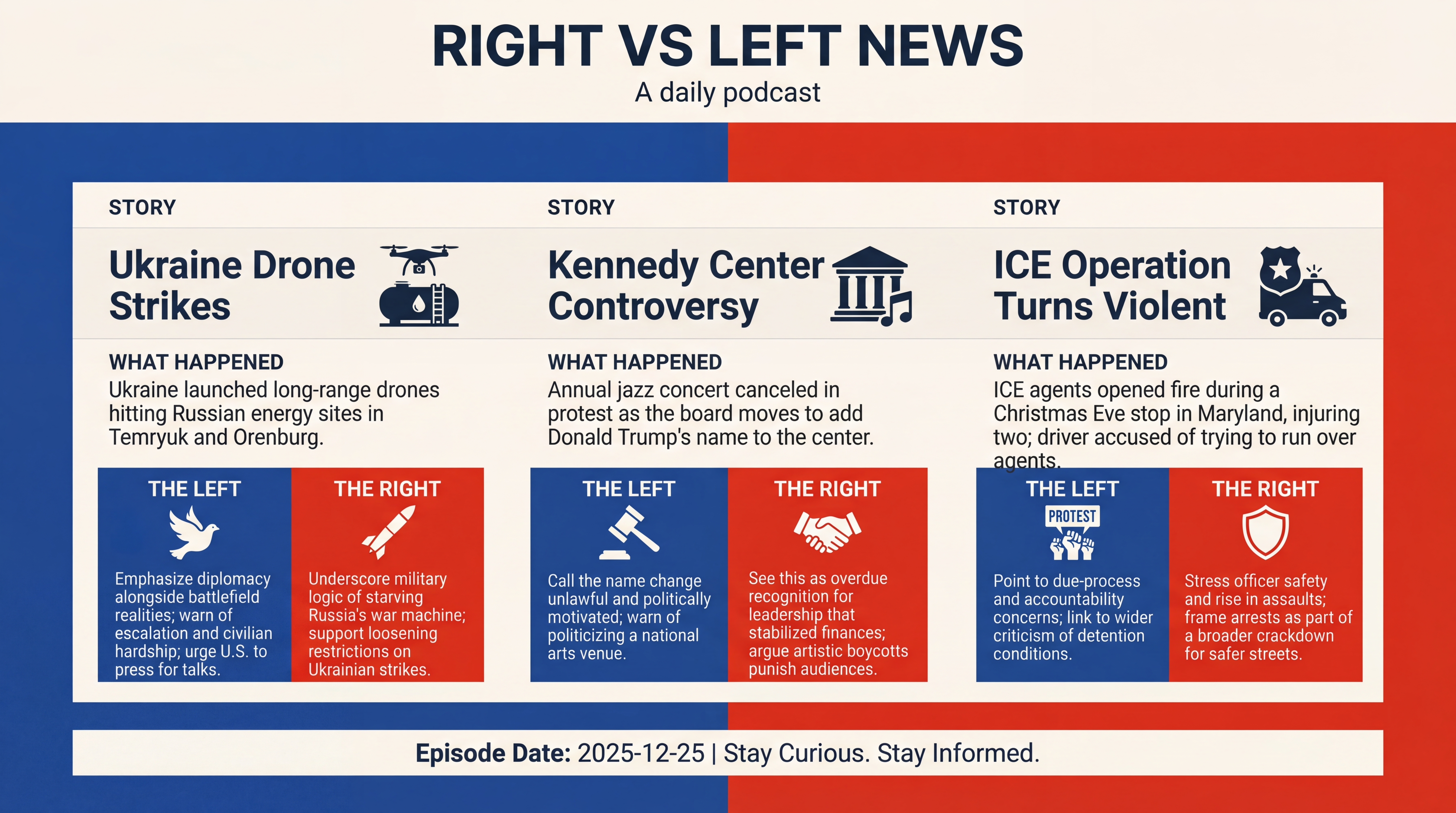
Ukrainian security officials say long-range drones hit oil tanks at the Russian Black Sea port of Temryuk, and a gas processing plant in Orenburg — part of Kyiv's campaign to target economic lifelines that fund Moscow's war. The SBU says the goal is to cut budget revenues and complicate Russian logistics. Meanwhile, several Moscow-area airports briefly restricted operations after waves of drone interceptions in recent days... another sign that deep-strike drone warfare is shaping the conflict's holiday tempo.
On the right: Conservative outlets underscore the military logic — hitting refineries and depots starves Russia's war machine and raises the cost of occupation. Some argue Washington and allies should loosen restrictions on Ukrainian strikes and surge air defenses, while noting energy markets could wobble if oil infrastructure burns.
On the left: Progressive voices emphasize diplomacy alongside battlefield realities. The Guardian highlighted President Zelensky's openness to a monitored demilitarized zone in the east — a signal Kyiv still wants a credible peace track. They warn that tit-for-tat strikes can escalate and spill into civilian hardship and global energy prices, urging the U.S. to press both sides toward talks while sustaining humanitarian aid.
Story two — here's what happened.
A long-running Christmas Eve jazz concert at Washington's Kennedy Center was canceled after host and drummer Chuck Redd withdrew in protest of the board's move to add President Trump's name to the building. Critics point to a 1964 law establishing the center as a living memorial solely to John F. Kennedy, arguing any name change requires Congress. The Washington Post has documented the new signage and the legal questions it raises; the center's Trump-appointed board says the change recognizes leadership that saved the institution.
On the right: Supporters see this as overdue recognition for a chairman they say stabilized finances and modernized operations. They argue boards routinely name spaces for philanthropists and leaders — and that artistic boycotts punish audiences more than politicians.
On the left: Legal experts and Kennedy family members call the change unlawful and politically motivated, warning it further politicizes a national arts venue and sets a precedent for rewriting congressionally designated memorials without legislation. Artists canceling performances say they won't legitimize what they view as a breach of the center's founding purpose.
Story three — here's what happened.
In Glen Burnie, Maryland, ICE agents opened fire on a van during a Christmas Eve enforcement stop, injuring two people who were hospitalized with non-life-threatening wounds. Agents say the driver tried to run them over; the van fled before stopping in a wooded area. Local police and the FBI are reviewing the incident. ICE says both occupants lacked legal status.
On the right: Coverage stresses officer safety and a rise in assaults on agents. Officials say suspects rammed vehicles and attempted to run over officers; DHS framed a string of year-end arrests as a Christmas gift of safer streets — part of a broader crackdown.
On the left: Progressive outlets point to due-process and accountability concerns, linking the shooting to wider criticism of detention conditions and aggressive tactics. A recent death in ICE custody has fueled calls for medical oversight and transparency. And on-the-ground reports from New Orleans describe immigrant families sheltering in place amid expanded operations... highlighting economic ripple effects and fear in mixed-status households.
[MIDPOINT_SPONSORS]
Story four — here's what happened.
In his first Christmas sermons as pope, Leo XIV used St. Peter's pulpit to center the poor and displaced — explicitly invoking Palestinians in Gaza and calling for compassion toward migrants and strangers. He drew parallels between the Nativity and today's makeshift tents... and appealed for a 24-hour global truce for Christmas.
On the right: Some conservative commentary embraces his pro-life and charity themes but bristles at sharp political takes. They emphasized his criticism of Moscow's refusal of a holiday truce and his opposition to assisted-suicide measures — echoing concerns that Western societies devalue life. Skeptics warn papal diplomacy can appear one-sided if it downplays Hamas or Iran-backed actors.
On the left: Liberal and Catholic social-justice voices highlight the moral urgency of his Gaza focus and his insistence that welcoming strangers is core Christian teaching. His homilies were read as a nudge toward cease-fires and refugee protection — a message progressives say should challenge hardline immigration and wartime policies alike.
Story five — here's what happened.
Saudi Arabia publicly urged Yemen's UAE-backed Southern Transitional Council to withdraw from two eastern governorates the separatists recently seized, warning the moves risk destabilizing the anti-Houthi coalition. Riyadh wants the STC to hand facilities to National Shield Forces as mediation continues. Analysts note the rift could aid the Houthis if anti-Houthi groups split.
On the right: Hawkish analysts focus on containing Iran's proxy network and keeping anti-Houthi forces unified. They argue Washington should support maritime patrols and back partners who can hold terrain — while pressing the STC and the internationally recognized government to coordinate rather than fracture the map.
On the left: Policy voices stress Yemen's humanitarian catastrophe and caution that great-power involvement — Saudi, Emirati, and U.S. — has too often worsened conditions. The priority, they argue, should be a UN-anchored political process and aid access... not new frontlines among ostensible allies.
Quick recap...
Ukraine's holiday-season drone campaign hit Russian energy sites... Washington's top arts venue plunged into legal and cultural crossfire... an ICE stop in Maryland raised fresh accountability questions... Pope Leo's Christmas plea spotlighted Gaza and the global poor... and Saudi pressure on Yemen's separatists exposed coalition fault lines. We'll keep tracking each thread as it evolves into the New Year.
That's it for today's episode of Right versus Left News. Remember, understanding both sides isn't about picking a team—it's about being informed. Subscribe wherever you get your podcasts, and join us tomorrow for another balanced look at the day's biggest stories. Until next time, stay curious and stay informed.
