Guard Limits, Visa Clash, H-1B Shake-Up
We break down the Supreme Court’s curb on a National Guard deployment to Chicago, U.S. visa bans tied to online speech rules, DHS’s H-1B overhaul, the return of student-loan wage garnishments, and a court order restoring disaster grants. Balanced perspectives from both sides — plus what to watch next.
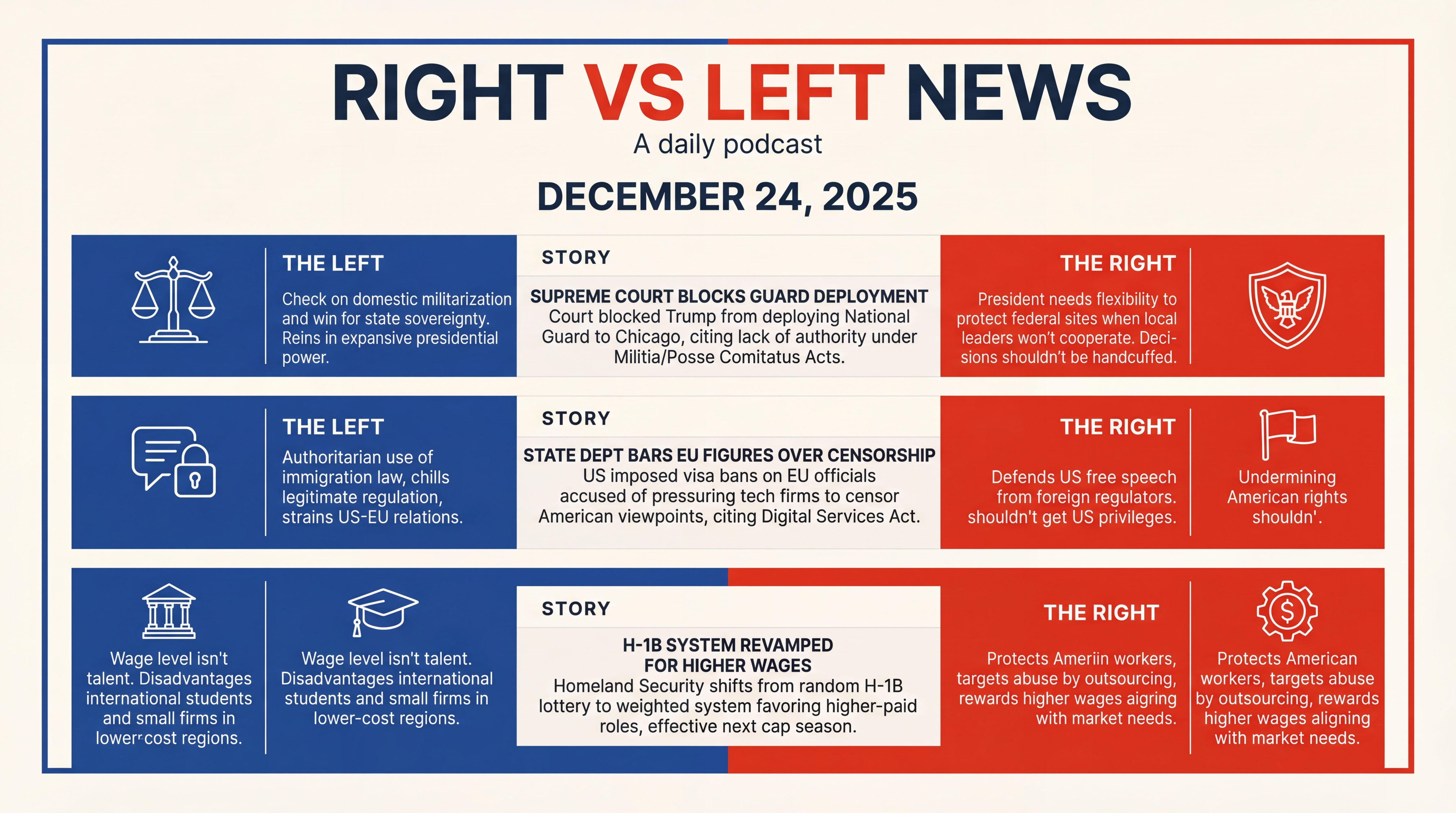
Episode Infographic
Show Notes
Welcome to Right versus Left News—your daily briefing on the stories that matter, told from both sides of the aisle. I'm your AI host - Chris, and each day I bring you the most important political and cultural news, with perspectives from conservative and progressive voices. No spin, no agenda—just the facts and the opinions that shape our national conversation. Let's dive in...
It’s Wednesday, December 24th. Here’s what we’re watching today...
The Supreme Court blocks a National Guard deployment to the Chicago area. The State Department bars several European figures over alleged online censorship. Homeland Security revamps the H-1B selection system to favor higher-paid roles. The Education Department says wage garnishments for defaulted student loans return in early January. And a federal judge orders Homeland Security to restore disaster and security grants after an immigration fight. Let’s dive in.
[BEGINNING_SPONSORS]
The Supreme Court, in an unsigned order, kept in place lower-court rulings that block President Trump from deploying National Guard troops to the Chicago area. Illinois and Chicago had sued after the administration federalized 300 Illinois Guard members and moved to bring in troops from Texas, arguing there was no legal basis under the Militia Act or the Posse Comitatus Act. The Court said the government hadn’t shown authority to use military force to execute the laws in Illinois. Justices Alito, Thomas, and Gorsuch dissented, while Justice Kavanaugh concurred on narrower grounds. The case now returns to the lower courts — and could shape similar disputes in other cities.
On the right, many argue the president needs latitude to protect federal personnel and facilities when local leaders won’t cooperate — pointing to the dissents and citing unrest around an ICE facility in Chicago. They say executive flexibility shouldn’t be handcuffed by courts.
On the left, progressives frame the decision as a check on domestic militarization and a win for state sovereignty. They note local police were handling demonstrations and say the ruling reins in expansive claims of presidential power over the Guard.
The State Department imposed visa bans on five Europeans — including former EU Commissioner Thierry Breton and leaders of several anti-disinformation groups — accusing them of pressuring U.S. tech firms to censor American viewpoints. France condemned the move, and Breton called it a “witch hunt.” This fight ties into EU enforcement of the Digital Services Act.
On the right, supporters hail the bans as defending U.S. free speech from foreign regulators. The argument is simple: if you work to undermine Americans’ rights, you shouldn’t enjoy U.S. travel privileges — and the DSA pressures platforms in ways that export censorship to America.
On the left, critics warn the bans are an authoritarian-style use of immigration law that chills legitimate regulation of harmful content and strains U.S.-EU relations. They note the DSA was democratically enacted in Europe and argue that using visas as a speech weapon sets a dangerous precedent.
Homeland Security finalized a rule replacing the random H-1B lottery with a weighted system that gives more chances to higher-paid positions, using the Labor Department’s four wage levels. Under the change, Level IV entries get four chances; Level I gets one. It’s slated to take effect for the upcoming cap season... with legal challenges expected.
On the right, supporters say this protects American workers and targets abuse by outsourcing firms. The administration frames it as prioritizing “the best of the best” — rewarding higher wages to align with market needs and discourage cheap-labor gaming.
On the left, immigration advocates, universities, and many tech employers counter that wage level isn’t the same as talent. They warn the rule disadvantages international students and small firms in lower-cost regions. Legal groups argue the statute doesn’t authorize a weighted lottery, and policy voices say the change may invite fraud while still missing top talent. Expect lawsuits.
[MIDPOINT_SPONSORS]
The Education Department will restart wage garnishment for borrowers in default on federal student loans starting the week of January 7, 2026 — initially about 1,000 borrowers, with monthly expansion afterward. By law, up to 15 percent of after-tax wages can be withheld after 30 days’ notice. More than 5 million borrowers are currently in default.
On the right, the focus is on personal responsibility and taxpayer fairness — arguing the long pandemic-era pause distorted repayment norms. Garnishment is framed as a necessary, if tough, tool to restore discipline and limit costs shifted to taxpayers.
On the left, progressives call the move cruel amid high costs and a strained loan system. They push alternatives like pausing garnishment, expanding income-driven options, and adding new protections. Some lawmakers are backing a bill to suspend garnishments for struggling borrowers.
A federal judge in Rhode Island ordered the Department of Homeland Security to restore more than $200 million in disaster and security grants after finding the administration illegally tied funding to state cooperation with immigration enforcement. Earlier rulings had called similar conditions unconstitutional or “arbitrary and capricious.” This decision fits into a broader legal fight over those funding conditions.
On the right, the view is that sanctuary-style policies endanger public safety and that conditioning federal funds is a legitimate tool to secure cooperation. DHS has publicly highlighted noncooperating jurisdictions as a matter of law and order.
On the left, supporters of the ruling call it a vital check on federal coercion — preventing politicization of money meant to be allocated based on risk. They argue community safety is harmed when states are forced into federal roles on immigration.
Quick recap...
The Supreme Court reins in a Guard deployment. Washington and Brussels clash over speech and platform rules. Homeland Security overhauls H-1B selection toward higher pay. Student loan wage garnishments return in January. And a judge orders DHS to restore disaster and security grants after an immigration fight. We’ll keep watching these into the new year.
That's it for today's episode of Right versus Left News. Remember, understanding both sides isn't about picking a team—it's about being informed. Subscribe wherever you get your podcasts, and join us tomorrow for another balanced look at the day's biggest stories. Until next time, stay curious and stay informed.
