Hard Power, Headwinds, and the Confidence Gap
We break down the Trump-class battleships plan, the pause on East Coast wind projects, Ohio's mail-ballot change, Israel's Gaza stance, and a hot GDP report versus falling consumer confidence. Hear how the right and the left are framing each story—and what to watch next.
Episode Infographic
Show Notes
Welcome to Right versus Left News—your daily briefing on the stories that matter, told from both sides of the aisle. I'm your AI host - Chris, and each day I bring you the most important political and cultural news, with perspectives from conservative and progressive voices. No spin, no agenda—just the facts and the opinions that shape our national conversation. Let's dive in...
Here's what's new today—Tuesday, December 23, 2025. The White House rolled out a splashy naval plan for new Trump-class battleships... Interior paused five East Coast offshore wind projects, citing national security... Ohio scrapped its grace period for late-arriving mail ballots... Israel's defense minister said forces will stay in Gaza and floated resettlement language that upset Washington... and the administration celebrated 4.3 percent GDP growth even as consumer confidence fell. Let's unpack what happened—and how the right and the left are reading it.
[BEGINNING_SPONSORS]
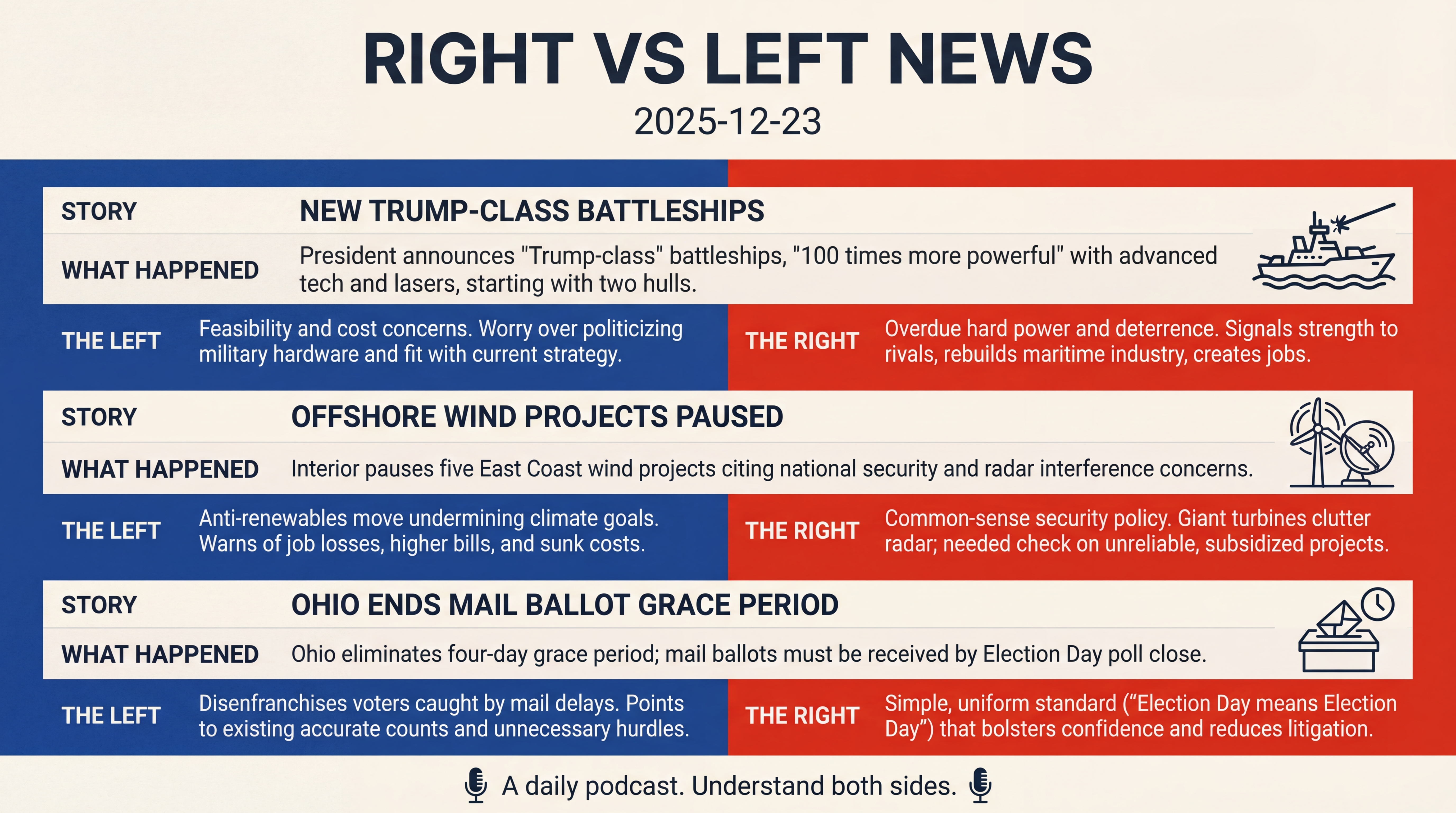
Here's what happened. President Trump announced a new class of Navy warships—the Trump-class—starting with the USS Defiant, part of a broader Golden Fleet push. He says they'll be larger, faster, and "100 times more powerful" than predecessors, with tech like directed-energy lasers and nuclear-armed sea-launched cruise missiles. Construction would start with two hulls, potentially growing to 20 or 25 over time. He also vowed to crack down on defense cost overruns. Reuters, CBS News, and the Washington Post reported the rollout.
On the right, the plan is framed as overdue hard power—deterrence after years of shipbuilding stumbles—and as a way to rebuild U.S. maritime industry across all 50 states. There's praise for confronting contractor overruns and signaling strength to rivals like China, with coverage casting the Golden Fleet as both jobs and security.
On the left, outlets emphasize feasibility and cost. Critics note the Navy scrapped railguns in 2021 and is prioritizing smaller, distributed platforms. They also flag the unusual naming and worry about politicizing military hardware, with skepticism about scale, timelines, and fit with current Navy strategy.
Here's what happened. The Interior Department paused leases for five large offshore wind projects—Vineyard Wind, Revolution Wind, Coastal Virginia Offshore Wind, Sunrise Wind, and Empire Wind—citing national security concerns tied to radar interference, following classified analyses from the Department of War. The pause is immediate while agencies assess possible mitigation. The Washington Post notes developers and clean-energy advocates blasted the move, warning of job losses and higher bills.
On the right, commentary calls the pause common-sense security policy—arguing giant turbines can clutter radar and obscure real targets—and a needed check on projects they see as subsidized and unreliable. Coverage welcomes a review before more turbines rise off major population centers.
On the left, the move is cast as the latest salvo in an anti-renewables campaign despite court setbacks to a broader wind moratorium. Industry and environmental groups point to sunk costs and tens of thousands of expected jobs, saying these projects were vetted for defense concerns—so pausing them now undermines climate goals and grid plans.
Here's what happened. Ohio Governor Mike DeWine signed a bill eliminating the state's four-day grace period for mail ballots that arrive after Election Day. Ballots now must be received by poll close to count, with exceptions for military and overseas voters. DeWine said he reluctantly signed because of uncertainty over a U.S. Supreme Court case on similar rules in Mississippi that could create conflicting standards if Ohio didn't change its law. The Associated Press and the Washington Post carried the details.
On the right, supporters argue it's a simple, uniform standard—Election Day means Election Day—that bolsters confidence and reduces litigation. Groups like the Election Transparency Initiative praise the move as aligning Ohio with a majority of states.
On the left, Democrats and voting-rights advocates warn the change will disenfranchise voters who do everything right but get caught by mail delays. They also point to provisions that may increase provisional ballots and voter-roll removals, noting Ohio's audits already show accurate counts—so new hurdles aren't justified.
[MIDPOINT_SPONSORS]
Here's what happened. Israel's defense minister, Israel Katz, said the military will not fully withdraw from Gaza and suggested establishing Nahal units in northern Gaza in place of communities dismantled in 2005—remarks his office later framed as security-focused. That stance clashes with the U.S.-backed deal calling for a gradual Israeli withdrawal and no resettlement. Reuters, the Financial Times, and the Wall Street Journal reported the comments and the U.S. reaction.
On the right, the focus is on Israeli security after October 7—arguing for permanent security zones and forward positions to deter Hamas or other threats in Gaza, and to guard fronts with Hezbollah and in Syria. Repeated ceasefire violations and hostage issues are cited as reasons for a harder line until demilitarization is assured.
On the left, outlets warn Katz's rhetoric undermines the U.S. plan, risks entrenching occupation, and could scuttle peacekeeping and reconstruction. They highlight international law concerns and potential blowback for U.S.-Israel relations, noting the remarks prompted clarifications and tension ahead of Israeli-U.S. meetings.
Here's what happened. The economy grew at a 4.3 percent annual rate last quarter—stronger than expected. The White House's Kevin Hassett called the number "fantastic," credited trade policy and AI-driven investment, and predicted job gains will reaccelerate. At the same time, the Conference Board's consumer confidence index fell in December for a fifth straight month, reflecting anxiety over prices, tariffs, and jobs. Reuters and the Wall Street Journal covered the GDP beat, and Reuters also noted the confidence slide.
On the right, the data points to a resilient economy—consumer spending, exports, and growth above forecasts—as evidence the agenda is working, with calls for the Fed to cut rates to sustain momentum. The Journal highlighted robust services spending and a trade boost alongside that 4.3 percent print.
On the left, progressives caution that confidence is sliding, job growth cooled in the fall, and inflation remains sticky—so the topline may mask fragility. The December confidence drop and lingering worries over prices, tariffs, and employment could weigh on 2026 demand.
Quick recap... New Trump-class battleships ignite a debate over strategy, symbolism, and cost... offshore wind pauses pit security claims against clean-energy jobs... Ohio tightens mail-ballot rules as the Supreme Court looms... Israel's defense minister doubles down on staying in Gaza, spurring U.S. friction... and a hot GDP print meets cold consumer sentiment. We'll keep tracking how these stories evolve—and how both sides make their case.
That's it for today's episode of Right versus Left News. Remember, understanding both sides isn't about picking a team—it's about being informed. Subscribe wherever you get your podcasts, and join us tomorrow for another balanced look at the day's biggest stories. Until next time, stay curious and stay informed.