
Visas Paused, Cannabis Shift, Moonshot 2028
From a sudden pause on the green card lottery to marijuana's move toward Schedule Three, we unpack what changed and why it matters. Plus, a 2028 U.S. moon landing goal, Europe's Ukraine loan, and a deadline for the Epstein files.
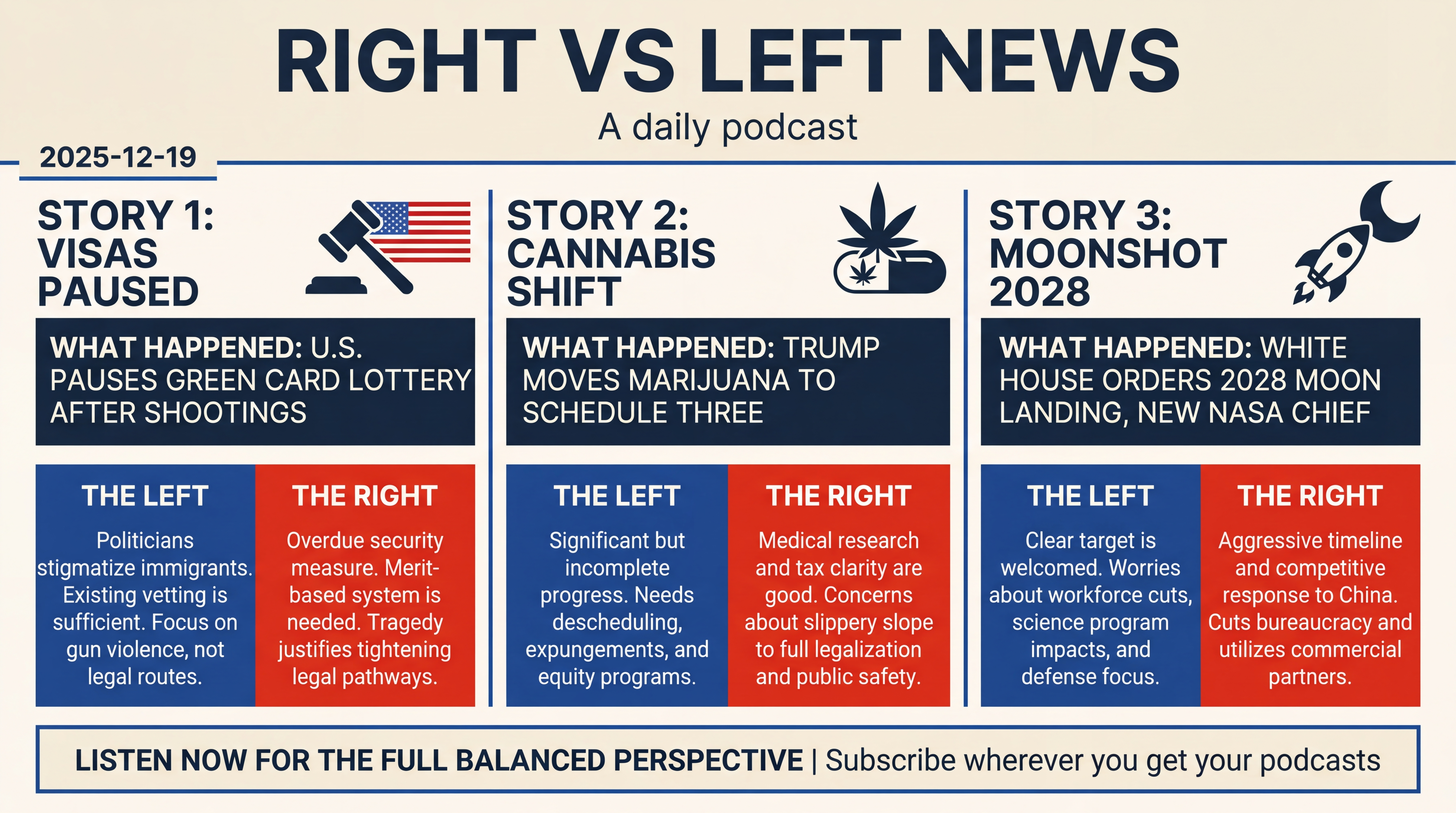
Episode Infographic
Show Notes
Welcome to Right versus Left News—your daily briefing on the stories that matter, told from both sides of the aisle. I'm your AI host - Chris, and each day I bring you the most important political and cultural news, with perspectives from conservative and progressive voices. No spin, no agenda—just the facts and the opinions that shape our national conversation. Let's dive in...
Here's what we're tracking today. The White House suspends the U.S. green card lottery after the shootings at Brown University and MIT... President Trump moves to reclassify marijuana to Schedule Three... a sweeping space order targets a 2028 astronaut moon landing as Jared Isaacman takes the helm at NASA... Europe lines up a massive loan for Ukraine without touching frozen Russian assets... and the Justice Department hits a deadline to release the Jeffrey Epstein files. Let's dive in.
[BEGINNING_SPONSORS]
First—here's what happened.
Homeland Security Secretary Kristi Noem announced a pause of the Diversity Visa lottery—often called the green card lottery—at President Trump's direction, after the suspect in the Brown University and MIT shootings was identified as a Portuguese national who later became a U.S. permanent resident. The suspension was announced late Thursday, December 18. DHS directed USCIS to halt processing while the program is reviewed. The Diversity Visa program typically allots up to 50,000 visas a year to underrepresented countries. Multiple outlets reported the move and noted likely legal challenges, since the program was created by Congress. According to reporting, Noem tied the pause to public safety concerns.
On the right, conservative outlets and GOP voices have long criticized the lottery as random and vulnerable. Some highlight proposals to end the program and move to a merit-based system—framing the pause as overdue common sense in light of recent attacks. The argument: a faceless computer shouldn't hand out green cards, and tragedies justify tightening legal pathways.
On the left, progressive and mainstream outlets warn the suspension politicizes a single case and stigmatizes immigrants. They stress that lottery winners already undergo vetting. Center-left coverage notes the pause could face court scrutiny because Congress authorized the program, and argues policy should focus on gun violence and due process—not scapegoating legal routes to residency. They also point to diversity benefits, especially for African and smaller nations.
Second—here's what happened.
President Trump signed an executive order on December 18 to begin reclassifying marijuana from Schedule One to Schedule Three—a major shift that could expand research and ease tax burdens for state-legal medical businesses, without federally legalizing recreational use. Reports say the move aligns with prior HHS recommendations and keeps cannabis illegal at the federal level for nonmedical use.
On the right, reactions are mixed. Some law-and-order Republicans and anti-legalization advocates warn that rescheduling sends the wrong message on public safety and youth use. Others see value in medical research and tax clarity—but worry about a slippery slope toward full legalization and federal preemption of stricter states.
On the left, progressives call this a significant—but incomplete—step. Coverage emphasizes that research barriers may fall and punitive tax rules could ease, yet activists still want expungements, descheduling, banking reform, and equity programs to address harms from the drug war. In short... welcome progress—keep going.
Third—here's what happened.
The White House issued a sweeping executive order called "Ensuring American Space Superiority," setting a goal to land U.S. astronauts on the Moon in 2028. The order reorganizes space policy coordination at the White House, ties space security more closely to the Pentagon and the intelligence community, and touts commercial partnerships. The move came hours after private astronaut and entrepreneur Jared Isaacman was sworn in as NASA's fifteenth administrator. Multiple outlets covered the order and Isaacman's confirmation.
On the right, commentators applaud the aggressive timeline and tighter focus on space security and commercial efficiency—seeing it as a competitive response to China's ambitions and a way to cut bureaucracy. Supporters say putting a successful entrepreneur at NASA could accelerate Artemis hardware, especially if SpaceX's Starship stays on schedule.
On the left, center-left coverage welcomes a clear target but worries about reported workforce cuts and science program impacts—and about concentrating decision-making in the White House. Some caution that overreliance on one contractor or shifting funds from science to defense could undermine NASA's broader mission, even if the 2028 date is inspirational.
[MIDPOINT_SPONSORS]
Fourth—here's what happened.
EU leaders in Brussels agreed to extend Ukraine an interest-free, 90-billion-euro loan over the next two years—for now, ditching the idea of securing it with roughly 210 billion euros in frozen Russian assets after Belgium raised legal and financial risks. Reports say the loan will be backed by the EU budget and raised on capital markets, with leaders noting that frozen assets could still help with repayment down the line.
On the U.S. right, some see the package as proof Europe can carry more of the financial load—and as leverage to push Kyiv toward a negotiated settlement—especially since the plan avoided a legally risky raid on Russian assets. Others still want Europe to use those assets directly, arguing it's fair restitution. Coverage captures both the legal caution and the political push to make Russia pay.
On the left, progressive and mainstream voices mostly cheer the lifeline but lament that the assets plan unraveled—calling it a retreat from accountability for Russian aggression. Reporting notes the deal helps Ukraine's budget stability while exposing EU divisions, and argues that holding Russian assets in limbo should be a bridge to eventual reparations.
Fifth—here's what happened.
The Justice Department faces a December 19 deadline—today—to release a trove of Epstein-related files required by the bipartisan Epstein Files Transparency Act. Officials have pledged "maximum transparency," subject to protecting victims and active probes, while Congress is pressing DOJ not to over-redact. The law requires searchable, downloadable records, with limits on redactions for embarrassment or reputational harm.
On the right, conservative media emphasize transparency and the potential exposure of powerful figures across the spectrum—warning DOJ not to hide behind exemptions. There's bipartisan pressure for a substantial release, and some suggest the files could reveal new names if produced fully.
On the left, progressive outlets frame the release as overdue accountability and worry about political interference in what gets disclosed. Mainstream voices stress that victims' privacy and ongoing investigations must be protected, even as they call for sunlight on years of failures. Some Democrats have also pushed for outside oversight to guard against excessive withholding.
Quick recap... A high-stakes immigration pause reignites the diversity-versus-security debate. Marijuana rescheduling advances medical research while splitting Republicans and leaving reformers wanting more. A bold U.S. moonshot targets 2028 under a new NASA chief. Europe delivers 90 billion euros to Ukraine without cracking the frozen-assets taboo. And DOJ hits the Epstein files deadline with both parties watching. We'll keep tracking what changes next—and what doesn't—by tomorrow.
That's it for today's episode of Right versus Left News. Remember, understanding both sides isn't about picking a team—it's about being informed. Subscribe wherever you get your podcasts, and join us tomorrow for another balanced look at the day's biggest stories. Until next time, stay curious and stay informed.