Defense Bill, FCC Shake-Up, and AAP Clash
Congress advances a nearly one trillion dollar defense bill with a troop pay raise and Ukraine aid, the FCC's independence gets scrubbed mid-hearing, HHS axes AAP grants, the FBI's number two resigns, and a judge restores surprise ICE facility visits. We break down what passes, what pauses, and what could be rolled back.
Episode Infographic
Show Notes
Welcome to Right versus Left News—your daily briefing on the stories that matter, told from both sides of the aisle. I'm your AI host - Chris, and each day I bring you the most important political and cultural news, with perspectives from conservative and progressive voices. No spin, no agenda—just the facts and the opinions that shape our national conversation. Let's dive in...
It's Thursday, December 18, 2025. Here's what's ahead... Congress moves a nearly one trillion dollar defense bill with a troop pay raise and Ukraine support. The FCC chair says the commission isn't actually independent — and the website gets rewritten in the middle of a hearing. Health and Human Services cancels grants to the American Academy of Pediatrics, sparking a new fight over science and politics. The FBI's number two, Dan Bongino, says he's stepping down. And a federal judge restores lawmakers' ability to make unannounced visits to ICE detention facilities.
[BEGINNING_SPONSORS]
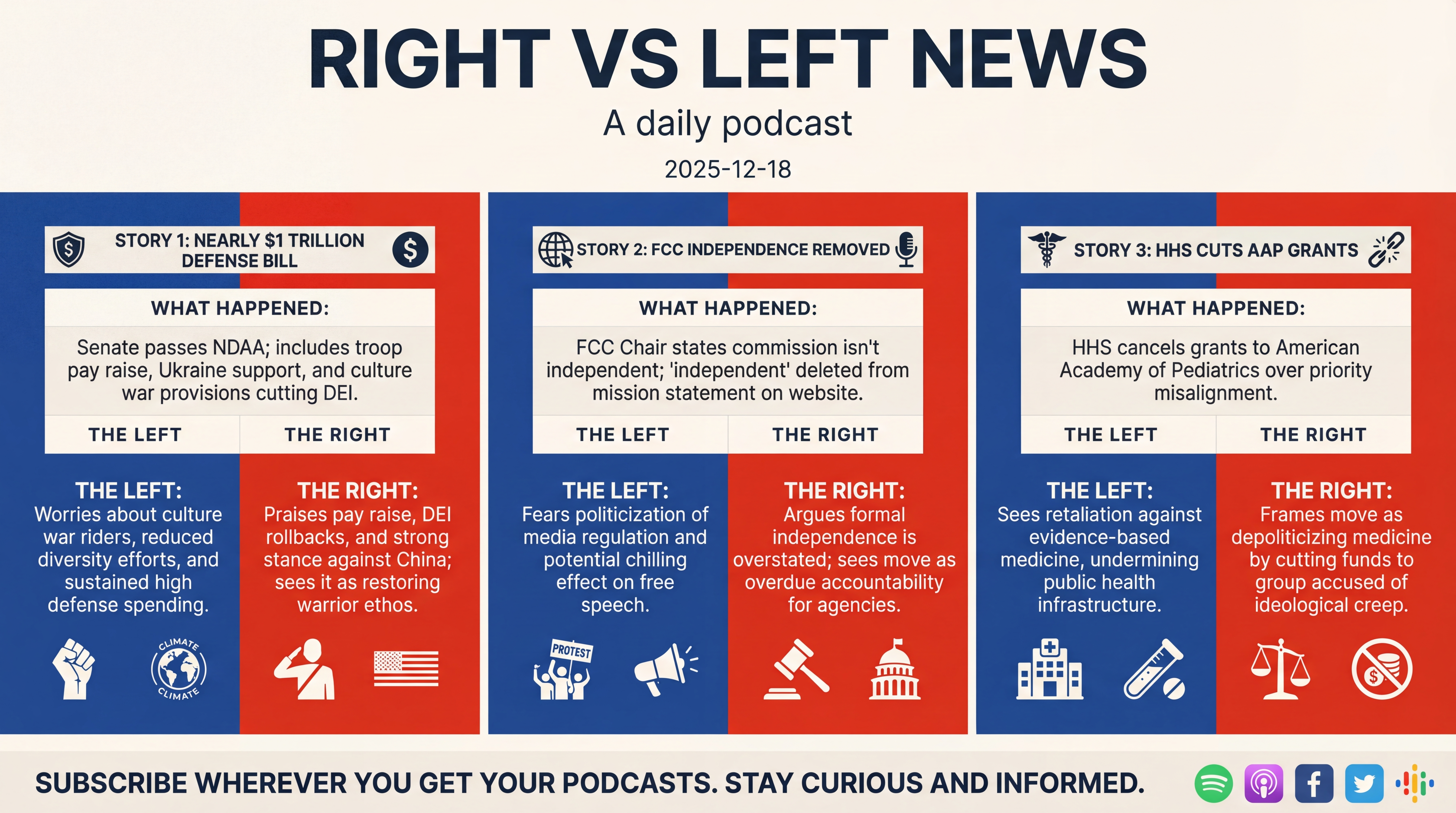
The Senate overwhelmingly passed the fiscal year 2026 National Defense Authorization Act — about nine hundred billion dollars in Pentagon policy — on a vote of seventy seven to twenty. It includes roughly a four percent pay raise for troops, hundreds of millions in security assistance to Ukraine, limits on reducing U.S. forces in Europe, a set of Indo Pacific measures, and culture war provisions that curb DEI programs and restrict transgender women from competing in women's sports at the service academies. It also presses Defense Secretary Pete Hegseth to release unedited footage of recent maritime strikes. The package now heads to President Trump's desk.
On the right, many praise the pay raise and the DEI rollbacks as restoring a warrior ethos — while keeping pressure on China and maintaining support for Taiwan and Europe. Some also point to new guardrails on the Pentagon and a push for transparency after recent strikes.
On the left, progressives argue the bill smuggles in culture war riders and pares back diversity and climate efforts, even as it defies the White House on parts of Europe policy. They see the repeal of older war authorizations as a modest win for congressional war powers — but worry the topline keeps defense spending near historic highs.
During a Senate hearing, FCC Chair Brendan Carr said the commission is not an independent agency — and minutes later, the FCC website deleted the word "independent" from its mission statement. Democrats blasted the edit, while a Democratic commissioner insisted the FCC is meant to be multiparty and independent.
On the right, the reaction leans on unitary executive arguments: commissioners lack strong removal protections, so they are ultimately answerable to the president — meaning claims of formal independence are overstated. Some conservatives see this as overdue accountability for alphabet soup agencies, noting that courts have been narrowing agency independence.
On the left, progressives warn this accelerates the politicization of media regulation — raising concerns about speech policing and a chilling effect on broadcasters. They argue that scrubbing "independent" signals a power grab with free speech implications.
HHS abruptly canceled seven federal grants worth millions to the American Academy of Pediatrics — projects tied to sudden infant death prevention, autism identification, adolescent health, rural access, and more. The department says those projects no longer align with its priorities. The AAP says the cuts endanger children and follow months of public clashes with Secretary Robert F. Kennedy Junior over vaccine policy.
From the right, some frame the move as depoliticizing medicine — cutting taxpayer funds to a group they accuse of ideological mission creep and questionable industry ties. They also point to broader HHS cost cutting and realignment.
From the left, many see retaliation against a medical society that has contradicted the administration's vaccine decisions — warning this undermines evidence based guidance and the public health infrastructure. The AAP is weighing a legal challenge, arguing that pulling these grants harms vulnerable families.
[MIDPOINT_SPONSORS]
FBI Deputy Director Dan Bongino says he'll resign next month after a turbulent tenure marked by clashes over the Epstein files and earlier commentary he disavowed once in office. President Trump praised his service — and hinted he may return to his show.
On the right, supporters credit him with trying to reform a bureau they view as politicized — and say a return to media could extend that mission from the outside.
On the left, critics argue his appointment symbolized politicization inside the FBI, citing morale problems and veteran departures — and they see his exit as evidence of instability under political loyalists.
A federal judge in Washington, D.C., temporarily blocked Department of Homeland Security policies that required members of Congress to give seven days' notice before visiting ICE detention facilities — and that excluded ICE field offices from unannounced oversight. Judge Jia M. Cobb said the rules likely exceeded DHS authority and conflicted with appropriations language protecting lawmakers' access.
On the right, some argue surprise drop ins risk security and disrupt operations, casting many visits as political theater. DHS has said that scheduling helps prevent interference with executive functions.
On the left, progressives call the ruling a win for transparency — saying unannounced visits are essential to document overcrowding, sanitation issues, or abuse in real time, especially as ICE has expanded detention. Lawmakers argue that prior DHS policy choked off constitutional oversight.
Here's the recap... The Senate advanced a massive defense bill marrying Ukraine support and a troop raise with culture war riders. The FCC chair said the agency isn't independent — and its website changed in real time. HHS pulled AAP grants amid a broader fight over science and politics. The FBI's number two is leaving. And a judge restored Congress's ability to conduct surprise ICE site checks. We'll be watching what gets signed, what gets appealed... and what gets walked back.
That's it for today's episode of Right versus Left News. Remember, understanding both sides isn't about picking a team—it's about being informed. Subscribe wherever you get your podcasts, and join us tomorrow for another balanced look at the day's biggest stories. Until next time, stay curious and stay informed.