
Blockades, Court Battles, and a Fragile Truce
From a Venezuela tanker blockade to a House vote on trans youth care, a constitutional fight over undocumented rights, peacekeeper debates in Ukraine, and a Boston deportation case — here’s what happened and why it matters. Clear context, minus the noise.
Episode Infographic
Show Notes
Welcome to Right versus Left News—your daily briefing on the stories that matter, told from both sides of the aisle. I'm your AI host - Chris, and each day I bring you the most important political and cultural news, with perspectives from conservative and progressive voices. No spin, no agenda—just the facts and the opinions that shape our national conversation. Let's dive in...
Here’s what’s breaking on Wednesday, December 17, 2025.
The White House escalates its Venezuela pressure campaign with a new blockade on sanctioned oil tankers. The House sets a vote on Representative Marjorie Taylor Greene’s bill to criminalize gender transition care for minors. A federal appellate judge argues the Constitution’s protections don’t extend to undocumented immigrants. In Europe, a U.S.-backed Ukraine plan featuring European peacekeepers draws fresh Kremlin pushback. And in Boston, a federal judge signals he may again block a policy that swiftly deports migrants to third countries — a dispute likely headed back to the Supreme Court.
These updates landed in the last 24 hours, with reporting from outlets like Reuters and the Washington Post.
[BEGINNING_SPONSORS]
First, Venezuela...
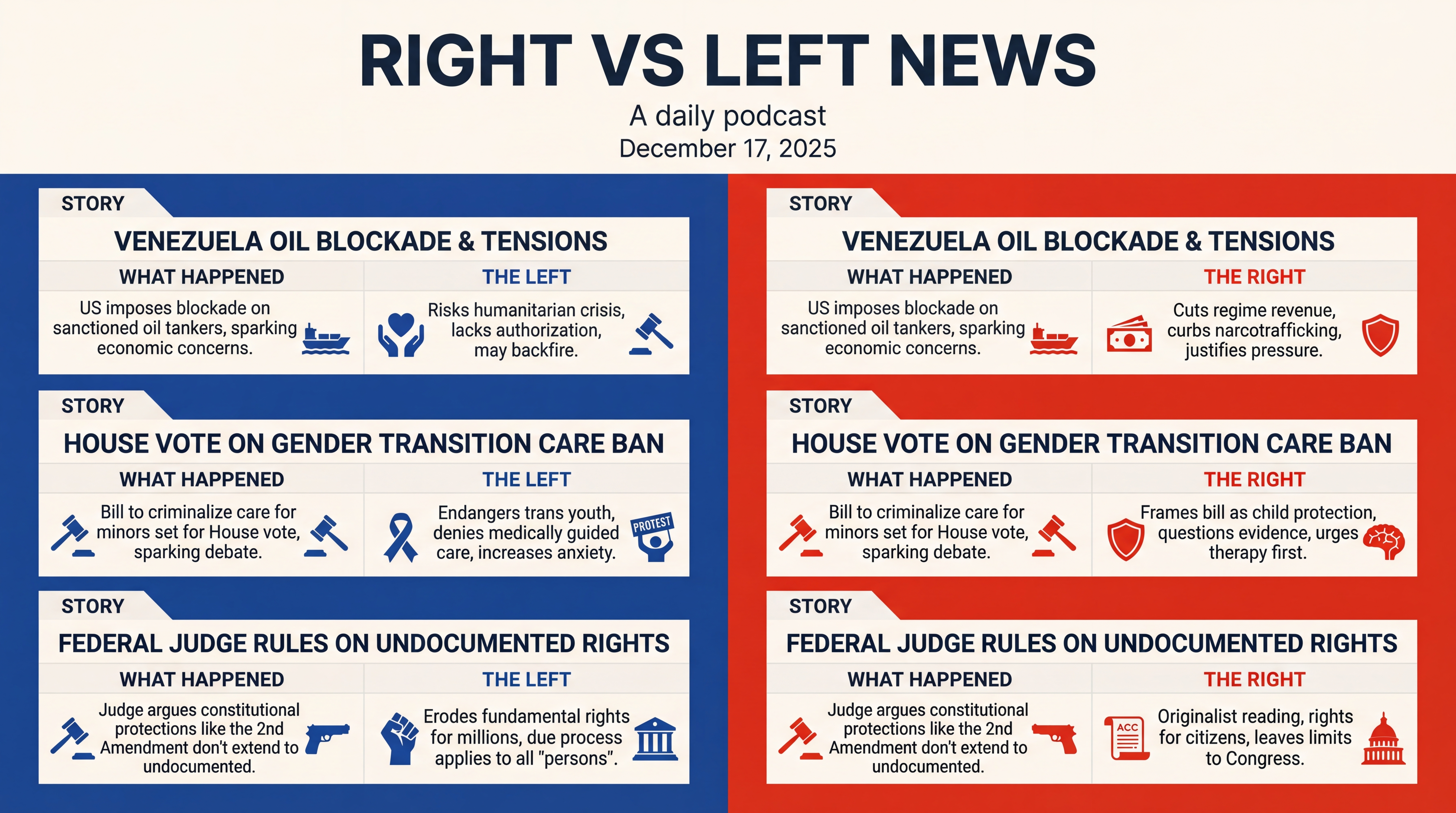
President Trump has ordered a “total and complete blockade” of all U.S.-sanctioned oil tankers entering or leaving Venezuela — and vowed a larger U.S. naval presence near the country. Oil prices ticked up on the news. Caracas called the move a “grotesque threat,” saying it will bring the issue to the U.N. Security Council. Some lawmakers are calling the action an unauthorized act of war, while analysts warn that aggressive enforcement could trigger economic shock.
On the right, the emphasis is on cutting off revenue to Nicolás Maduro’s regime and curbing narcotrafficking — with arguments that limited pressure only helps Maduro ride out existing sanctions. Some back stepped-up measures against Maduro’s inner circle and shipping firms as part of a justified pressure campaign.
On the left, critics warn a blockade risks collective punishment — fueling shortages and a broader humanitarian crisis — and may lack clear congressional authorization. Analysts note that choking off oil revenue could be devastating inside Venezuela, and that sanctions-heavy strategies rarely deliver regime change — and can backfire.
Let’s move to Capitol Hill...
The House is set to vote on Representative Marjorie Taylor Greene’s Protect Children’s Innocence Act, which would criminalize providing puberty blockers, hormones, and surgeries to minors. She secured the vote as part of a defense-bill deal. It’s unlikely to pass the Senate, but it forces lawmakers to take a recorded stance on an issue dividing the country — and the medical community.
On the right, supporters frame the bill as child protection, urging therapy-first approaches and questioning the evidence behind pediatric interventions. They point to stepped-up state enforcement against doctors accused of violating state laws.
On the left, opponents argue bans endanger trans youth by cutting off medically guided care endorsed by major U.S. medical groups. Human-rights advocates cite increased anxiety, depression, and treatment disruptions under state bans, and medical organizations have pushed back on federal efforts to curtail care.
Now to the courts...
In a case involving a Guatemalan man convicted of unlawful gun possession, Sixth Circuit Judge Amul Thapar wrote that constitutional rights — including the Second Amendment — do not extend to immigrants who are unlawfully present. He concurred in upholding the gun law, but argued that only citizens are covered by “We, the People.” The majority, however, said some protections can apply to non-citizens with substantial ties to the U.S.
On the right, some praise Thapar’s originalist reading — that enumerated rights attach to the political community, meaning citizens — while leaving immigration limits to Congress and the states. They argue that extending full constitutional guarantees to those here unlawfully blurs sovereignty and weakens deterrence.
On the left, civil-liberties groups counter that due process and equal protection apply to “persons,” not just citizens, citing long-standing precedent. They warn Thapar’s approach would erode fundamental rights for millions living on U.S. soil.
[MIDPOINT_SPONSORS]
In Europe, a U.S.-backed ceasefire framework for Ukraine is taking shape. The Kremlin reiterated opposition to any European troop presence, but left the door open to discussion. Germany’s chancellor, Friedrich Merz, described a potential post-ceasefire peacekeeping mission empowered to repel violations and secure a demilitarized zone. Kyiv says a proposal could soon be presented to Moscow.
On the right, hawkish voices argue Europe should shoulder more of the burden — peacekeepers, funding, and long-term deterrence — so U.S. support isn’t open-ended. Without a credible European force, they warn, any truce could freeze the conflict and invite future Russian aggression.
On the left, progressives worry foreign troops inside Ukraine could heighten the risk of direct Russia–NATO confrontation. They insist any deal must include enforceable Russian pullbacks, real accountability, and robust civilian protections — and caution that Moscow’s red lines make the proposal fragile.
Back in Boston...
A federal judge indicated he’s open to again blocking a policy that swiftly deports migrants to third countries — sometimes with minimal notice — without a meaningful chance to raise fears of persecution or torture. The Supreme Court previously paused his injunction, but he signaled the case will likely return to the high court. Reporting has documented deportation flights toward South Sudan — and disputes over whether due-process safeguards were followed.
On the right, immigration hawks argue the executive needs flexibility to remove people with final orders, and that court-imposed procedures can be exploited to delay removal indefinitely. They call for tighter vetting, stronger deterrence, and faster removals.
On the left, immigrant-rights advocates say the policy risks refoulement — sending people to danger — without due process. They argue the Constitution and U.S. treaty obligations bar deportations where torture is likely, and that courts are essential to stop unlawful shortcuts.
Quick recap...
A Venezuela tanker blockade raises the stakes in the Caribbean. The House readies a high-profile vote on trans youth care. A conservative judge ignites a constitutional fight over undocumented rights. Europe weighs peacekeepers for a fragile Ukraine plan. And a Boston judge could again slow third-country deportations.
We’ll keep tracking each of these stories as votes are cast, filings drop, and diplomacy shifts in the days ahead.
That's it for today's episode of Right versus Left News. Remember, understanding both sides isn't about picking a team—it's about being informed. Subscribe wherever you get your podcasts, and join us tomorrow for another balanced look at the day's biggest stories. Until next time, stay curious and stay informed.