
Drones, Ballrooms, FAA Fixes, and Ceasefires
U.S. maritime strikes intensify as fentanyl gets a WMD label, the White House defends a massive ballroom as a security need, and the FAA unveils a post-crash safety overhaul. Plus, Europe launches a Ukraine claims commission while Moscow ties any truce to a broader deal — and Trump takes the BBC to court.
Episode Infographic
Show Notes
Welcome to Right versus Left News—your daily briefing on the stories that matter, told from both sides of the aisle. I'm your AI host - Chris, and each day I bring you the most important political and cultural news, with perspectives from conservative and progressive voices. No spin, no agenda—just the facts and the opinions that shape our national conversation. Let's dive in...
Here's what we're watching on Tuesday, December 16, 2025... The U.S. is expanding its campaign of drone strikes on suspected drug-running boats as President Trump formally labels fentanyl a weapon of mass destruction. The White House is in court defending a 90,000 square foot ballroom project as a matter of national security. After the deadly midair collision over D.C., the FAA rolls out a safety overhaul — while Senator Ted Cruz fights language in the defense bill he says weakens airspace protections. In Europe, leaders launch a commission to document Ukraine's war-damage claims, even as the Kremlin ties any Christmas ceasefire to a broader peace deal. And President Trump sues the BBC for ten billion dollars over a January 6 documentary edit.
[BEGINNING_SPONSORS]
Here's what happened... According to the Washington Post, U.S. forces destroyed three more suspected drug-trafficking boats in the eastern Pacific on December 15, killing eight people — part of an air-and-sea campaign that has left at least 95 people dead since September. The operations have sparked congressional demands for unedited strike footage after a controversial follow-up strike that month.
Meanwhile, Reuters says President Trump signed an order classifying fentanyl as a "weapon of mass destruction," opening more Pentagon and intelligence tools against traffickers. Fox News reports Defense Secretary Pete Hegseth says the strikes will continue against what he calls "narco-terrorists."
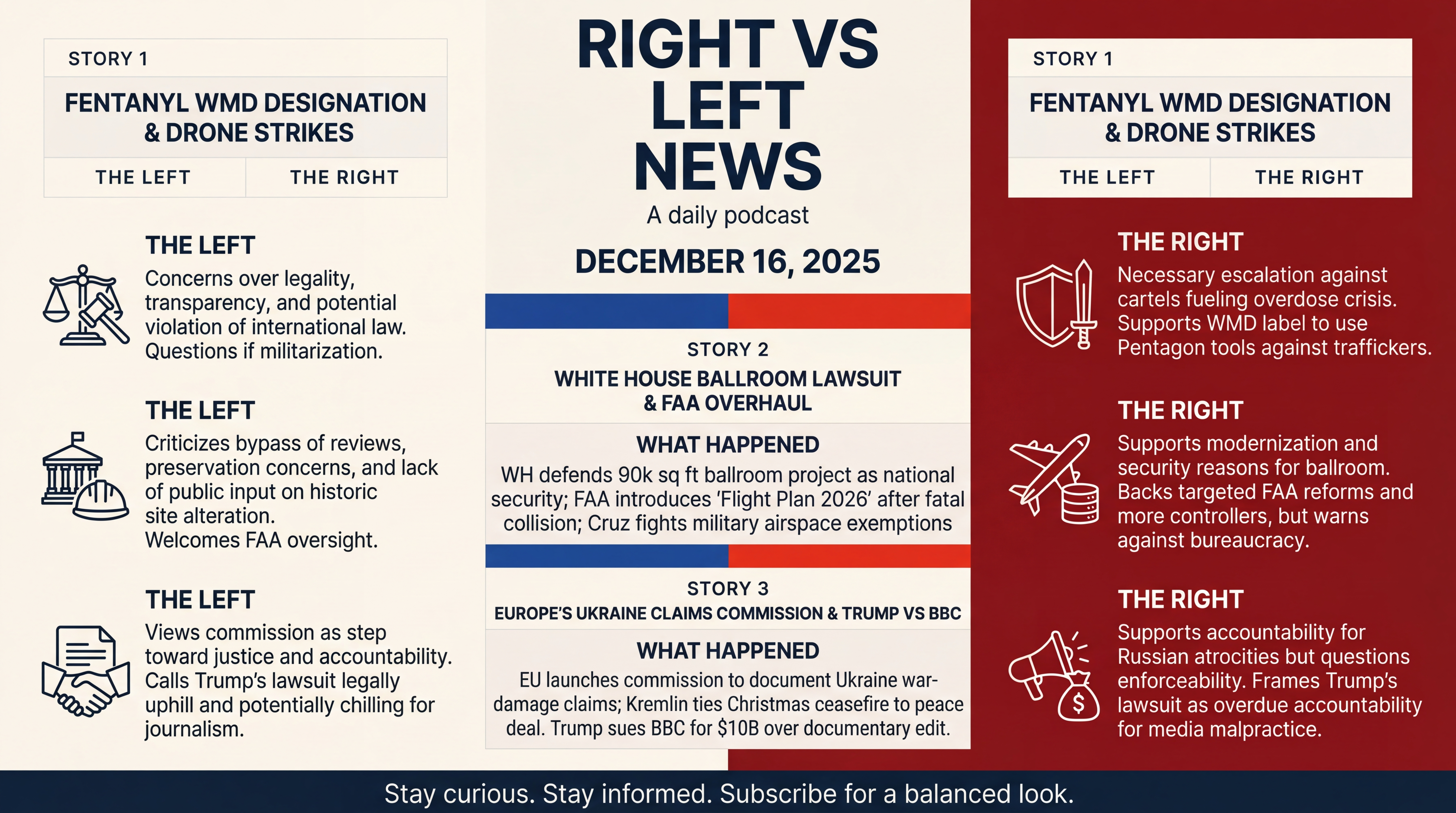
How the right sees it: Conservative outlets frame the strikes as a necessary escalation to stop cartels fueling the overdose crisis — highlighting claims that targets are on known smuggling routes, that operations occur in international waters, and that there have been no U.S. casualties. The fentanyl WMD designation, in this view, finally matches national security tools to the human toll of the opioid crisis.
How the left sees it: Others emphasize legal and ethical concerns — noting the lack of transparency around the September incident — and argue the campaign may violate international and U.S. law. "Narco-terrorism" isn't a recognized legal basis for lethal force, they say, and the strategy risks a wider conflict, including with Venezuela. Progressives also question whether militarized tactics address a fentanyl supply chain rooted in Mexico and China.
Here's what happened... The Associated Press reports the administration told a federal judge that building a 300 million dollar, 90,000 square foot White House ballroom is a national security imperative — urging the court to throw out a preservationist lawsuit seeking to halt construction after the East Wing's demolition. The National Trust for Historic Preservation argues the project bypassed required reviews and public input. Reuters noted a filing that set up today's hearing on a temporary halt.
How the right sees it: Supporters emphasize that presidents have long modernized the People's House, that the project is privately funded, and that the Secret Service backs the plan for security reasons. Some on the right call the outcry overblown — a cosmetic controversy getting outsized attention.
How the left sees it: Critics focus on process and precedent — calling it an unprecedented alteration of a national landmark without adequate oversight. They raise ethics concerns about donor influence and transparency, and stress that statutes and commissions should review a project like this before work proceeds.
Here's what happened... Reuters reports the FAA's administrator will outline "Flight Plan 2026," a safety overhaul following January's fatal midair collision over D.C. The plan would create a Safety Integration Office, use risk heat maps, and push greater transparency. Axios says Senator Ted Cruz is pressing to remove defense-bill language that could ease military helicopter operating restrictions near Reagan National Airport — arguing it undercuts safety after the crash.
How the right sees it: Republican voices spotlight antiquated FAA systems and back targeted reforms — more air traffic controllers, tech upgrades, and mandatory ADS-B tools — while warning against bureaucracy that dodges accountability. They add that military exemptions shouldn't override safety when missions aren't critical.
How the left sees it: Many welcome aggressive oversight and data-driven standards — tighter requirements aligned with the NTSB, and no carve-outs that could repeat the circumstances of the crash. The through-line is transparency and uniform compliance across congested airspace, civilian and military alike.
[MIDPOINT_SPONSORS]
Here's what happened... Reuters says European leaders meeting in The Hague launched an International Claims Commission to validate Ukraine's war-damage claims — building on the Council of Europe's register of damage — with the Netherlands hosting the body. On the same day, the Kremlin responded to Kyiv's truce idea by saying any Christmas ceasefire depends on progress toward a broader peace deal.
How the right sees it: There's support for accountability for Russian atrocities, but questions about enforceability — divisions over seizing Russian assets and the risk of escalation. Some point to Belgium's reluctance to confiscate frozen funds and warn bold legal moves could invite retaliation without ending the war.
How the left sees it: Many view the commission as a credible step toward justice and a bridge to longer-term compensation, potentially using frozen Russian assets. Documenting harm, they argue, strengthens any eventual peace by centering accountability.
Here's what happened... The Wall Street Journal reports President Trump filed a ten billion dollar defamation suit against the BBC, alleging a 2024 documentary deceptively edited his January 6 speech to imply he incited violence. The Washington Post adds the BBC apologized for an editing error but denies defamation, and legal experts note he faces a high bar as a public figure.
How the right sees it: Many conservatives frame the suit as overdue accountability for media malpractice — saying the edit distorted key language and that apologies mean little without consequences.
How the left sees it: Others call the case legally uphill and potentially chilling for journalism — arguing the remedy for bad editing is correction and transparency, not billion-dollar penalties — and noting the documentary's U.K. origin complicates jurisdiction.
Quick recap... The U.S. intensifies strikes at sea as fentanyl gets a WMD label; the White House defends its new ballroom as a security need; the FAA moves to tighten safety while Cruz pushes to keep protections strong; Europe opens a Ukraine claims commission even as Moscow ties any truce to a larger deal; and Trump sues the BBC for ten billion dollars. We'll keep watching what changes next — and how both right and left see it.
That's it for today's episode of Right versus Left News. Remember, understanding both sides isn't about picking a team—it's about being informed. Subscribe wherever you get your podcasts, and join us tomorrow for another balanced look at the day's biggest stories. Until next time, stay curious and stay informed.