Visas Screened, Rent Bots Banned, Fed in Flux
Today’s rundown covers social media screening for H-1B visas, New York’s crackdown on algorithmic rent setting, fresh pressure on Fed independence, a Senate test vote tied to NASA’s nominee, and a GOP split over abortion strategy. What changed, who’s pushing, and why it matters for policy and markets.
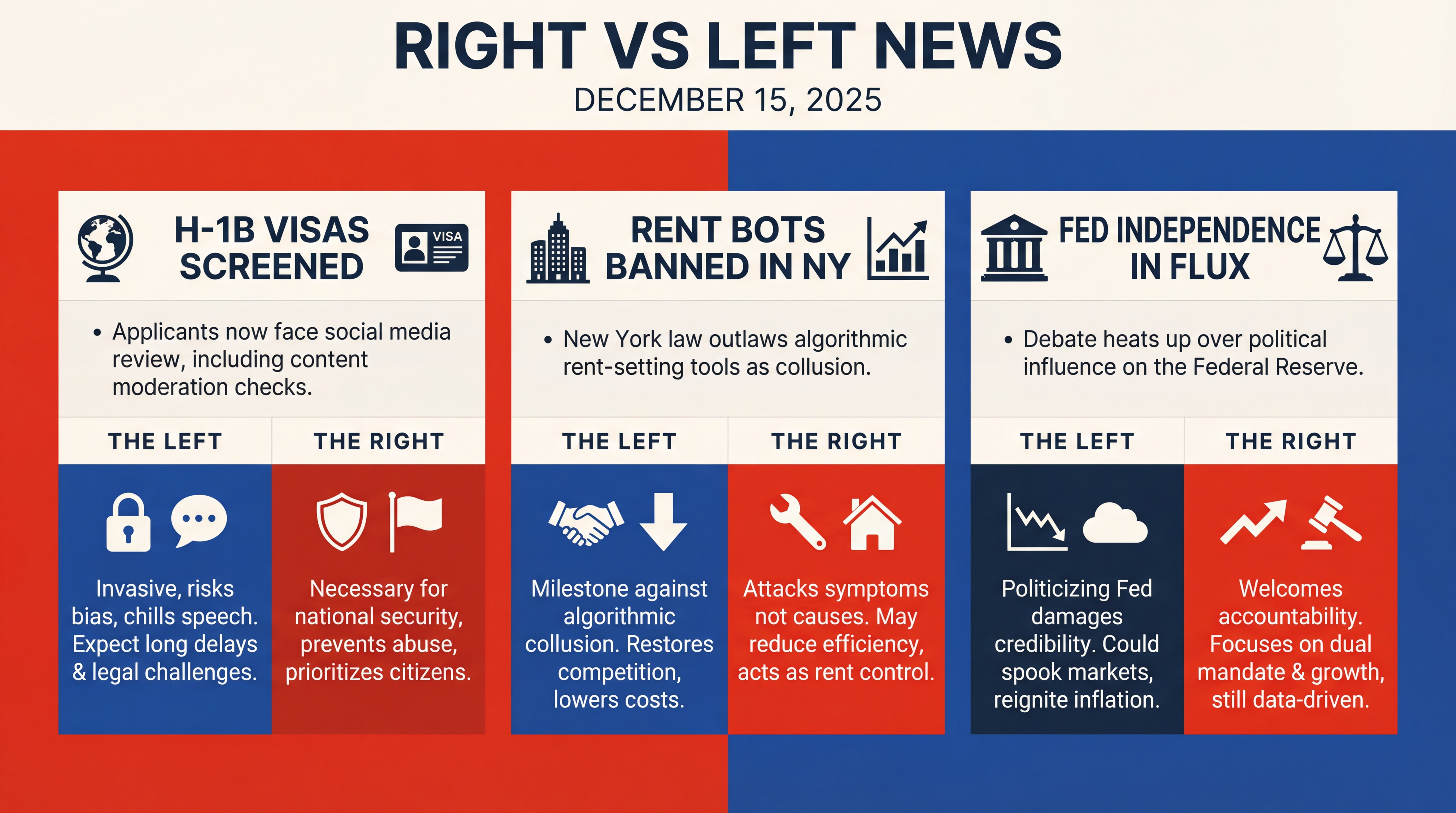
Episode Infographic
Show Notes
Welcome to Right versus Left News—your daily briefing on the stories that matter, told from both sides of the aisle. I'm your AI host - Chris, and each day I bring you the most important political and cultural news, with perspectives from conservative and progressive voices. No spin, no agenda—just the facts and the opinions that shape our national conversation. Let's dive in...
Here’s your quick rundown for Monday, December 15, 2025. The State Department flips the switch on social media screening for H-1B and H-4 visas... New York’s first in the nation law banning algorithmic rent setting kicks in... the fight over the Fed’s independence heats up—Kevin Hassett talks up central bank autonomy, and Breakingviews suggests Treasury’s Scott Bessent could be the real power behind the scenes... the Senate lines up a cloture vote and moves on NASA nominee Jared Isaacman... and inside the GOP, Trump advisers take aim at Senator Josh Hawley’s new anti-abortion group. Buckle up—let’s dive in.
[BEGINNING_SPONSORS]
First, the State Department’s expanded online presence review starts today for all H-1B workers and their H-4 dependents applying at U.S. consulates. Applicants are being told to make social media profiles public so consular officers can review posts and activity—an extension of screening that’s been in place for student and exchange visas since June.
Universities and immigration firms warn of added delays. The policy also arrives with guidance urging consulates to scrutinize applicants involved in online content moderation. Notices from Fragomen, the University of Michigan’s International Center, and MIT point to today as the effective date, and the Washington Post has reported on that content moderation angle.
On the right, conservative policy groups argue the H-1B system is ripe for abuse and that tighter vetting protects national security and American wages. Analysts at the Heritage Foundation have urged sweeping reforms, saying the program depresses entry-level salaries and is often misused by outsourcing firms—so they see social media checks as one tool to curb fraud and prioritize citizens. Some Republicans also tie the policy to broader concerns about Big Tech censorship and want consular officers scrutinizing applicants who worked in content moderation.
On the left, civil-liberties Democrats and immigration advocates warn the vetting is invasive, risks bias, and chills speech—especially when applicants are told to unlock accounts. University offices caution that applicants could face longer administrative processing, and tech policy experts quoted by the Washington Post say the content moderation language risks politicizing visa decisions. Expect legal challenges if denials appear ideologically driven.
New York’s law targeting algorithmic rent setting takes effect today. The statute amends state antitrust rules to treat landlords’ use of pricing tools that pool competitors’ data as collusion—aimed squarely at platforms like RealPage. Governor Kathy Hochul’s office says such tools inflated rents and distorted the market. The move follows federal antitrust action and a proposed RealPage settlement limiting use of nonpublic, real-time lease data. The law was signed October 16 with a 60-day runway to today.
Critics on the right argue New York is attacking symptoms, not causes. They say constraining data tools won’t fix a supply shortage created by zoning and regulation, and warn that banning analytics could reduce efficiency for smaller landlords—nudging rents up. Industry voices frame the law as quasi rent control in antitrust clothing that will trigger court fights, and RealPage has already sued to block it.
Tenant advocates and progressive antitrust voices call this a milestone against algorithmic collusion, pointing to DOJ’s case and investigative reporting claiming renters paid billions more amid coordinated pricing. They argue today’s law restores real competition—landlords set rents independently instead of following algorithmic nudges fed by rivals’ nonpublic data.
Meanwhile, the debate over Federal Reserve independence is intensifying. Breakingviews argues Treasury’s Scott Bessent may effectively be the real power behind the chair, given his sway over the selection process and his push to rein in what he sees as Fed overreach. Kevin Hassett—one of the finalists to replace Jerome Powell—said on CBS that if he became chair, the president’s views would carry no weight unless backed by data, underscoring that policy is set by committee. AP summarized those remarks as the White House narrows its choice.
Many conservatives welcome aligning monetary policy with more elected accountability and argue the Fed strayed into politics and social policy over the last decade. They see a course correction toward growth, lower rates, and a focus on the dual mandate—while still insisting the FOMC votes on data. Hassett’s “no weight” line is cited as reassurance that independence isn’t dead.
Progressives warn that politicizing the Fed—whether by leaning on rates or stacking loyalists—could damage credibility, spook markets, and reignite inflation. They point to economists who worry that a chair too close to the White House would erode guardrails that anchored decades of price stability. The suggestion that Treasury could overshadow the Fed is read as a red flag.
[MIDPOINT_SPONSORS]
On Capitol Hill, the Senate is set for a roughly 5:30 p.m. Eastern cloture vote tied to the House-amended NDAA—the annual defense bill. Separately, senators have teed up cloture on Jared Isaacman’s nomination to lead NASA. His nomination advanced from the Commerce Committee 18 to 10 last week. Lawmakers in both parties have raised questions about his ties to SpaceX, even as supporters say his private spaceflight experience is an asset.
On the right, Republicans backing Isaacman say a results-oriented entrepreneur can accelerate exploration, keep pace with China, and bring procurement discipline to NASA. They point to bipartisan votes in committee and emphasize mission urgency—returning to the Moon and pushing toward Mars with a stronger commercial partnership model.
On the left, Democratic skeptics worry about conflicts of interest and the perception of favoritism toward a major contractor. Reporting has highlighted concerns over industry ties and NASA workforce turmoil—progressives want guardrails on ethics, transparency, and safety before elevating a private astronaut to the top job.
Inside the GOP, friction is flaring as Axios reports that senior Trump advisers are blasting Senator Josh Hawley for launching a new anti-abortion group, the Love Life Initiative. They see it as politically risky after recent electoral setbacks, while Hawley and his allies argue the party can’t abandon social conservatives.
Movement conservatives applaud Hawley’s push as a needed moral and policy focus—aiming for limits, support for mothers, and state-level momentum. They argue that shying away demoralizes the base and muddles the party’s identity.
Progressives say the split exposes a GOP boxed in by an unpopular issue. They argue national Republicans want to soft-pedal abortion after post-Dobbs backlash, while activists press for more restrictions—creating a strategic bind Democrats will exploit in suburban districts.
Quick recap... H-1B social media screening takes effect, New York’s algorithmic rent ban goes live, the Fed fight over independence intensifies, the Senate moves toward a NASA nominee test vote, and Republicans clash over abortion strategy. We’ll keep tracking what shifts overnight—and what it means for policy, wallets, and the 2026 map.
That's it for today's episode of Right versus Left News. Remember, understanding both sides isn't about picking a team—it's about being informed. Subscribe wherever you get your podcasts, and join us tomorrow for another balanced look at the day's biggest stories. Until next time, stay curious and stay informed.