
Five Flashpoints: Ukraine, Courts, Pipelines, Gaza
A clear, fast tour through five breaking stories: a U.S. push on Ukraine in Berlin, a key appeals ruling on Planned Parenthood, House pipeline permitting reform, a judge’s rebuke in the Comey case, and U.S.-led talks on a Gaza stabilization force. Get the context, the cross-partisan takes, and what to watch next.
Episode Infographic
Show Notes
Welcome to Right versus Left News—your daily briefing on the stories that matter, told from both sides of the aisle. I'm your AI host - Chris, and each day I bring you the most important political and cultural news, with perspectives from conservative and progressive voices. No spin, no agenda—just the facts and the opinions that shape our national conversation. Let's dive in...
Today we’re tracking five big developments: a U.S. diplomatic push on Ukraine with meetings in Berlin... a major appeals court ruling affecting Planned Parenthood’s Medicaid reimbursements... a House vote to speed natural gas pipeline permits... a federal judge blasting the Justice Department’s handling of evidence in the James Comey case... and new U.S.-led talks in Doha to stand up a stabilization force for Gaza. Let’s dive in.
According to Reuters and the Washington Post, the administration is sending special envoy Steve Witkoff — joined by Jared Kushner — to Berlin to meet President Volodymyr Zelensky and European leaders on a U.S.-backed peace proposal. Moscow, meanwhile, is signaling skepticism.
[BEGINNING_SPONSORS]
Here’s what’s on the table. Witkoff is set to meet counterparts from France, the U.K., and Germany on Sunday and Monday — aiming to align Kyiv and Western capitals around conditions for a potential settlement. The Kremlin has hinted it may not accept parts of the emerging plan, while Zelensky has ruled out territorial concessions... even as he acknowledges some revisions to U.S. proposals. The Post has also described unease over backchannel meetings and pressure tactics surrounding the talks.
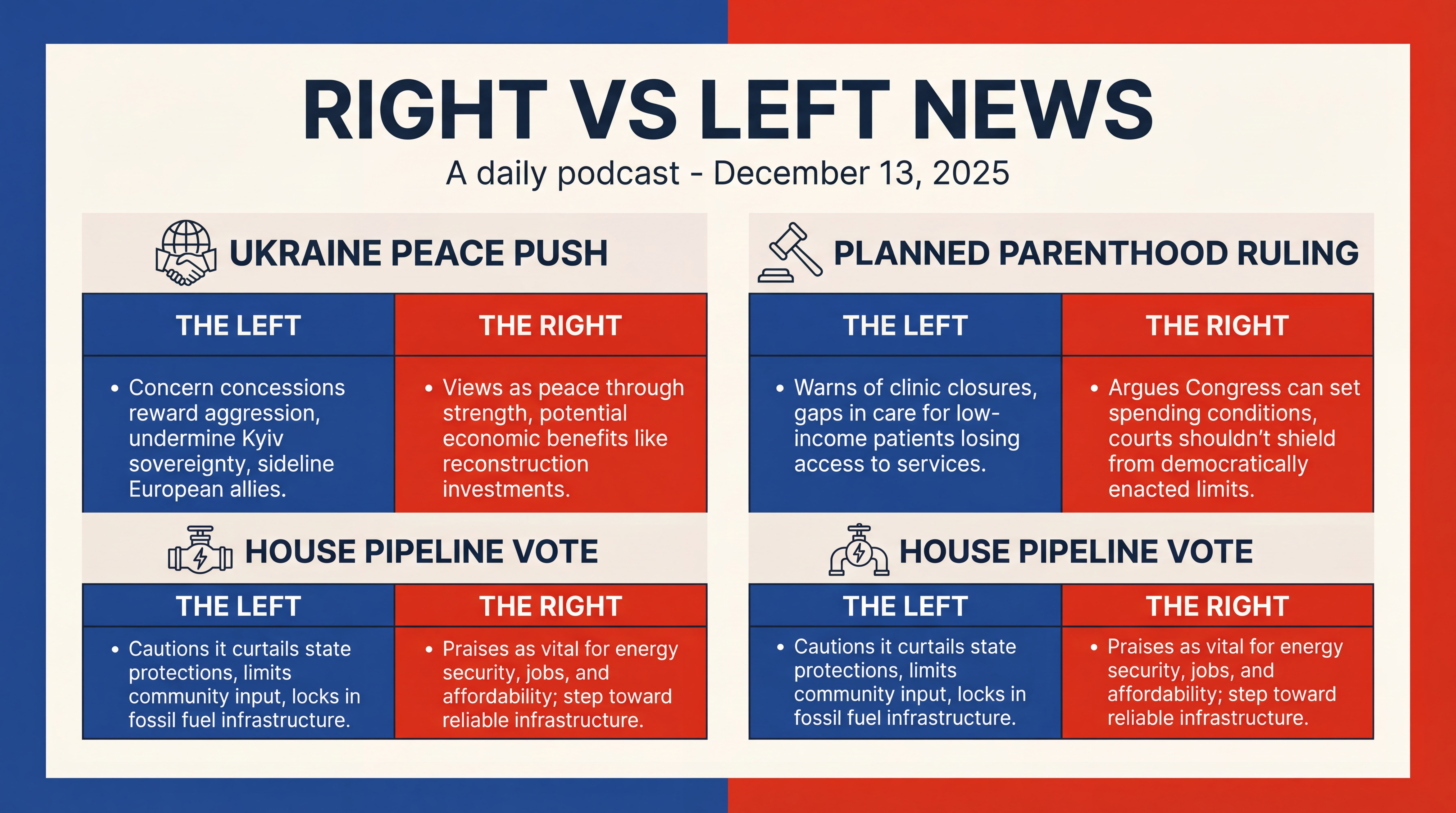
On the right, Fox News frames Trump’s approach as peace through strength — with some Republicans, and even NATO’s secretary-general, expressing confidence that a U.S.-driven plan could end the war. Others point to potential economic angles, like rare earths investment tied to reconstruction.
On the left, the Washington Post and the Guardian emphasize that proposed concessions — limits on Ukraine’s army, neutrality, and de facto recognition of Russian control — could reward aggression and undermine Kyiv’s sovereignty, while sidelining European allies and normalizing Kremlin demands.
In the courts, a federal appeals court in Boston allowed a Trump-era provision to move forward. It would block Medicaid reimbursements to Planned Parenthood and similar nonprofits for one year if they both provide abortions and receive over eight hundred thousand dollars in Medicaid funds. The First Circuit overturned a lower-court injunction, though separate cases in Democratic-led states are still unfolding.
On the right, National Review argues that Congress can set conditions on federal spending — and that courts shouldn’t shield Planned Parenthood from democratically enacted limits.
On the left, the Washington Post, PBS, and the Associated Press highlight the risk of clinic closures and gaps in care — warning that millions of low-income patients could lose access to cancer screenings, treatment for sexually transmitted infections, and contraception if Medicaid dollars can’t be used at Planned Parenthood facilities.
On Capitol Hill, the House passed the Improving Interagency Coordination for Pipeline Reviews Act by a vote of two hundred thirteen to one hundred eighty four. The bill would make FERC — the Federal Energy Regulatory Commission — the lead agency for interstate natural gas pipeline approvals and streamline reviews. Supporters say the change will meet rising power demand — especially from data centers — and cut delays. Critics warn it weakens states’ roles under the Clean Water Act.
On the right, the Wall Street Journal and industry groups say permitting reform is vital for energy security, jobs, and affordability. The American Petroleum Institute’s Mike Sommers praised the bill as a step toward reliable, lower-cost infrastructure.
On the left, environmental and many Democratic voices caution that the bill curtails state water protections and limits community challenges — potentially locking in fossil-fuel infrastructure when the grid needs more clean power and transmission instead.
[MIDPOINT_SPONSORS]
Back in Washington, a federal judge ordered the Justice Department to return certain emails and communications it accessed in the case involving former FBI Director James Comey — finding constitutional problems with how that evidence, linked to Comey associate Daniel Richman, was obtained and reused. The ruling follows earlier turbulence over the appointment of the lead prosecutor and prior dismissals.
On the right, Fox News highlights judicial criticism of Justice Department conduct — portraying the case as emblematic of past FBI and prosecutorial abuses — and arguing that accountability efforts should continue despite procedural setbacks.
On the left, the Washington Post underscores concerns about politicization — pointing to the unusual prosecutor appointment and broader pressure on the Justice Department as reasons these cases are faltering, and calling for stronger guardrails against using prosecutions as political weapons.
Gaza and regional diplomacy. U.S. Central Command will host a December sixteenth conference in Doha with more than two dozen countries to plan an International Stabilization Force for Gaza — working through command structure and rules of the road. This follows a fragile cease-fire and action at the United Nations endorsing a U.S.-backed plan to transition Gaza’s security and governance.
On the right, Fox News commentary casts the plan as a decisive way to prevent Hamas’s return — pairing stabilization with reconstruction — and to share burdens among partners, with more enforcement than past peacekeeping missions.
On the left, outlets like Vox warn about mission creep, an unclear mandate and contributors, and the risk that a force could entrench the status quo without addressing Palestinian sovereignty or Israeli settlement policy — raising doubts about long-term legitimacy and durability.
Here’s the bottom line. A high-stakes U.S. push on Ukraine heads to Berlin... Planned Parenthood loses a key round in court... the House moves to speed gas pipelines... a judge rebukes the Justice Department in the Comey matter... and Washington gathers partners in Doha on Gaza. We’ll see what turns into law — and what turns into leverage — in the days ahead.
That's it for today's episode of Right versus Left News. Remember, understanding both sides isn't about picking a team—it's about being informed. Subscribe wherever you get your podcasts, and join us tomorrow for another balanced look at the day's biggest stories. Until next time, stay curious and stay informed.