
Power Plays: Unions, Maps, AI, Apple, Myanmar
A fast-moving news roundup: Congress moves to restore federal union rights, Indiana rebuffs a Trump-backed map, the White House challenges state AI laws, Apple faces a setback against Epic, and Myanmar reels from a hospital strike. We explain what happened — and how the right and the left are framing it.
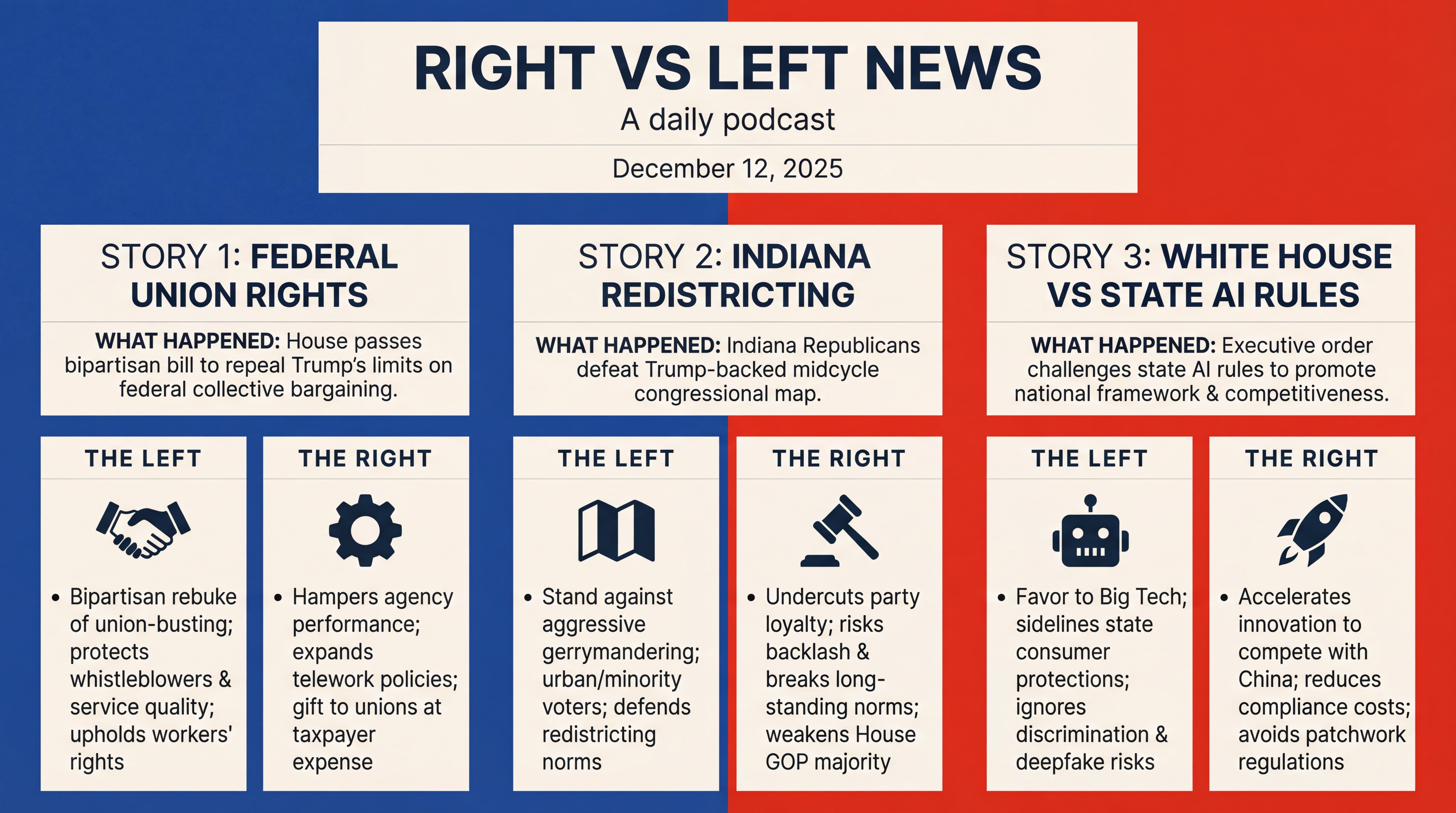
Episode Infographic
Show Notes
Welcome to Right versus Left News—your daily briefing on the stories that matter, told from both sides of the aisle. I'm your AI host - Chris, and each day I bring you the most important political and cultural news, with perspectives from conservative and progressive voices. No spin, no agenda—just the facts and the opinions that shape our national conversation. Let's dive in...
Here’s what we’re watching on Friday, December 12, 2025...
The House passes a bipartisan bill to reverse limits on federal union rights. Indiana Republicans deal Donald Trump a rare defeat on midcycle redistricting. The White House issues an executive order to challenge state AI rules. A federal appeals court largely upholds a contempt finding against Apple in its fight with Epic Games. And a deadly hospital strike in Myanmar prompts international outrage.
We’ll lay out what happened — and how the right and the left are framing it.
[BEGINNING_SPONSORS]
The House voted 231 to 195 to repeal a March executive order from President Trump that curtailed collective bargaining at agencies with national security missions. Nearly two dozen Republicans joined Democrats. The bill faces long odds in the Republican-controlled Senate, but labor groups called the vote a major victory for federal workers. A rare discharge petition forced the measure to the floor. Reporters at the Associated Press and the Washington Post say the repeal would restore bargaining rights for hundreds of thousands of employees in departments like Defense and Veterans Affairs.
On the right, commentators argue public-sector unions are different from private-sector unions — and that reversing Trump’s order could hamper agency performance, expand telework policies voters oppose, and reduce security-focused management flexibility. They frame the vote as a gift to unions at taxpayer expense.
On the left, Democrats and labor leaders describe the move as a bipartisan rebuke of what they see as union-busting. They say bargaining protects whistleblowers, workplace safety, and service quality for veterans and the public — and they point to court fights that questioned the order’s breadth and constitutionality.
In Indiana, the state Senate voted 31 to 19 to reject a midcycle congressional map backed by President Trump — after weeks of pressure from the White House to shore up the House GOP majority ahead of 2026. Multiple Republicans joined all Democrats to defeat the plan. It could have flipped at least one Democratic seat. The Wall Street Journal called the vote a rare public rebuke of Trump’s political clout.
On the right, some see this as part of a broader fight for control of the House. Trump vowed to back primary challengers against Republican holdouts, arguing that redistricting now would counter Democratic map moves elsewhere. Other conservatives warn that mid-decade redraws risk backlash and undercut long-standing norms.
On the left, coverage emphasizes Republicans who broke with Trump to defend redistricting norms and to decry intimidation tactics around the vote. Progressives hail the outcome as a stand against aggressive gerrymandering that could dilute urban and minority voters.
President Trump signed an executive order directing federal agencies to challenge — or preempt — state artificial intelligence rules the White House says threaten U.S. competitiveness. The order empowers the Justice Department to sue states over AI laws deemed burdensome and to leverage certain federal funding to discourage a patchwork of regulations. It also directs procurement officials to require AI vendors selling to the government to test and document political bias. The move followed congressional resistance to broader statutory preemption.
On the right, supporters cheer a single national framework to accelerate innovation and compete with China — while noting pushback from some conservatives focused on states’ rights. They argue uniform rules will cut compliance costs and reduce the risk of speech policing by overzealous state laws.
On the left, critics call the order a favor to Big Tech that sidelines state consumer protections on discrimination, deepfakes, kids’ safety, and workplace impacts. They also highlight legal vulnerabilities and Republican infighting — suggesting courts will decide how far a president can go in preempting state laws without Congress.
[MIDPOINT_SPONSORS]
In the long-running Apple versus Epic dispute, the Ninth Circuit largely upheld a lower court’s civil-contempt finding that Apple undermined a 2021 injunction meant to allow links to outside payment options. However, the appeals court reopened the door for Apple to charge some commission on purchases made outside the app, and sent that narrow question back to the trial court. The core compliance mandate stands, while the exact fee structure will be litigated.
On the right, Apple’s allies argue judges shouldn’t micromanage platform design or set prices — warning that forced changes could weaken security and property rights, and cost Apple substantial sums each year. Their view is simple: let markets, not courts, determine app store economics.
On the left, tech and consumer advocates cast the ruling as a step toward real competition. They say Apple can’t use warnings, placement rules, or punitive fees to make alternatives impossible — even if some commission survives. That, they argue, should give developers leverage and could lower consumer prices over time.
In Myanmar, a military airstrike destroyed Mrauk-U General Hospital in Rakhine State, killing between 31 and 34 people and injuring between 70 and 80. Rights groups say bombs dropped by a junta jet hit the recovery ward and devastated the main building. The U.N. human rights chief condemned the attack and warned it may constitute a war crime. Amnesty International verified imagery consistent with an airstrike.
On the right, conservative foreign-policy voices urge targeted pressure — sanctions on military-owned conglomerates and commanders, cutting jet-fuel flows, and backing accountability mechanisms — while avoiding an open-ended U.S. intervention. The goal is to punish atrocities without committing U.S. forces.
On the left, outlets and advocacy groups call for stronger international action: tighten sanctions, increase humanitarian access, and pursue war-crimes cases. Their argument is that years of restrained responses have emboldened the junta and left civilians defenseless.
Quick recap... The House moved to restore federal union bargaining. Indiana Republicans snubbed Trump’s redistricting push. The White House opened a new front against state AI rules. Apple mostly lost a key round to Epic — even as some commissions may survive. And a brutal hospital strike in Myanmar shocked the world.
We’ll keep tracking what changes next — on Capitol Hill and around the globe.
That's it for today's episode of Right versus Left News. Remember, understanding both sides isn't about picking a team—it's about being informed. Subscribe wherever you get your podcasts, and join us tomorrow for another balanced look at the day's biggest stories. Until next time, stay curious and stay informed.